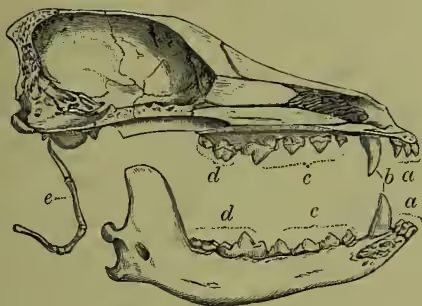
Dog, the popular name of the Canis familiaris of Linnaeus, as well as of several more or less closely allied forms. The word is not co-extensive with any zoological term, but all the animals to which it is applied belong to the family Canidae (q.v.), which may be defined as digitigrade carnivora, with small head, pointed muzzle, somewhat contracted neck, slightly compressed body, and slender legs; fore-feet bearing five, hinder four toes, claws not retractile, hair thick, tongue smooth, anal glands wanting, a gland often present at the root of the tail. The teeth usually consist of three incisors, one canine, and four premolars (teeth which are preceded by temporary or milk molars) in each jaw. The upper jaw has two, the lower three molars on each side. The last premolar of the upper jaw, and the first molar of the lower jaw are decidedly larger than any of the others, and bite against one another; they are known as the 'carnassials.' The distribution of the Canidae is universal; many are nocturnal or semi-nocturnal; they run swiftly and persistently, swim well, and climb and leap, though not so well as the cats. Their senses are acute, especially that of smell, and they possess higher mental qualities than those of any other animal. They frequently combine to procure food, and live on other mammals and birds, devouring fresh meat or carrion with equal avidity; some kinds will also eat reptiles, fish, crabs, insects, and various kinds of vegetable matter. The period of gestation is sixty-three days; usually from four to eight (occasionally as many as twenty) pups are produced at a birth. These are blind for ten or twelve days, and are tended with the greatest solicitude by the mother, though the father is sometimes inimical to them. Full growth is attained in about two years, the average term of life being ten or twelve, and very rarely more than twenty years. The oldest fossil form is Canis parisiensis, from the upper Eocene period. The creatures thus characterised are separable into three categories: (i.) Wolves (genus Canis), characterised by the round pupil of the eye and the tail having dependent hairs. (ii.) Foxes (genus Vulpes), characterised by a slit-like pupil and a bushy tail. Certain minor, but constant, differences in the skull have been pointed out by Huxley. (iii.) The Eared-fox (genus Otocyon or Megalotis).
I. The category of wolves (Canis) comprises (1) The Domestic Dog (C. familiaris), which is, to quote the perhaps extravagant words of Cuvier, 'the most complete, the most singular, and the most useful conquest ever made by man.' The origin of this subjugation is shrouded in immemorial antiquity. Almost the earliest human beings of whom we have any record seem to have been accompanied by dogs, which were apparently the first animals domesticated. In the Danish kitchen-middens belonging to the Neolithic period, canine remains accompany those of man. The birds' bones are those of the legs and wings, which dogs cannot eat, and hence it seems likely that the men, after eating the flesh of the birds, gave their remains to the dogs, who devoured what they could. This has led to the further conjecture that these dogs were domesticated. A similar form of dog has been recorded from deposits of the same age in Switzerland. In the bronze age traces of a larger dog appear. The Egyptian monuments of about 3000 B.C. furnish us with pictures of several varieties of domestic dogs—a wolf-dog, a hound, a greyhound, and a kind of terrier. 'The most ancient dog represented on the Egyptian monuments is one of the most singular; it resembles a greyhound, but has long pointed ears and a short curled tail; a closely allied variety exists in Northern Africa, as the Arab boarhound.'
Assyrian sculptures depict two canine forms, a greyhound and a mastiff, described as 'the chained-up, mouth-opening dog' (watch-dog), and several other kinds are alluded to in the cuneiform inscriptions. The first mention of the dog in the Bible occurs in connection with the sojourn of the Israelites in Egypt, and the earliest allusion to it as the companion of man is in the Book of Tobit. The detestation with which the Hebrews regarded the dog was possibly due to its being an object of adoration to the Egyptians. Xenophon records two species of Spartan dogs. Many references are found to their use in battle, for which purpose they were sometimes provided with spiked collars, so that the 'dogs of war' was no mere figure of speech. At Marathon, one of these four-footed warriors gave such assistance to its master, that its effigy was engraved upon his tablet. Among the Romans, we have evidence of their use for many purposes, and their study had so far advanced, that a classification of them was drawn up. Three main divisions are recognised: (1) Canes villatici (watch-dogs); (2) C. pastorales (sheep-dogs); (3) C. venatici (hunting-dogs); which were again subdivided into pugnaces, to attack the quarry; nare sagaces, to track it out; and pedibus celeres, to overtake it. Between the Roman period and the middle ages materials for the history of the dog are scanty, but from this time onwards there is an extensive literature of the subject, more especially in regard to those kinds which were used in various forms of sport.
Dogs still play an important part in folklore everywhere, whether as revenants whose intention is merely to warn or foretell, or as hell-hounds of purely malignant nature. They are represented as quick to detect the presence of invisible spirits, and, in connection with this aptitude for seeing into the spirit-world, they are often the outward objects through which devils and demons make their appearance, and they have often been associated with such masters of unhallowed arts as the great Cornelius Agrippa. The Wild Huntsman with his train of hounds is one of the most widespread superstitious in Europe, and in the dim mythological histories of the early world we find many dogs of supernatural strength and courage who give material aid to the heroes in their exploits. Such are Fingal's companions, Bran and Lugh, the Gelert of the Welsh story, Arthur's hound Cavall, and Hodain, the hound linked so strangely with the fates of Tristrem and Ysolde. St Eustace was the patron of dogs in the south of Europe, as St Hubert was in the north, and the invocation of the latter was especially efficacious in cases of hydrophobia (see Gaidoz, La Rage et St Hubert, 1887). In Egypt, where in ancient times the dog was a sacred animal, his name is the most insulting term of reproach at the present day; yet by some Orientals, as the Parsees, he is held in strange respect; while Kitmer, the dog of the Seven Sleepers, with Balaam's ass and the camel that bore Mohammed in his flight from Mecca, have a place in the Moslem paradise. From the old Argus that first recognised his master in the Odyssey down to Pope's Bounce and the Maida of Sir Walter Scott, dogs have been celebrated in the history of letters, and have been depicted in art, by none more admirably than by Velasquez, Veronese, and Landseer. Among famous historical dogs may merely be mentioned the mastiffs of the Knights of Rhodes, who knew a Turk from a Christian by the smell, the Spanish bloodhounds who helped in the conquest of Mexico and Peru, and the spaniel which saved the Dutch republic by waking William the Silent during the night attack on the camp before Mons. Punch's dog Toby, and the famous dog of Montargis that avenged his master's death upon his murderer, are among the best-known animals of Europe. See 'The Dog in History and Folklore' in R. J. King's Sketches and Studies, Descriptive and Historical (1874).
The question of the origin of our various domestic dogs may now be considered. Buffon supposed that the sheep-dog was their progenitor; Bell, the wolf. Neither of these earlier views, however, takes a sufficiently wide survey of the whole subject to be worthy of much consideration. Put very briefly, the principal facts which help us to the solution of this problem are the following: The different breeds are very unlike each other, which would suggest the likelihood, though it would not prove, that they were descended from different ancestors. This variety of breeds obtains even in the earliest domestic dogs of which we have any record. There is no difficulty in imagining that various races of men have domesticated dogs in different places and at different periods. Wild canine species are scattered over the whole world; they are social animals, hunting in packs, and such are most easily tamed. When first in contact with man, too, animals are not as a rule shy. Savages are known to value dogs highly, and it has been suggested that perhaps the sight of their combined pursuit of their prey may have given man the idea of employing them. Furthermore, the dogs of semi-civilised or barbarous peoples often present a very close resemblance to the wild forms surrounding them; thus, the Indian dogs of North America so closely resemble the wolves of that region, that they have been mistaken for them even by well-trained naturalists. The Eskimo dogs are very like the gray Arctic wolves, with which their owners not unfrequently cross them to improve the breed. The dog of the Hare Indians differs but very slightly from the prairie-wolf or coyote (C. latrans). The natives of Guiana seem to have partially domesticated two aboriginal forms. Many European varieties approximate closely to the wolf, as, for instance, the Hungarian sheep-dog. The Indian pariah dogs are but little removed from the native wolf, whilst some other breeds show a close affinity to the jackals. These latter, when tamed, wag their tails, crouch to their masters, and behave in other respects like domestic dogs. From these statements, and many others which might be added, it seems fair to conclude that the various domesticated canine forms have arisen from the following separate sources: two well-defined species of wolf (C. lupus and C. latrans); certain doubtful species, European, Indian, and North African, from several species of jackal, and perhaps also from some extinct forms.
It must not, however, be supposed that the differences between the various breeds are entirely due to this difference of parentage, for there can be no doubt that they are largely the effect of careful breeding and selection. Variations occur in almost every part of the animal's organisation. As regards size some are six times as long as others (the tail being excluded); the ratio of the height to the length varies from 1 : 2 to 1 : 4. The number of caudal vertebrae, the number of teats, and the number and disposition of the teeth, are all subject to modifications. Among peculiarities which are confined to domestic as opposed to wild dogs may be mentioned the drooping ears and the curled up tail; the former correlated with a diminished need for watchfulness; the latter with a decreased use of the tail as a helm. Barking, too, is almost universal in domestic breeds, but does not characterise a single wild form. Certain tame dogs, which were left on the island of Jnan Fernandez, were found after thirty years to have quite lost the faculty, and only gradually reacquired it on renewed contact with man.
The systematic arrangement of domestic dogs has been attempted by numerous authors, the latest being the revised scheme of Professor Nehrung of Berlin (1889); but no two are agreed upon the same classification. The old Roman method has been alluded to above. Cuvier, relying upon the shape of the head and the length of the jaws, classed the varieties under three heads—Mâtins, Spaniels, and House-dogs. As a contrast to this may be mentioned the elaborate scheme of Fitzinger, in which over 180 different forms are defined. Youatt's arrangement, based on Cuvier, is as follows: Division I.—Head more or less elongated, parietal bones widest at base, and gradually approaching as they ascend; condyles of lower jaw in same line with upper molar teeth. To this division most wild dogs belong—the Dalmatian, Greyhound, Irish Wolf-dog, &c. Division II.—Head moderately elongated, parietals not approaching, rather diverging, so as to enlarge the cerebral cavities. Here are the Spaniel, Poodle, Maltese Dog, St Bernard, Newfoundland, Eskimo, Sheep-dog, Pomeranian, and various kinds of hounds. Division III.—Muzzle shortened, frontal sinuses enlarged, cranium elevated and diminished in capacity. In this group are placed the Bulldog, Mastiff, and Terrier. Special articles upon most of these forms will be found in their appropriate places.
No account of the domestic dog would be complete without an allusion to his mental qualities, which lift him high above all other animals, and pre-eminently fit him to be the companion of man. Anecdotes illustrative of his keenness of sense, reasoning faculties, fidelity, and conscientiousness, might be multiplied indefinitely. For these we may refer our readers to the pages of Jesse, Walsh ('Stonehenge'), and Gordon Stables; for their scientific treatment, to the works of Darwin, Lubbock, and Romanes. See also INSTINCT.
The natural qualities of the dog enable him to be of service to man chiefly in the chase, but he has been utilised also (to say nothing of his consumption by the Chinese and certain barbarians as food) as a guardian and a guide, as a saviour of life from drowning, and a beast of draught; he has ministered to a depraved curiosity in the ancient sports of bull and bear baiting, and has even acted as an instrument of torture and as a minister of justice. Dog-farming is regularly pursued in Manchuria for the sake of the skins, the breed cultivated being remarkable for the length and fine quality of the hair. There are thousands of such dog-farms, keeping from a score to several hundreds of dogs. The dogs are strangled in mid-winter, that the furs may be got in the best condition, but they must be at least eight months old. Eight animals are required for a robe which is sold for about 14s. 6d.
(2) The Wolf (Canis lupus) will be considered in a special article.
(3) The Indian Wild Dogs (C. dukhunensis, C. primævus, C. rutilans) are sometimes separated as a distinct genus (Cuon). They occur in different parts of India, and are variously known as Kolsun, Buansuh, or Dhole. They are generally reddish-brown in colour, with a moderately long tail, full below, not a round brush like the fox; the pupil is round, and the ears erect, large, and hairy. They hunt in packs of from six to thirty, with such keen scent and pertinacity that competent observers declare that, 'when once a pack of them put up any animal, no matter whether deer or tiger, that animal's doom is sealed; they never leave it.' Certain half-domesticated individuals are employed for coursing and pig-sticking.
(4) The Australian Wild Dog or Dingo (Canis dingo) is particularly interesting, as being the only higher mammal found in that country. It was formerly believed that it was sprung from some domestic form which had run wild, but this opinion is now abandoned owing, amongst other reasons, to the discovery of fossil dingoes in the diluvial deposits. It resembles the larger varieties of shepherds' dogs. The forehead is flat, and the ears short and erect. The body has two kinds of hair, silky and woolly. When running, the head is carried high and the tail horizontally. The earliest settlers in Tasmania suffered much from the loss of their sheep owing to these animals; now the dingoes are almost destroyed. They are sometimes domesticated by the aborigines, who, however, never capture the adults, but secure a litter of pups, which they bring up by hand. They are easily tamed, but almost invariably run wild again when the breeding season comes on. See DINGO.
(5) The Jackals (Canis anthus, C. aureus, &c.). See JACKAL.
(6) The Pariah Dogs form a nondescript breed of animals, which inhabit the towns and villages of the East, where they act as general scavengers. They associate in bands, each of which has its own allotted territory, beyond whose bounds no member dares to pass.
(7) The Raccoon Dog (Canis procynoides) is so called because it presents a superficial likeness to the racoon. It is, however, a true dog, and it is more than doubtful whether the generic name (Nyctereutes) proposed for it should be allowed to stand. The body is arched, the legs short and slender, the tail also short but bushy. It is found in Japan and Northern China.
(8) The Hyæna Dog (Canis or Lycæon pictus) occurs in South Africa. It is about the size of a wolf, with blunt muzzle and sloping back. There are only four toes on each foot. Its colour varies greatly, consisting of very irregular patches of black, white, and yellow. It is partly diurnal, partly nocturnal. Large packs of these animals hunt together, and run with an untiring gallop which will overtake the swiftest antelope. They have three different calls, the most curious of which is a soft and melodious cry, something like the second note of the cuckoo, and appears to serve as a rallying note for the pack.
II. The Foxes (genus Vulpes) will be the subject of a special article (q.v.).
III. The Long-eared Fox (Otocyon or Megalotis lalandii) is also a native of South Africa. It has a short bushy tail, not more than half the length of the body and head, which measure about two feet. The ears are very large, and the snout short and pointed. It has six more teeth than most of the Canidæ, two in each upper and one in each lower jaw.
Law as to Dogs.—In Britain, dogs cannot be kept without a license, which, for each dog, costs 7s. 6d. Dogs not six months old, dogs for tending sheep and cattle, and dogs for guiding blind men are exempt. Certificates of exemption may be obtained from the Commissioners of Inland Revenue. Any one keeping a dog in the habit of attacking or biting people, is liable to an action of damages at the suit of an injured person; and a court of summary jurisdiction may, on complaint that a dog is dangerous, order it to be destroyed. Owners are also liable for the injuries done by their dogs to sheep and cattle. Dog-stealing; having stolen dogs, or the skins of stolen dogs, in one's possession in the knowledge that they are stolen; taking money to restore a stolen dog under pretence of aiding the owner to recover it; and unlawfully and maliciously killing or wounding or maiming dogs, are offences under various criminal statutes, and are punishable summarily, and by indictment for misdemeanour. A gamekeeper may seize a dog within the limits of a manor, but is not allowed to kill a dog there following game, even although its owner has received notice that trespassing dogs will be shot; and a man is liable in damages if he places on his land traps scented with strong-smelling bait, so as to influence the instinct of another man's dogs, and draw them irresistibly to destruction. Stray dogs may be detained and sold or destroyed by the police. For the employment of dogs to draw carriages or carts, see ANIMALS (CRUELTY TO). See Lupton on The Law relating to Dogs (1888).
In the United States, the statutory regulations of most states empower a person to have property in a dog, not only sufficient for the owner to be indemnified for injury done to the dog, but also to make theft of the dog liable to punishment as a crime. Some states require that the dog shall be duly licensed or registered and collared, and therefore subject to taxation, before these results follow. Unless duly authorised by law to kill unlicensed dogs, no citizen may kill a dog belonging to another, unless he, or some one under his protection, or his animal, is in immediate danger of injury from the dog, or the dog is rabid, or has been bitten by a rabid animal. In general, the owner of a dog is liable in damages for injuries done by his dog; neither can the master plead ignorance of the vicious habits of the dog in mitigation of the damages. The owner of a dog is bound to know the character of the dog he keeps. The owner of a vicious dog may be indicted for keeping a nuisance, and compelled to kill or muzzle his dog. Dog-racing is not illegal when for training purposes only, but if chance is the principal clement, it becomes a crime within the statutes against gaming.
In some countries it is usual to compel the dogs living in towns to be muzzled; the civic authorities in Britain sometimes, and in the United States generally, issue edicts that all dogs be kept muzzled for a certain number of weeks, and occasionally the police make raids on ownerless dogs and destroy them. It is now not unusual to have homes maintained for stray dogs, the least valuable of the unclaimed ones being ultimately destroyed.
For the various breeds of dogs, see BEAGLE, BLOOD-HOUND, BULLDOG, COLLIE, GREYHOUND, MASTIFF, NEWFOUNDLAND DOG, TERRIER, &c.; also Walsh, The Dog in Health and Disease (new ed. 1879) and Dogs of the British Islands (new ed. 1882); Shaw, Illustrated Book of the Dog (new ed. 1884); Burges, American Kennel and Sporting Dogs (New York, 1876). For the diseases of the dog, see DISTEMPER, MANGE, RABIES, and the works of Mayhew, Steel, or Hill. See also COURSING, HUNTING.