Dormouse (Lat. dormire, 'to sleep'), a common name applicable to any member of the rodent family Myoxidae, but especially used with reference to various species of Myoxus and Muscardinus. The dormice may be described as arboreal rodents, squirrel-like in form and habit, but are classified in the mouse-like or Myomorph section of the order Rodentia. They have long hairy tails, short fore-limbs, tolerably large eyes, and large, almost naked ears. The head is narrow, the upper lip cleft, the body compressed, the thumb rudimentary, the molars with more or less marked transverse enamel folds. They live among trees and bushes, are principally twilight animals, and as their name (sleeping-mice) implies, hibernate. In their distribution they are confined to the Old World, in its palæarctic and Ethiopian regions. The family includes four genera—Myoxus, Muscardinus, Eliomys, and Graphiurus. Remains of dormice are found in Miocene strata.
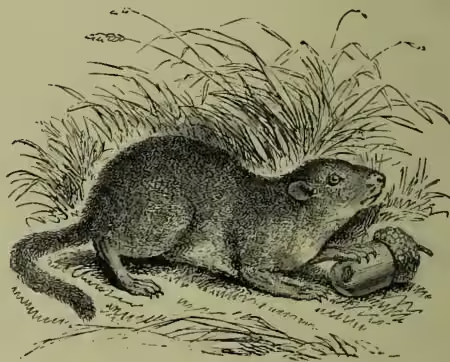
The Common Dormouse (Muscardinus avellanarius) is a pretty little animal, about three inches in length, not including the bushy tail, which is almost as long as the body. The general colour is a beautiful tawny yellow, but there is white on throat and breast. It is widely distributed from Britain and Scandinavia to Tuscany and Turkey, and is especially fond of hazel-copses. It feeds on nuts, seeds, berries, buds, &c., grows very fat in autumn, sleeps intermittently through the winter in a round grassy nest a little above the ground. It breeds in spring, but, in some cases at least, also in autumn. It is the only British dormouse.—The Loir or Fat Dormouse (Myoxus glis) is about twice the size of the common dormouse, and has the hairs of the tail in two rows, as in squirrels. It is ashen-gray, sometimes brownish above and white below. In its distribution the loir is restricted to the south. The favourite haunts are in oak and beech woods. It is very fond of fruit, and is said even to become carnivorous. The Roman epicures esteemed its flesh, and fattened it in their gliraria. It is still cooked by the Italians.
—The Garden Dormouse (Eliomys nitela) is a destructive thief, smaller and more active than the last, common in Central and Western Europe. It is justly persecuted for the damage it does in orchards, where it is said to destroy much more than it eats.—In the genus Graphiurus the tail is shorter and ends in a brush-like tuft of hairs. The molar teeth are very small, and the cross enamel folds are hardly developed. See RODENT.