Dragon-fly, a name applied to the members of a large family (Libellulidae) of orthopterous insects, in the subdivision technically known as Pseudoneuroptera. They are very frequently referred to under the title Odonata. They are well-known insects, conspicuous in their large size, brilliant iridescent colouring, and rapid, restless flight. The slender grace of some forms, especially when half-concealed by the drapery of the wings, has suggested their French title of demoiselles, while the Germans hint at a similar comparison in calling them wasserjungfern. None the less do they deserve our English name, for they are indeed the dragons and tyrants of the insect world.
Structure.—The body is long and lank; the two pairs of wings are large and almost equal; the head is freely movable upon the thorax; the eyes are usually very large, and are associated with eyespots; the mouth organs, overlapped by a large upper lip, are very strong, and remarkably adapted for the capture and mastication of other insects.
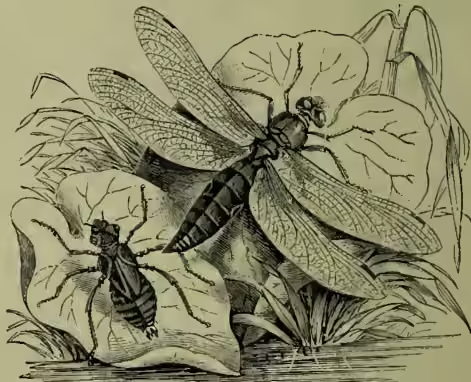
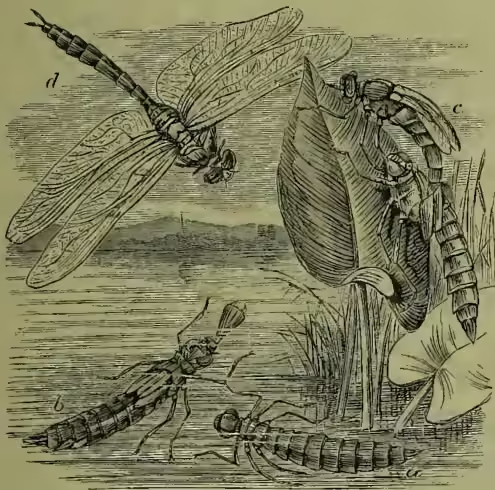
Habit.—The dragon-flies live near water, in which they spend their early life. During the day they are ceaselessly active, poising in the air with very rapid vibrations of their wings, or darting over the pools indeed like 'living flashes of light.' They rest upon bushes and the like during the night. Both as larvæ and as adults they are exceedingly voracious, feeding chiefly upon other insects. The two sexes are often seen flying together in amatory dance, the male clasping his partner's neck with his tail. The colours of the sexes are often different, and the characteristic radiance of the male is in some cases assumed only at reproductive maturity. The males are sometimes larger, never smaller, than the females. The eggs are laid under water, sometimes within aquatic plants. The larvæ live in the water until they are ready for their metamorphosis. Their voracity is very great, and is satisfied by the deft exercise of the peculiarly modified second pair of maxillæ (labium), which can be extended in front of the head like a pair of nippers mounted on a flexible stalk. This peculiar development is often called the 'mask.' In some young dragon-flies (smaller species of Agriion) there are leaf-like respiratory plates (tracheal gills) at the end of the body; in most the respiration is effected by a rhythmic water-current in and out of the rectum, on the walls of which there are numerous plates abundantly riddled by tracheæ. The expulsion of the water is strong enough to drive the larva slowly onwards. Before the final moult, the larva creeps up the stem of some water-plant, and rests for a while. Then 'an inner impulse rends the veil of his old husk, from head to tail come out bright plates of sapphire mail.' The wings are first small, soon 'grow like gauze,' and are perfected in the using. Tennyson's well-known description of the metamorphosis is vividly accurate.
Forms.—The family includes some 1500 species, which are widely distributed, but most abundant in tropical countries. Yet even the exotic forms do not surpass the splendour of some of our British species. There are three sub-families: (1) Agriionæ (e.g. Agriion, Calopteryx); (2) Aeschninæ (e.g. Aeschna, Gomphus); (3) Libellulinæ (e.g. Libellula). There are numerous British species—e.g. Aeschna grandis, the great dragon-fly, about 4 inches long, and the smaller Libellula depressa. The restless activity, the splendid colouring, the voracious carnivorous diet, are probably associated facts.
See T. de Charpentier, Libellulinæ Europææ descriptæ et depictæ (Leip. 1840); De Sélvs-Longchamps et Hagen, Revue des Odonates ou Libellules d'Europe (Brussels, 1850); and the works of Kirby and M'Lachlan.