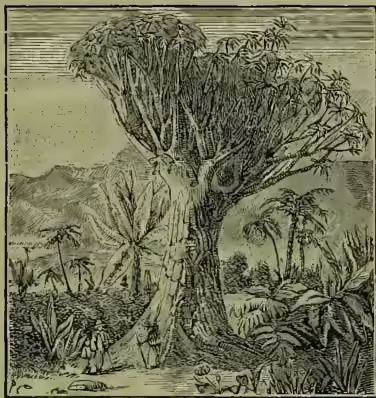
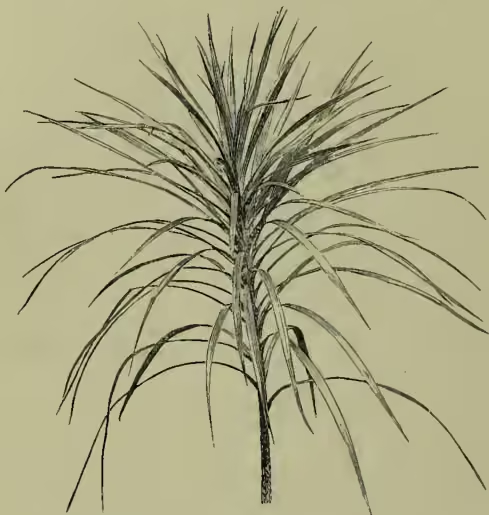
Dragon-tree (Dracæna draco). This genus of Liliacæe (sub-order Smilacæe) is not only remarkable for its resin (see DRAGON'S BLOOD), but also through the indefinite thickening of its stem by means of a cambium-like layer of embryonic cells, and the consequent resemblance in permanence and general habit to a dicotyledonous tree. The examination of a microscopic section of a young stem, however, shows that the thickening arises not as in dicotyledons or conifers through the activity of true cambium—i.e. a surviving tract of embryonic tissue between the wood and bast of the fibro-vascular bundles—but in an essentially distinct and simpler manner. The stem is at first normally monocotyledonous in structure—i.e. with closed scattered bundles of the ordinary type. The embryonic layer (false cambium) lies wholly outside these, and grows steadily outwards, depositing new imperfect bundles on the inner side alone (see MONOCOTYLEDONS, STEM). The growth is slow, but seems practically unlimited. Thus the great dragon-tree of Orotava, Teneriffe, so famous through the description of Humboldt and other travellers, was about 75 feet high, 50 feet in girth, with an internal cavity about 10 feet in diameter. Not simply was it of almost as vast size when the islands were discovered in 1492, but calculations, based on the observed rate of growth of younger trees, carried it back to a probable age of from five to six thousand years. Unfortunately it was blown down by a storm in 1868. Species and varieties of Dracæna are in great and increasing esteem as foliage plants. D. marginata, stricta, terminalis, &c. may be mentioned as old favourites, but a due conception of their importance may be best obtained by reference to florists' catalogues. Species of the allied genus Cordylina, especially those from New Zealand, are sufficiently hardy to be planted out of doors in summer. D. terminalis is used for hedges in the East, and boundary marks in the West Indies, on account of its conspicuous red foliage.