Drainage is the art of carrying off water from the soil and subsoil of land by means of open or closed drains or trenches; the term, however, is generally understood to apply to closed drains. By its means the fertility of wet land has been greatly increased, and the climate of districts which were before wet and swampy very much improved. When the drains are put in every six or ten yards, it is called furrow or frequent draining.
The vast amount of capital which has been expended in drainage since the development of the improved methods of draining attests its utility and necessity. Before the introduction of furrow-draining, stiff and tenacious clays were of comparatively little value. They were cultivated at much expenditure of labour, and the crops which grew upon them were influenced to an exceptional extent by the variations of the seasons.
Drainage by open ditches was no doubt the first mode of freeing land from superfluous water. The Roman agricultural writers mention the good results arising from covered drains, formed of wood and other substances, which served so far to render the land dry. In the 18th century, a large extent of clay-land was drained at narrow intervals in Norfolk and Essex, by putting in brushwood and even straw in the bottom of the drains. The progress of draining, which is now regarded in many soils as essential to economic culture, was slow and partial, until James Smith of Deanston, in 1823, reduced the practice to a system, and showed the principles upon which its efficiency depended. Through the exertions of this advocate, furrow-draining soon became a sine quâ non in the culture of clay-soils, or indeed most soils, in moist climates.
Practical men consider the line of greatest fall, or quickest descent, as the best for cutting drains in a field. The smaller drains are usually conducted into larger or main drains, instead of each discharging its quota of water into the open ditch. This is rendered necessary, as the mouths of the smaller drains would be more liable to be choked up by the growth of weeds; while the collecting of water into main drains secures a fuller flow to sweep out any matters which might accumulate where the discharge was small. Moreover, the less of the action of the air in the drains the more efficient they are.
The most efficient, and at the same time most cheaply cut drain, is one represented at fig. 1. It is made so that a pipe of a cylindrical form may be laid along the bottom, which need be of no greater width than what is necessary to allow of the pipes being properly laid. Drains of this form are cut with a set of spades which are of different widths—the broadest being used for taking out the top, and the narrowest for the bottom. The work of forming pipe-drains is now accomplished in some cases by a mechanical apparatus which is propelled by steam-power, and which at the same operation makes the cutting in the soil and lays the pipe.
Before the general use of pipes, stones were the common materials with which drains were formed.
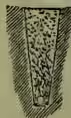
Smith of Deanston, recommended that they should be broken so small, that they might pass through a ring two inches and a half in diameter. From nine inches to a foot in depth was the quantity which was commonly put in. Where stones can be easily got they are still preferred to tiles, as cheaper, and if well put in, more efficient and durable. A good plan is to set a pretty large block at each side of the bottom of the drain, and then use a third as a sort of wedge. A coating of smaller stones is surmounted by turf.
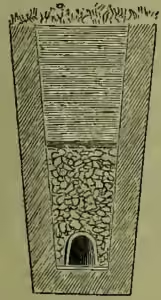
When tiles and pipes were first used, it was even thought necessary to have some gravel, or small stones, placed above them in the drains, for the purpose of enabling the water to find its way into them, as seen at fig. 2. It was soon found, however, that tile drains were quite as efficient without any stones or gravel; and that they were less liable to be choked up, as the clay or earth acted as a filter in preventing the intrusion of any kind of solid matter.
Many kinds of tiles and pipes have been tried, but the cylindrical form is most used. At one time, a bore in the pipe of an inch in diameter was thought sufficient, but two-inch pipes are now preferred, the size of pipe selected in each case, depending upon the probable amount of water to be carried away. Drain-pipes are usually made about 15 inches in length. In some cases a collar is used to insure the complete continuity of the drain. The collar is a short length of circular tube which loosely embraces the two pipes and thus covers the joint. This collar was at one time thought quite essential for the durability of the drain, but it has been found in practice that well-laid pipes will work efficiently and endure satisfactorily without them. And, therefore, as they increase the cost considerably they are not now so largely used. In soft mossy or clayey subsoils, semi-cylindrical tiles called muggs have been laid on lath, with the bend up.
Mr Smith at first advocated the making of drains from 2½ to 3 feet deep, at intervals of from 10 to 40 feet. Experience, however, has been gradually favouring deeper drains, at wider intervals. Even on the most tenacious soils with subsoils of till, few now think of having drains less than 33 to 36 inches in depth, though the distance apart should not in many cases be more than from 15 to 18 feet. The depth, however, depends greatly on the soil; 3 to 4 feet, with the leader drains 6 inches more, are common dimensions. In mossy land the depth has sometimes to be 7 feet. The width between drains depends on the wetness of the land and the character of the subsoil. It is now well understood that the success of draining by pipes depends upon the fissures which are produced in the subsoil by the droughts of summer never entirely closing up; and thus minute channels are formed, which lead the water into the drains.
The principal advantages of drainage are, the deepening of the staple soil, and rendering it more friable, so that a superfluity of water, which would cause the formation of those chemical compounds that are found in stagnant water, is prevented. The greater depth of mould, and more perfect culture, render the soil more absorbent of moisture in dry weather. As crops can usually be sown sooner on drained lands, they also ripen earlier, and produce more abundantly. In short, while drained land obtains a greater capacity for moisture and manure, it imparts to plants greater capabilities for economically working up the materials which they find in the soil and atmosphere, seeing they are maintained in the most healthy conditions of growth.
Drainage in its various forms has, as is well known, not only improved the fertility and value of land in Britain, but materially changed the aspect and climate of large districts which before suffered from the wet, swampy character of the surface soil. Mosses and wet rushy lands have been transformed into dry and productive fields, while by the removal of all superfluous pools, the air is freed from those hovering vapours which are injurious to general amenity and salubrity. To the farmer, the more immediate advantage of drainage consists in that rapid running off of the water which falls as rain, so as to admit of working lands without any undue delay, while natural springs and dampness, from whatever source arising, are also run away with wonderful success. Drainage on methods similar to those of Mr Smith is also practised in the United States.
The drainage of houses and cities will be considered at SEWAGE; and the reclamation by draining of fens, swamps, lakes, and inundated regions is noticed under WASTE LANDS, BEDFORD LEVEL, BGOTIA, BOG, FUCINO (LAKE OF), HAARLEM LAKE, HOLLAND, MAREOTIS, MEXICO (CITY), POLDER, ZUYDER ZEE, &c. And see IRRIGATION.