Drift, a name formerly given to boulder-clay, a deposit of the Pleistocene epoch. More fully, it was called the Northern Drift, Glacial Drift, or Diluvial Drift, in allusion to its supposed origin. The old river-gravels of Pleistocene age were also often termed river-drift. The term drift has now fallen out of use. For an account of the deposits formerly termed drift, see BOULDER-CLAY, PLEISTOCENE SYSTEM. For the drift-men, see MAN.
DRIFT-WOOD is wood carried by tides and currents to a distance from its native locality. Thus the shores of the Faroe Islands, Iceland, &c. are often strewn with logs brought by the Gulf Stream. Fragments of drift-wood occur as fossils in many geological formations, as in the Carboniferous Sandstones, the Chalk, the London Clay, &c.
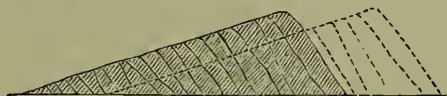
SAND-DRIFT is sand driven and accumulated by the wind. Deposits thus formed are occasionally found among the stratified rocks, but compared with other strata they are few, though, from their anomalous character, an acquaintance with their phenomena is of importance to the geologist. As a rule, the mineral ingredients of wind-blown sand are better rounded than the grains of an aqueous accumulation of sand—the latter being carried in suspension, and thus to a large extent escaping the mutual trituration to which the former are subjected. Moving sands are at the present day, in many places, altering the surface of the land. In the interior of great dry continents, as Africa, Asia, and Australia, extensive districts are covered with moving sands. The continuous blowing of a steady wind in one direction often covers a rich tract with this arid material. But the influence of the wind on loose sand is most evident along low sandy coasts, where hills, called 'dunes,' are formed entirely of it; they sometimes attain a considerable height, as much, for instance, as 200 or 300 feet. Dunes are advancing on the French coasts of the Bay of Biscay at the rate of about 60 feet per annum, covering houses and farms in their progress. Similar accumulations are forming on the coasts of Nairn, Cornwall, Wexford, and other parts of the British Isles. The Culbin Sands, in Nairn and Elgin shires, cover a large district which at a period not very distant was rich arable land. The prevailing wind is from the west, hence the hills are slowly moving in an easterly direction, at the rate of a mile in somewhat less than a hundred years. A singular stratification exists in these hills. The prevailing west wind lifts, or rather rolls the particles of sand up the gentle incline of the western aspect of the hill, until they reach the summit, where they fall, forming a steep declivity to the east, equal to the angle of repose for sand. A shower consolidates the surface of the new bed, or a land-breeze carrying fine dust separates it by a very thin layer of finer material from the one that follows, and thus, as the hill moves eastward, a regular series of strata is formed at a high angle, as is shown by the diagram. The progress of the hill is represented by the dotted outline. Little can be done to arrest the progress of these devastating sand-drifts. It has been recommended to plant Carex arenaria and similar sand-loving plants, which have long creeping roots: they certainly check to a considerable extent the influence of the wind. A great forest of sea-pine seven miles in width has since 1789 been maintained along the sand-dunes of the French Landes (q.v.), with great benefit to the country inland.