Dublin (Irish Dubh-linn, 'black pool;' the Eblana of Ptolemy), the capital of Ireland, stands on the river Liffey, where it falls into Dublin Bay, in 53° 20' 38" N. lat., and 6° 17' 30" W. long. It is 64 miles W. of Holyhead, 138 W. of Liverpool, 223 SSW. of Glasgow, and 245 NW. of Bristol. The city covers an area of 1300 acres, but its parliamentary boundary comprises an area of about 5000 acres, and its municipal boundary 3808 acres. Some of Dublin is built on land reclaimed from the sea, and the ground is generally flat. The river, running from west to east, divides the city into two almost equal portions. The fashionable quarter is to the south-east of the city; and the principal shops are in the centre of the town; there are many good private houses in the suburbs. In the south-west, where were situated the ancient 'Liberties' of St Patrick's, the streets are narrow, crooked, and irregular, while in the fashionable and business portions they are broad, clean, and well kept. The city is surrounded by a 'Circular Road' of nearly 9 miles in length. The city and most of its suburbs are supplied with excellent water from the Vartry river, Co. Wicklow; the works, completed in 1868, cost £550,000.
The most important street is Saekville Street, which is 120 feet broad and 700 yards long; at its north end stands the Rotunda, with Rutland Square; in its centre the beautiful Ionic portico of the General Post-office, and Nelson's Monument (upwards of 130 feet high); while on the south it is terminated by O'Connell Bridge. St Stephen's Green, the largest of Dublin's squares, lately laid out with great taste as a People's Park by the munificence of the Guinness family, occupies an area of nearly 20 acres, and is about a mile in circuit. Somewhat smaller, but more fashionable, are Merrion Square (13 acres) and Fitzwilliam Square. The large park and quadrangles of Trinity College occupy more than 40 acres. Leinster House, once the town mansion of the Dukes of Leinster, is now the home of the Royal Dublin Society. Beside it were erected in 1864 a National Art Gallery and a Museum of Natural History; and new buildings for a Science and Art Museum and National Library were completed in 1890, at a cost to government of £250,000. The Royal Irish Academy has a valuable collection of antiquities.
Among the public buildings of Dublin may be mentioned the Bank of Ireland (formerly the Houses of Parliament), Trinity College, the Custom-house, and the Four Courts, which, from the boldness of their design, and the massiveness of their proportions, have a very imposing effect. The Castle has no pretensions to architectural beauty. The Chapel is interesting, and contains some fine carved work of Grinling Gibbons, now barbarously painted white! There are monuments of William III. in College Green (once a green, but now a paved street); of Nelson, the Duke of Wellington, Goldsmith, Burke, Grattan, O'Connell, and many others, in various public sites.
Within the limits of the Circular Road, the Liffey is crossed by twelve bridges (four of iron), and throughout the whole extent of the city the banks of the river are faced with granite walls and parapets. On each side of these 'quays,' 2½ miles long, there is a roadway, with houses and shops. The quay proper extends eastward from the Butt Bridge. Near the Custom-house, a strikingly handsome classic building of native granite, there are several large docks for the accommodation of vessels from distant ports with excisable cargoes, and in communication with the Royal and Grand Canals; the former connecting Dublin with the North Shannon and the west of Ireland, the latter with the southerly portion of the same river and the sea. A large basin, the 'Spencer Dock,' was opened in 1873; and the harbour has been much improved in late years by the completion of two large breakwaters, the North and South 'Walls.' There is a bar at the mouth of the harbour, but even there the least depth at low tide is about 17 feet.
The chief manufacture of Dublin is porter, of which nearly half a million hogsheads are annually exported, 'Guinness' being, of course, the most important, the capital engaged in Guinness's Company being £6,000,000, and the number of hands employed being over 2000. Next in order is whisky, and then poplin, which is much celebrated. The principal banks are the Bank of Ireland, the Royal, National, Provincial, Hibernian, and Northern.
The great educational institution of Dublin is Trinity College (see below). There is also a Roman Catholic university (since 1854). The Royal University of Ireland, which superseded in 1880 the Queen's University, is not a teaching body, but resembles the University of London; it has its seat here. For the humbler classes much has been done by the National Board (whose model schools are attended by large numbers of children), by the Church Education Society, Roman Catholic brotherhoods and sisterhoods, such as the Christian Brothers, and other agencies. There are many literary and scientific societies dealing with subjects of general knowledge, or with matters of local or national interest. There are two botanic gardens—one at Glasnevin, belonging to the Royal Dublin Society, and one at Ballsbridge, connected with the university. The hospitals, asylums, orphanages, and other charitable institutions are numerous, and liberally maintained.
The municipal affairs are under the control of a town-council, which consists of a lord mayor, fifteen aldermen, and forty-five councillors. The city police—under government control and supervision—is excellent. The city sends four members to parliament. The population has risen from 64,500 in 1688 to 167,899 in 1804, 232,726 in 1841, and 249,602 in 1881; but was only 245,001 in 1891.
The environs of Dublin are especially beautiful.
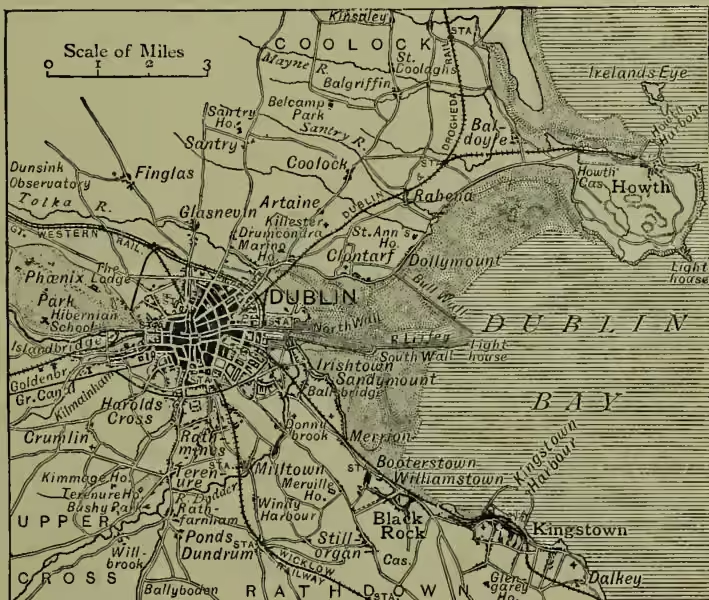
Rathmynes, a southern suburb, has become a large township, and, together with Monkstown, Kingstown, and Killiney, is the favourite residence of the wealthier part of the mercantile community. Glas- nevin, on the north, has memories of Swift, Addison, Steele, Tickell, Thomas Parnell, and Thomas Sheridan; its cemetery, opened in 1832, is classic ground, and contains the ashes of Curran, O'Connell (under a Round Tower 150 feet high), and C. S. Parnell. The Phoenix Park is a magnificent area of nearly 2000 acres, in some parts broken ground, and finely timbered. It affords a splendid field for military reviews, and is used by the inhabitants of Dublin of all classes for recreation. Dublin, as a whole, with its fine bay—which has often been compared to the Bay of Naples—its splendid park, massive public buildings, wide streets, spacious and well-kept squares, regular quays, and beautiful environs, is one of the handsomest capitals in Europe.
There are numerous places of worship, monasteries, convents, friaries, and a Jewish synagogue. Dublin is remarkable in possessing two Protestant cathedrals. St Patrick's, founded in 1190, was restored in 1865 by the munificence of a single individual, Sir Benjamin Lee Guinness; and Christ Church, dating from 1038, but not raised to cathedral rank till 1541, is a smaller but more beautiful edifice, also restored in 1878 by Mr Henry Roe.
The ancient history of Dublin is mainly legend, but we know that in the 9th century the Danes took the place, and it was in their hands for the most part until the English Conquest. Henry II. held his court there in 1171; the English residents were almost extirpated in the rising of 'Black Monday' in 1207. In 1689 James II. held a parliament in Dublin, and the town was immediately afterwards occupied by William III. Since then, Dublin has as capital continued to be the centre of Irish history. See IRELAND.
UNIVERSITY OF DUBLIN.—The first university of Dublin was established in connection with St Patrick's Cathedral in 1320. The existing university, with a single college, Trinity, was founded in 1591. Queen Elizabeth provided the charter, the corporation of Dublin bestowed the ground and ruins of the suppressed monastery of All-Hallows, and the Irish gentry supplied by subscription the funds necessary for the erection of the buildings. James I. gave additional endowments. By Queen Elizabeth's charter, the governing body of Trinity College was to consist of a provost, three fellows, and three scholars. The new statutes of Archbishop Laud, definitively published in 1637, are in the main still in force. In 1613 James I. conferred on the university the right of sending two members to the Irish parliament. One of these was taken away at the Union in 1800, but was again restored by the Reform Bill of 1832. The electors were formerly the provost, fellows, and scholars of Trinity College; but in 1832 the privilege was extended to masters of arts and those of higher degree. The last Reform Bill has left the representation of the university unchanged.
The provost and senior fellows form the board of management of the college; and by letters-patent of 1874, a council was established to co-operate with the board in the regulation of the studies of the university, and in the appointment and regulation of the tenure of office and duties of professors. This council consists of seventeen members—viz. the provost of Trinity College, four members elected by the senior fellows, four elected by the junior fellows, four by the professors, and four by the senate of the university.
The government and working of the university are in the hands of the chancellor, vice-chancellor, the provost of Trinity College, two proctors (one chosen from the senior and one from the junior fellows), a senior lecturer (who regulates the public examinations), two deans, and a censor, a librarian, registrar, auditor, professors, and examiners. The chancellor (or, in his absence, the vice-chancellor or pro vice-chancellor), all masters of arts, and doctors of the three faculties, whose names are on the college books, form the senate of the university. The senate elects the chancellor, and confers degrees. The provost of Trinity College, who is appointed by the crown, may be a layman, and of any religious denomination. The junior fellows are elected by examination. They form the great teaching staff of the college, and perform all the duties of lecturing and examining the undergraduates. Most of them are tutors, and their income, which may average £600 a year, is derived partly from a salary given by the college, and partly from their duties as tutors, lecturers, and examiners. Fellowships were formerly tenable only by members of the Episcopal Church, but by the recent act all religious restrictions were abolished. The number of the junior fellows is now twenty-six. The rule of celibacy, imposed in the reign of Charles I., was repealed in 1840. The senior fellows (seven) enjoy considerably larger emoluments, and are 'co-opted' by seniority from among the junior fellows.
There is a very complete staff of professors in divinity, natural philosophy, mathematics, law, and medicine; there are also professors of ancient, oriental, and modern languages, including Irish; moral philosophy, oratory, and English literature, modern history, political economy, natural history, botany, geology, mineralogy, civil engineering, &c.
The scholars, seventy in number, are elected from among the undergraduates. They are members of the corporation, and enjoy the university franchise. Scholarships (which are tenable for five years) are gained by public competition—some being assigned to classics, and others to science. The various emoluments of a scholar, arising from salary, remission of fees, rooms, commons, &c., amount to about £50 per annum. There are also minor scholarships for the encouragement of the study of divinity and of the Irish language; while others are connected with the royal and endowed schools.
There are four grades of students. (1) Noblemen, sons of noblemen, and baronets, who have certain special privileges; the first two being allowed the degree of B.A. per specialem gratiam. (2) Fellow-commoners, who dine at the fellows' table. (3) Pensioners, who form the great body of the students. (4) Sizars, who have rooms and commons free. The sizars are limited to thirty; they are elected by competitive examination, and hold their sizarships (worth about £37 per annum) for four years. Each rank has a dress peculiar to itself. Students are admitted to the college after an examination. Each student must at entrance place himself under one of the eighteen junior fellows who are tutors. In 1859 fourteen university scholarships were founded, worth £100 a year each, tenable for seven years, to encourage graduates in the pursuit of some special branch of study.
To proceed to the degree of A.B., a student must keep terms for four years, two terms at least being necessary in each year. Terms may be kept either by residence, by attendance at lectures, or by simply appearing on a stated day in the public hall, and passing a creditable examination in a prescribed course. Lectures are delivered on the different subjects of each term examination by the tutors, the honour examiners, and the university professors; and money prizes and parchment 'honours' are awarded to the most successful candidates at the Term examinations. Classes or schools—viz. of the first and second years, are compelled to take up classics, mathematics, and logic; but after passing the 'Little-go' at the end of the second year, undergraduates may confine their attention to certain studies in seven different courses: Classics, mathematics, ethics, experimental science (mathematical physics), natural science, history, modern literature. Degrees are conferred in arts, divinity, law, medicine, music, and engineering. The teaching staff is numerous, and in the actual work of tuition the tutorial and professorial elements are more largely combined than in any other British college or university. Many distinguished men are counted among the alumni of Trinity. The names of Ussher and Berkeley; of Tate, Brady, Toplady; of Magee, Sir W. R. Hamilton, Archer Butler, Lord Cairns; and of Burke, Congreve, Farquhar, Curran, Swift, Goldsmith, Moore, Lever, and a host of others celebrated in politics, in law, in science, and in literature, are sufficient to indicate the success which has attended her sons.
See histories of the City by Warburton (2 vols. 1818) and Gilbert (3 vols. 1854-59); of the University, by W. Taylor (1845), Heron (1847), and Stubbs (1889); the Trinity College Calendar, and Gerard's Picturesque Dublin (1898).