Dugong (Halicore), a genus of marine mammals in the order Sirenia. Along with the manatees, the dugongs exhibit the following general characteristics. The form of the body is fish-like, but somewhat depressed; the head is rounded, distinct, and not out of proportion to the body; there is hardly any neck; the tail is horizontally flattened; there are no hind-limbs, nor is there a dorsal fin. In relation to the aquatic habit, the fore-limbs are paddle-shaped flippers, the skin is almost hairless except about the mouth, there are no external ears, and the nostrils have valves. The very small eyes, with imperfect lids, have a nictitating membrane, which is absent in Cetaceans. The nostrils are at the end of the snout. The lips are thick and bristly. The bones of the skeleton are very massive and heavy, a condition which, as Professor Flower notes, must help these animals to keep to the bottom while feeding on algae. The skull is in many ways peculiar, but is not like that of Cetaceans. The usual separate terminal ossifications or epiphyses on the vertebrae are absent; so too are the clavicles; there is no fused sacrum, and a most rudimentary hip-girdle, without trace of hind-limbs. There are no canine teeth. The brain is relatively small, with few convolutions. The tongue is small, fixed, and very rough. The stomach is chambered; the long muscular intestine is provided with a cæcum. The two ventricles of the heart are partly separated by a deep cleft, and the arteries form complex networks (retia mirabilia), which may aid the animals when under water. The larynx is not modified as in Cetaceans. The lungs are very long and narrow, and the diaphragm is very oblique. The teats are two in number, behind the arm-pits. The placenta is diffuse. The animals are sluggish, herbivorous, inoffensive, and gregarious. Halicore and Manatus are the only living genera; Rhytina is recently extinct; Halitherium is an important fossil form referable to this now moribund but once flourishing order.
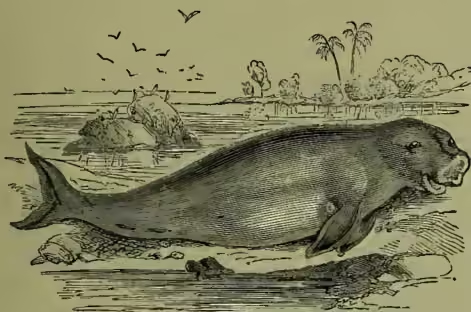
The dugong differs in many important respects from the manatee. A few of its numerous peculiarities must be noticed. The upper jaw is very massive and turned sharply downwards, overlapping the lower, which is also crooked. The males possess two tusk-like projecting incisors, but the corresponding teeth abort in the females. The front-teeth of the lower jaw abort, and are absorbed. The jaws both bear rough horny plates. There are five to six molar teeth of a primitive sort, with persisting pulps and no enamel. Only two or three are in use at a time. The dark, elephant-like, tough skin bears short sparse bristles. The tail is deeply notched. The fingers are nailless. The crecum is thick and simple. Of the three species of Halicore, one (H. tabernaculi) is restricted to the East African coast and the Red Sea; another (H. dugong) inhabits the Indian and Pacific oceans, eastward from the home of the last to the Philippines; and the third (H. australis), the waters of Eastern and Northern Australia.
The dugongs keep to the water, rising to the surface to breathe. They never venture ashore, but graze at the bottom in shallow water. Their food consists chiefly of seaweeds, which they gather in with their thick lips. They are sociable but stupid, often to their own undoing. They are known to attain a length of about 10 feet, but larger sizes are alleged. The habit the dugong has of lifting its round head out of the water, and of carrying its baby under its arm, is suggested as a possible foundation for the mermaid myth, which the name of the order (Sirenia) recalls. Their peculiar, feeble cry may also have aided the imagination of early observers. The female bears one young one at a time, and exhibits an affection said to be proverbial. When the young one is speared, the mother is readily taken. The flesh of the dugong is eaten and esteemed, especially when young. The Australian species is killed for the sake of its oil, which is free from disagreeable smell, and said to have the medicinal qualities of the cod-liver equivalent. According to Rüppell, it was with the skin of the Red Sea dugong (not 'badger-skins,' as in A.V.) that the Jews were directed to veil the tabernacle.
Cuvier called the Sirenia herbivorous Cetaceans, De Blainville emphasised their connection with elephant types, and some modern zoologists maintain their affinity with Ungulates. No conclusion is yet possible, except that they have no direct connection with Cetaceans. Even the fossil forms, Flower observes, have not in this case helped much towards solving the riddle of Sirenian affinities. All that can be certainly said is that the order is at once peculiar and primitive.
See HALITHERIUM, MANATEE, RHYTTINA; J. F. Brandt, Symbolæ Sirenologie (St Petersburg, 1846-68); Huxley's Anatomy of the Vertebrates; Flower's Osteology of the Mammalia, &c.