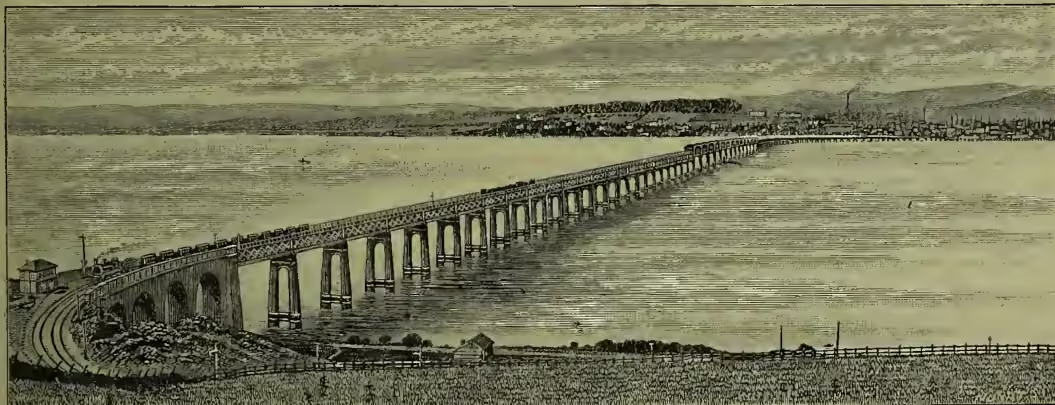
Dundee (Lat. Taodunum, the 'hill or fort on the Tay'), a city in Forfarshire, on the left bank of the estuary of the Tay, here two miles broad, 10 miles from the entrance of that river into the sea, 59 miles NNE. of Edinburgh, 20 ENE. of Perth, and 14 S. by W. of Forfar. In population it is the third town in Scotland. It stands mostly on the slope between Dundee Law (571 feet high, composed of trap, and with traces of ancient vitrification) and Balgay Hill and the Tay. The new streets are wide and well laid out. The most striking architectural features of the town are the town-hall, in the Roman Ionic style, with a spire of 140 feet high, erected by the 'Elder Adam' in 1734; the Albert Institute, with free library, museum, picture-gallery, &c., in 15th-century Gothic, from designs by Sir Gilbert Scott, erected 1865-89; the Royal Exchange, built in the Flemish pointed style of the 15th century, at a cost of upwards of £12,000, and opened in 1856; the Eastern Club House; the Kinnaird Hall, holding 2000 people; the infirmary; the Justiciary and Sheriff Court Buildings; the post-office; the high school; the Town's Churches, with the old tower, 156 feet high; St Paul's Episcopal Church; the Morgan Hospital for 100 boys (now acquired by the school board for secondary school purposes); the Harris Institute; and the Orphan Hospital. An incurables' hospital and a statue of Queen Victoria were unveiled by the Duke of Connaught, August 26, 1899. Dundee University College, instituted by Miss Baxter for the education of both sexes, and the study of science, literature, and the fine arts, was opened in 1883, united to the University of St Andrews in 1890, but separated again (through opposition before parliament) in 1894-95. In 1895 there were nine chairs and seven lecturships. The scheme of the college includes evening classes for those who are unable to enter on a systematic course of training during the day. Dundee has several public parks, one of which, the gift of Sir David Baxter, on a beautiful slope to the eastward of the town, is 37 acres in extent; another of 60 acres, to the westward of the town, occupies the hill of Balgay. Dundee is the chief seat in Great Britain of the manufacture of coarse linen fabrics (Osnaburgs, sheetings, ducks, dowlas, drills, canvas, and cordage). Manufactures of jute are carried on here on an immense scale. The consumption in Dundee of this material, which is grown in India, amounts to fully 300,000 tons annually. The raw material costs in Dundee a little under 2d. per lb.; and the cloth made from it, reckoned by weight, is the cheapest textile fabric made in Great Britain. Of jute many varieties of fabric are made, from the coarsest nail-bagging to carpets of great beauty. This range includes packing-sheets for every species of merchandise, sacks for grain, wool, coffee, gnano, &c. The annual value of the flax, hemp, and jute manufactures in Dundee is upwards of £5,500,000. Dundee is also famous for its manufacture of confectionery, which is exported to all parts of the world. One firm uses 250 tons of bitter oranges annually in the manufacture of marmalade. Dundee is the centre of the whale and seal fishing trade of Great Britain. Shipbuilding (both wood and iron) and machine-making are carried on to some extent. In addition to the tidal harbour, Dundee has several large and magnificent wet-docks, two graving-docks, and a slip for large vessels. The docks have been erected at a cost of upwards of £700,000; and the tonnage of vessels entering the port exceeds in some years half a million. The direct railway communication of Dundee with the south, established in 1878 by the Tay Bridge, two miles long, was interrupted by a sad disaster on 28th December 1879, when a great part of the bridge and a passenger-train passing over it were thrown into the river. A new and more substantial bridge was rebuilt, 60 feet higher up the river, at a somewhat lower elevation, and was opened for traffic in 1887. It is 3593 yards long, and contains eighty-five piers, the height above high-water mark averaging 77 feet clear; under four of the spans is the navigable channel. Pop. (1841) 63,732; (1871) 120,724; (1881) 140,239; (1891) 153,587. Dundee sends two members to parliament; since 1892 its chief magistrate has been styled Lord Provost. Edward I. was here twice. Wallace is said to have taken the castle in 1297, and Bruce demolished it in 1313. The Duke of Lancaster burned Dundee in 1385, and the Marquis of Montrose pillaged it in 1645. Charles II. lived here, after his coronation at Seone, in 1650. On the refusal of Dundee to submit to Cromwell, General Monk, in 1651, sacked and burned it, massacring 1000 citizens and soldiers, and filling 60 vessels with booty, which were totally wrecked on their voyage to England. Dundee was one of the first Scotch towns to adopt the Reformation. Wishart the martyr preached here during the plague of 1544. Since 1889 Dundee has been styled a city. See works by Thomson (1847), Beatts (1873-82), Maclaren (1874), Norrie (1876), Hay (1880), Maxwell (1884-92), and Lamb (1895); also Millar's Roll of Eminent Burgesses of Dundee (1887).