Dunlin (Pelidna alpina or cinclus), one of the Sandpipers (q.v.), a common British shore-bird, occurring in great flocks. It generally breeds further north, and is widely distributed in Europe. The plumage varies considerably; in winter it is ashen-gray above and white beneath; in summer there is much less uniformity, more brown and black, and a black horseshoe band on the breast.
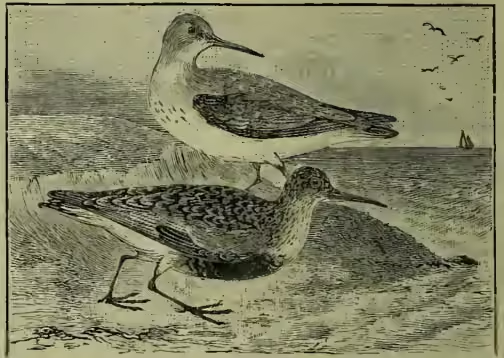
It exhibits great activity in running about, searching and probing for its food. Another species (P. temminckii) is common in Europe and North America. The Curlew Sandpiper (P. subarquata), with a more curved bill and deep-red breast, also occurs on European and British shores. These three species are sometimes included in the genus Tringa, along with the Knot (T. canutus) and other Sandpipers (q.v.). 'When flying in great autumnal flocks, the aerial movements of the dunlin are extremely beautiful, each individual of the vast assemblage yielding so instantaneously to the same impulsion as to exhibit alternately the upper and the under surface of the body, so that we have for a time a living moving cloud of dusky brown, and then a brilliant flash of snowy whiteness.'