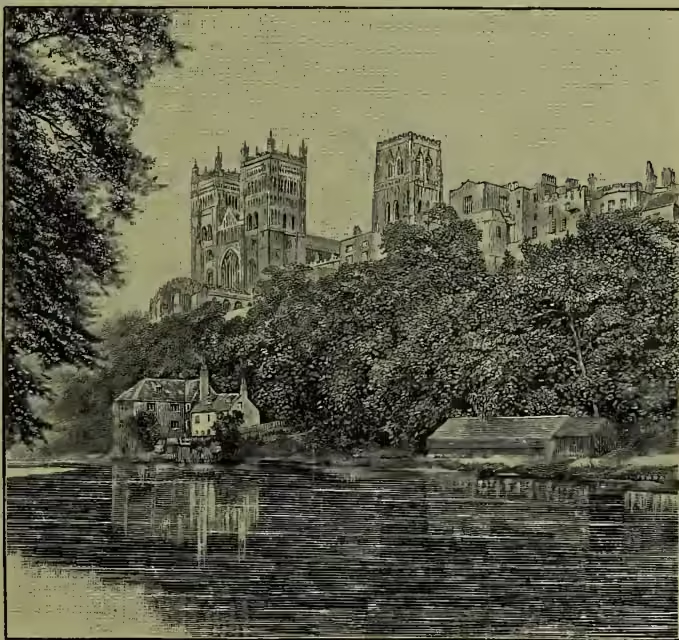
Durham, a parliamentary and municipal borough, and ancient episcopal city, near the middle of Durham county, 12 miles S. of Newcastle, is built around a steep rocky hill 86 feet high, nearly encircled by the Wear. On the top of the hill are the cathedral and castle. Ancient walls partly inclose the hill, from which are fine views of the fertile wooded country around, and of the suburbs across the river. The chief manufactures are mustard, carpets, and iron. In the vicinity are coal-mines and coke-ovens. Pop. (1841) 14,151; (1881) 14,932; (1891) 15,287. Formerly it sent two members to parliament, but since 1885 only one. Durham arose about the year 995, when Bishop Aldune brought hither St Cuthbert's bones from Ripon, and built a church to enshrine them. On the site of this church, Bishop William de Carilepho, about 1093, began the present cathedral, one of the noblest specimens of Norman architecture in the kingdom, alike from situation and from structure, that massive pile—'half church of God, half castle 'gainst the Scot.' To the main structure various additions continued to be made up till 1500; and the whole has on various occasions undergone extensive renovation. Its extreme length is 510 feet; length of the transept, 175 feet; height of the central tower, 214 feet; and height of the two western towers, 138 feet. The cathedral contains many old monuments, and the tombs of St Cuthbert (q. v.) and of Bede. The castle, once the residence of the bishops of Durham, but now occupied by the university, was founded about 1072, by the Conqueror, in the Romanesque style, but it has received many alterations and additions. The dormitory of the monastery of Durham, now the new library of the cathedral, is one of the finest in England. The see extends over the county of Durham (Northumberland having been detached in 1882 to form the diocese of Newcastle); among the bishops of Durham have been Bek, Aungerville, Wolsey, Cosin, Butler, and Lightfoot. Two of the bridges over the Wear dated originally from the 12th century. Durham possesses seven parish churches, a town-hall, a miners' hall, large prison, grammar-school, diocesan training-colleges, and a school of art.
A college was founded in Oxford in 1290 by the prior and convent of Durham. It was abolished, however, at the dissolution of monastic houses in the reign of Henry VIII., and its endowments given to the dean and chapter of Durham. Under the Commonwealth, Cromwell instituted a college here, and endowed it with the sequestered revenues of the dean and chapter, to whom, however, these revenues again reverted at the Restoration, when Cronwell's college was suppressed. The present university of Durham was opened for students in 1833, under the provisions of an act of parliament, obtained by the dean and chapter during the previous year. A royal charter in 1837 empowered the university to bestow degrees. Licentiates in theology must be members of the Church of England; but otherwise subscription is not required from any member of the university. The Durham University comprises professorships in Divinity and Ecclesiastical History, Classical Literature, Hebrew, Mathematics and Astronomy, and Medicine, with lectureships in Hebrew, Classical Literature, and Mathematics, with several tutors and other teachers. It has two collegiate establishments—University College, and Bishop Hatfield's Hall. The Colleges of Medicine and of Physical Science at Newcastle-on-Tyne are affiliated with Durham University. See Murray's Northern Cathedrals (1869), and the Rev. J. L. Low's Durham (Dioc. Histories, 1881).