Dzungaria. See ZUNGARIA.
E
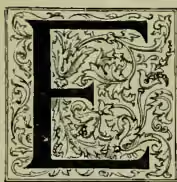
is the fifth letter in our own and the cognate alphabets. The original symbol in the Egyptian hieroglyphs had the value of the aspirate h. It is usually called the Mæander, but is supposed to represent the ground-plan of a house (see the table in Vol. I. page
187). The Phœnicians called it he, a name which probably meant a 'window.' When the Phœnician alphabet was taken over by the Greeks, the symbol lost its aspiration, and was used to represent the vowel e, and was called e-psilon or 'bare e,' to distinguish it from eta. In Latin it had the two sounds which are heard in the French eté. In English it has four sounds. The normal sound is heard in get, bed, met. The name-sound ee is usually expressed by doubling the letter, as in see, feet, heel, but it is expressed by a single e in evil, and in some monosyllabic words, such as he, me, we, be. It has the sound of i in the word England, and of u in the last syllable of eleven and better, and also when followed by r, as in the words fern, pert. When followed by y, as in grey, prey, it has the sound of the Italian e, which is our a in fate. Custom will not allow any English word to end in v, and hence a mute e has been appended to such words as give, live. But this subscript e is most commonly used to lengthen the previous vowel, as in not, note; bit, bite; met, mete. The use of a subscript e was originally a mere fashion in spelling, introduced from France in the 15th century, but in the 16th century it became generally used, as now, to lengthen the preceding vowel. This, though anomalous, is a very convenient device, since without introducing any new symbol, it practically doubles the number of vowel-signs which we possess.
E, in Music, is the third note or sound of the natural diatonic scale, and is a third above the tonic C. See MUSIC, SCALE; for the keys of E major and E minor, see KEY.