Eagle, a name given to many birds of prey in the family Falconidæ and the order Accipitres. The Golden Eagle, the White-headed Eagle, and the Sea-eagles are characteristic examples. The falcon family includes over 300 predacious birds, feeding for the most part on living animals, hunting by day, and living usually on exposed rocky places. They are cosmopolitan in distribution. The bill is powerful, but rather short, high at the root, and slightly curved; the partition between the nostrils is complete; the upper margin of the eye-socket projects; the head and neck are feathered; the soles of the feet bear large callosities. It is a matter of much difficulty to separate the eagles definitely from the related falcons, buzzards, kites, and hawks.
(1) The genus Aquila includes the Golden Eagle, the Imperial Eagle, and other species. The bill is large and high, with the upper part much bent, and with notched margins; the powerful wings reach to the end of the tail, and are rounded off; the tail is of medium size, broad, and straight; the leg-feathers extend down to the toes. Representatives of this noble genus are found in all parts of the world except the neotropical and Australian regions. The powers of vision and flight are well known; the power of 'renewing youth' is mythical.
The Golden Eagle (A. chrysaëtus) is a large and magnificent bird. The predominant colour is dark, tawny brown, but the back of the head and neck are more tawny and look golden in the sunlight. The young birds have tails of a brighter colour. The adult female measures about 3 feet in length; the male is rather less both in length of body and is loud and shrill, but with some hoarseness. The golden eagles have been almost exterminated in Britain, and are only very occasionally seen, except in Sutherlandshire, where they are strictly preserved and are not unfrequent. The species is widely distributed in Europe, Asia, and North America. Allied species are the Imperial Eagle (A. imperialis) in south-eastern Europe, western Asia, and North Africa; and the Screaming Eagle (A. naviæ), with similar distribution, but commoner in the north of Europe than either of the above species.
(2) Other Genera.—The Crested Eagles (Spizaëtus and Morphnus), the former in tropical parts of both hemispheres, the latter in South and Central America, are in some species distinguished by tufts of feathers on the back of the head. The Harrier-eagle (Circaëtus) is an Old-World genus represented in Europe, North Africa, and western Asia. The European species (C. gallicus) is known as Jean-le-Blanc. The White-tailed or Sea-eagles (Haliaëtus) are absent only in South America. One species (H. albicilla) is, like the golden eagle, a British species, becoming as usual increasingly rare (see ERNE). The Fishing Eagle or Fish-hawk (Pandion haliaëtus) is an almost cosmopolitan bird, with markedly piscivorous diet. It nests on high trees, and is remarkable among eagles for the backward grasping adaptation of the outermost toe. The Bateleur Eagle (Helotarsus) is represented by two species in South and Central Africa. The best-known species (H. ecaudatus) is remarkable for its short tail, as the specific title suggests. With the exception of the first (Spizaëtus), all the above genera are distinguished from Aquila in being bare-legged, the feathers being restricted to the upper part of the limb. The Harpy-eagle of South America (Thrasactius harpyia) seems to be a buzzard. There are several eagles in Australia, such as Aquila audax.
While undoubtedly doing much damage to useful birds and quadrupeds, the eagles must be allowed some share in the credit of keeping down the 'vermin.' In one case at least, the prey consists in part of serpents. See ERNE; and, for the golden eagle, Macgillivray's British Birds.
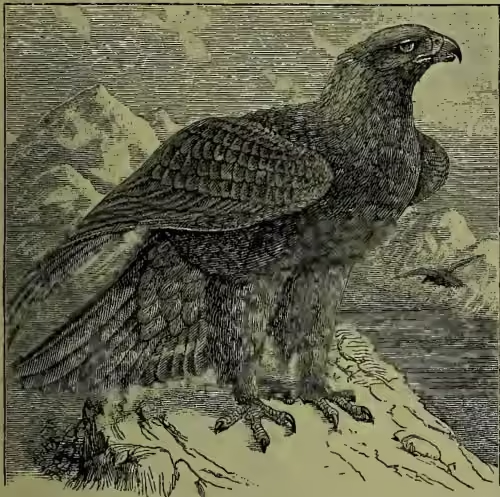
From E. T. Booth's Birds of the British Islands (Porter, London, 1881).
In Mythology, the eagle usually represents the sun; its beak, its talons, or the whole bird itself, the lightning and the sunbeam. The great mythical eagle of India, the Garuda, is the bearer of the god Vishnu, victorious by his brightness over all demons. In the Scandinavian mythology, the eagle is a gloomy figure assumed by demons of darkness, or by Odin himself, concealed in gloomy night or in wind-swept cloud. The storm-giant Hraswelgr sits in the form of an eagle at the extremity of heaven, and blows blasts of wind over all peoples; and on the great tree Yggdrasil sits an eagle observing everything that happens. When Zeus was preparing for his struggle with the Titans, the eagle brought him a thunderbolt, whereupon the god took the bird for his emblem. He holds the bolts of Zeus in his talons, inspires heroes with courage, and also carries out the tyrannous behests of Zeus, as in tearing at the heart of Prometheus, and carrying off Ganymede from the earth. As an emblem of the immortal gods he becomes also a symbol of abstract immortality and of the human soul ascending after death. From the analogy of the heavenly authority of Zeus, the eagle also became the symbol of earthly power. Ptolemy Soter made it the emblem of the Egyptian kingdom. In the Roman story, an eagle was the herald to Tarquinius of his royal power, and it was one of the most important insignia of the republic, was also assumed by the emperors, and adopted into mediæval heraldry after the time of Charlemagne. In the apotheosis of the Roman emperors, wing. The golden eagles have their homes in remote rocky regions, but often wander far in search of booty. They prey upon numerous mammals and birds, but are rarely willing to run any great risks in so doing. Rabbits, hares, lambs, and even young deer; ducks, plovers, ptarmigan, and the like, are seized and torn up, or carried home to the eyry. They have been known to drive roe deer over the rocks, and even to attack a pony, but at the same time they do not disdain carrion. The nest, usually upon a rocky ledge, is large and roughly made. There are most commonly two eggs. Though a strong and majestic bird, it cannot be credited with much bravery. The occasional cry an eagle ascending from a funeral pyre symbolised their reception among the gods. Even in Christian symbolism the eagle has preserved to the present day its significance as the symbol of St John the Evangelist in the lecterns of churches.
As a standard of war the eagle seems first to have been used by the Persians, but the most famous eagles of antiquity were those that so often carried the Romans on to victory. These were made of silver or bronze and with outstretched wings, and were carried before the legions upon long poles, just as the great Napoleon's armies after 1804 carried gilded eagles with outstretched wings in place of banners.
The German imperial eagle was originally one-headed, and was first adopted by Charlemagne as a symbol of his empire after his coronation at Rome in 800. We find it already on the imperial banner in the time of the Emperor Otto II. When it came to be armorially depicted, its blazon was or, an eagle displayed sable, beaked and membered gules. The eagle is occasionally figured as two-headed towards the end of the 13th century, and is so represented on coins of Ludwig the Bavarian in 1325. It has been matter of speculation whether the double head symbolises the eastern and western divisions of the Roman empire or the union of the imperial and the kingly dignity. The eagle continued to be the arms of the Holy Roman Empire to its close. It was first crowned in the 15th century; somewhat later the sword, sceptre, and orb came to be borne in its claws; and on the breast of the eagle were the personal arms of the emperor. In the arms of the present German empire (fig. 1), an eagle (with one head) displayed sable, beaked and membered gules, sustains on its breast a shield containing the arms of Prussia—viz. argent, an eagle displayed sable, crowned, armed, and membered or,
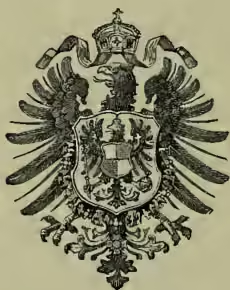
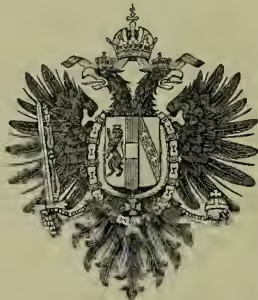
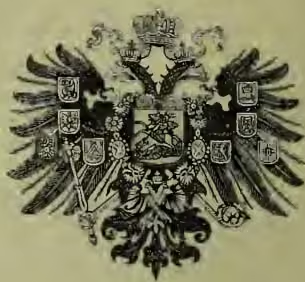
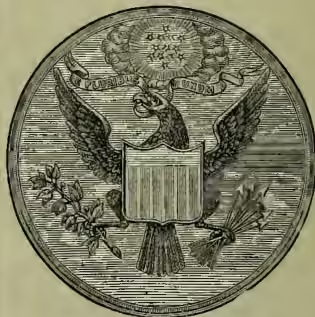
and charged on the breast with the arms of Hohen-zollern—viz. quarterly argent and sable, with which is entwined the collar of the order of the Black Eagle. On the head of the imperial eagle rests the imperial crown, from which fall down on both sides golden fillets embellished with arabesques. The Prussian eagle is the original imperial eagle granted as a special mark of honour to the Teutonic knights by the Emperor Frederick II., and retained by them after the double-headed eagle had become the imperial emblem. Austria has preserved the double-headed eagle (fig. 2) of the earlier German empire. Russia assumed in 1472 the double-headed eagle under Ivan III. to signify that the czar sprung from the Greek emperors, who had borne it as a symbol since the partition of the Roman empire. The Russian arms (fig. 3) differ from the Austrian in the eagle's holding only a sceptre in its dexter claw, and being charged with a shield gules, bearing a figure of St George and the dragon. The shield is encircled with the collar of the Russian order of St Andrew, and the wings of the eagle are charged with groups of small shields representing the provinces of the empire. A white crowned eagle in a red field was the shield of the kingdom of Poland; and the United States of America have adopted a dark-brown eagle with outspread wings, having in one of its talons a bundle of arrows, in the other an olive-branch, bearing on its breast a shield whose upper part is blue and under part silver, and crossed by six red vertical bars (fig. 4). In its beak it holds a band with the inscription E pluribus unum, surmounted by thirteen stars, the original number of states. In France, the eagle was assumed as his imperial symbol by Napoleon I. (fig. 5), was set aside at his fall,
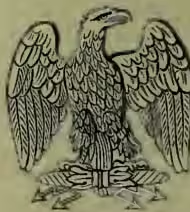
restored by Napoleon III. in 1852, and once more abolished by the republic in 1870. The arms of the French empire may be blazoned azure, an eagle rising and respecting to the sinister, grasping in both his claws a thunderbolt all or.