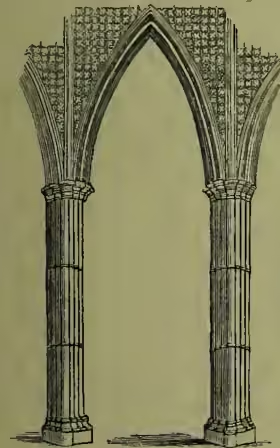
Early English. the term generally applied to the form of Gothic in which the pointed arch was first employed in Britain. The Early English succeeded the Norman towards the end of the 12th century, and merged into the Decorated (q.v.) at the end of the 13th. Its characteristics are beautiful and peculiar. Retaining much of the strength and solidity of the earlier style, it exhibited the graceful forms without the redundancy of ornament which latterly degenerated into a fault in the Decorated. Generally, it may be said to bear to the Decorated something like the relation which an expanding rosebud bears to a full-blown rose. The pointed arch was introduced in the 12th century in the north of France, when it was found convenient in enabling the cross vaulting of oblong spaces to be carried out, so that the ridges of the groins might all be kept at the same height. The wall ribs being pointed, led to the windows within them being made of the same form, and thus the pointed arch came to be gradually adopted in all the wall openings. The windows are long and narrow, and are often acutely pointed, when they are called lancet windows. When gathered into a group, they are frequently surmounted by a large arch, which springs from the extreme mouldings of the window on each side. The space between this arch and the tops of the windows is often pierced with circles, or with trefoils or quatrefoils, which by degrees led to the development of tracery. Each window, however, is generally destitute of any tracery in itself. 'The mouldings,' says Parker, 'in general consist of alternate rounds and deeply-cut hollows, with a small admixture of fillets, producing a strong effect of light and shadow.'—Glossary of Architecture. From the same work we borrow the accompanying illustration of two very beautiful piers, surmounted by a lancet-shaped arch, and decorated in the manner peculiar to the style. They are from Westminster Abbey. Circular windows are much used, and trifoliated archways over doors are also to be found, as at Salisbury Cathedral. By far the most characteristic decoration of the style is the Tooth-ornament (q.v.), which is often used in great profusion. Where foliage is used, it is conventionally treated and cut with great boldness, so as to throw deep shadows, and produce a very fine effect. The under-cutting is often so deep as to leave nothing to connect the leaves with the mouldings but the stalks, and occasionally the edge or point of a leaf. The caps of the columns are often composed of mouldings only, and are circular in plan, both of which features distinguish Early English from the Early Pointed style of France. The buttresses are more prominent than in the Norman style, and pinnacles and flying buttresses are introduced. The term Early English is said to have been introduced by Mr Millers in 1805. It corresponds to Ogivalle primi- tive of French writers, and is very often known as the First Pointed or lancet-arched amongst ourselves. See GOTHIC ARCHITECTURE.