Earthquake, the term applied to any tremor or shaking of the ground. Many earthquakes are so gentle as to pass almost unrecognised, others again are sufficiently pronounced to excite general remark or alarm, without, however, causing any damage, while some spread enormous destruction over wide areas. Probably no part of the earth's surface is entirely free from vibration, but, fortunately, destructive earthquakes are confined to comparatively limited regions. According to Mallet, the well-known authority upon seismology (seismos, 'an earthquake,' logos, 'a discourse'), the almost universal succession of phenomena recorded in notable earthquakes is first a trembling, next a severe shock, or several in quick succession, and then a trembling gradually but rapidly becoming insensible. In most cases, each shock lasts only a few seconds, but the tremblings that follow may be continued for days, weeks, or even months. Noises of sundry kinds usually precede, accompany, or succeed an earthquake. These have been variously described, some likening them to the howling of a storm, the growling of thunder, the clanking and clashing of iron chains, the rumbling of heavy wagons along a road, the shattering and crashing of enormous masses of obsidian or glass, &c. Such noises are conducted through the ground, or they may travel through the sea, or be transmitted through the air. They are often propagated through the ground for very great distances, so that they may be heard in regions far removed from the disturbed area. Cases are on record where such sounds have travelled more than 158 geographical miles. Some earthquakes, however, are not attended by any subterranean sounds. This has been the case with some of the most destructive South American disturbances. Thus at the time of the terrible shock which destroyed Riobamba in Ecuador on February 4, 1797, a complete silence reigned. On the other hand, subterranean sounds may be heard without any earth-tremor being perceived. Humboldt tells us that at Guanaxnato, in Mexico (1784), the inhabitants were terrified by loud subterranean thunder, which continued for more than a month, but was not accompanied by any trace of earthquake. The noise ceased gradually as it commenced, and was curiously local, as it was not heard at the distance of only a few miles.
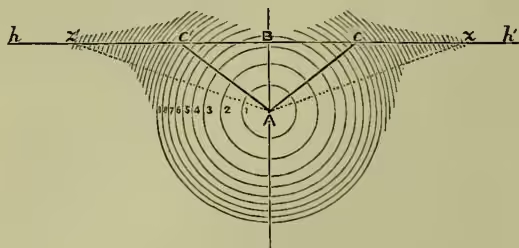
Earthquakes are felt either as vertical shocks, from below upwards, as horizontal or lateral shocks, or as undulatory movements. As illustrating the force of a vertical shock, it is related that in 1837, at the fort of San Carlos in Chili, a flagstaff which was sunk for 30 feet in the ground, and secured with iron rods, was violently shot into the air, leaving a round hole in the ground. Again, at the time of the great earthquake of Riobamba, the bodies of many of the inhabitants were projected across the river and fell upon La Culla, a hill over 300 feet in height. During the Calabrian earthquake of 1783, the undulatory motion was well marked by the way in which the trees swayed to and fro, their branches touching the ground. The same appearance was noted at New Madrid (Missouri) during the earthquakes of 1811–12, where the trees were observed bending as the earth-waves passed under them, and immediately afterwards recovering their position. Numerous observations of this kind have led physicists to the belief that an earthquake is a wave or true undulation of the crust. The wave produced by the original impulse travels outwards , the horizon; A, centrum; B, epicentrum; AB, , , , , wave-paths; 1, 2, 3, 4, &c., spherical concentric shells, or similar phases of the earth-wave. The most destructive effects upon buildings are produced at some point between the epicentrum, B, and or , say at or . in all directions from the 'focal cavity,' or 'centrum,' A, in successive spherical shells (1, 2, 3, &c.), the form of which, however, as we shall see presently, is subject to many modifications. The point or area on the surface of the ground directly above the 'origin' or centrum is called the 'epicentrum,' B, and it is at this point where usually the shock is felt as a vertical stroke coming from below upwards. As we recede from this point, the direction of motion becomes more and more horizontal, and gradually also decreases in intensity until it becomes insensible. Away from the epicentrum, then, it is obvious that the earth-wave at every point comes up obliquely from below—the radial lines along which an earthquake is propagated from the centrum being called 'wave-paths,' AB, , , , . If the earth's crust were composed of perfectly homogeneous materials, then the undulations propagated from the centrum would extend equally in all directions, and might be shown diagrammatically by describing a series of concentric circles round the epicentrum. But the crust is very far from being homogeneous. It is composed of different kinds of rock, arranged often in very discordant ways, and traversed by irregular joints, fissures, cavities, and dislocations. All these differences affect the transmission of an earthquake; and the direction of motion is still further influenced by the configuration or varying topographical features of the disturbed districts. Thus geological structure and topographical features combined lead to continual deflections and delays of the earth-wave; but inasmuch as the topography of the surface is fundamentally influenced by the nature and structure of the underlying rocks, we may assign the irregularities of the isoseismic circles primarily to geological causes. Hitherto we have been supposing that the earth-waves are propagated in successive spherical shells, the shape of which is modified in various ways. We must remember, however, that the impulse may not originate from a point or spherical cavity, but from a fissure inclined at a considerable angle from the vertical. In such a case the waves, even in a homogeneous medium, would not be concentric circles, but, originating from all points of the fissure, would spread outwards in ellipsoidal shells to the surface, where the waves would take the form of ovals or distorted ellipses. In such a case as this, the greatest effect of shock would not be felt in the area vertically above the centrum, but rather to one side of the epicentrum; in other words, the direction of greatest effect would coincide with the major axis of the ellipsoidal shells. As a matter of fact, isoseismic lines, or lines of equal disturbance, are seldom circles; elliptical or irregular curves being the common forms. And that their form is greatly influenced by geological structure and topography, is shown by the circumstance that earthquakes are propagated not unfrequently in lines or zones—the major axis of elliptical areas of disturbance often having a general direction parallel to the trend of some great valley or considerable mountain-range. In the South American earthquakes, the vibrations are confined to the long narrow strip of low ground between the Andes and the sea, and are not felt on the eastern side of the mountains. Similarly the earthquakes that shake the coast-lands of Venezuela, Caraccas, and New Granada are rarely transmitted inland across the coast-ranges.
The velocity of propagation of an earthquake is very variable. Thus in the case of the earthquake of Lisbon in 1755, it seems to have considerably exceeded 1000 feet per second, while in the Lisbon earthquake of 1761 the rate was three times greater. At Tokio, in 1881, the velocities, as estimated by Professor Milne, varied between 4000 feet and 9000 feet per second. From his own observations, taken in connection with those of previous investigators, Mr Milne thinks we may conclude (1) that different earthquakes, although travelling across the same country, have velocities which may vary between several hundreds and several thousands of feet per second; (2) that the same earthquake travels more quickly across districts near to than far from its origin; (3) that the greater the intensity of shock, the greater is the velocity.
Various attempts have been made to estimate the depth at which earthquakes originate. Mallet was of opinion that the centrum of the Neapolitan earthquake of 1857 was probably miles from the surface. His calculations were based on the assumption that the earth-wave radiated in straight lines from the centrum. Immediately above the centrum the wave-path was supposed to be vertical, while at points at different distances from the epicentrum the wave-paths would be oblique, and emerge at different angles at the surface. These angles he obtained by drawing lines at right angles to the direction of the large cracks and rents observed in numerous buildings. The lines so drawn converged approximately to a point below the area of greatest disturbance (epicentrum)—the point of convergence indicating the site of the original impulse or earthquake centrum. The same eminent physicist thought that an earthquake centrum probably never exceeded a depth of 30 geographical miles. According to Professor Milne, the angles of emergence of the earth-waves obtained during the Yokohama earthquake of 1880 showed that the depth of origin of that earthquake might be between and 5 miles; and he gives a table, compiled from the writings of various observers, which exhibits the mean depths at which certain earthquakes have originated. These estimated depths range from 17,260 feet to 127,309 feet. Two of these depths were obtained by Mallet's method, and four were made by the assistance of Seebach's method, which depends, amongst other things, on the assumption of exact time-determinations, direct transmission by waves from the centrum, and a constant velocity of propagation. But Professor Milne thinks that even if the observations of time be practically accurate, yet the other assumptions may often lead to errors of such magnitude that the calculated results may be of but little value.
The area disturbed by an earthquake is generally proportionate to the intensity of the shock.
The great earthquake of Lisbon disturbed an area four times as great as the whole of Europe. In the form of tremors and pulsations, Mr Milne remarks, it may have shaken the whole globe.
Mr Mallet made a preliminary subdivision of all the earthquakes recorded in his great catalogue (British Association Report, 1854) into three classes, as follows: (1) Great earthquakes, in which large areas were shaken violently, numerous cities destroyed, and multitudes of people killed, rocky masses dislocated, and powerful secondary effects produced; (2) mean earthquakes, sometimes with a wide superficial area, but doing less damage to cities, and attended by scarcely any loss of life, and effecting little or no change on natural objects; (3) minor earthquakes, in which buildings were shaken and sometimes fissured, but natural objects were not at all affected, and which left few or no traces of their occurrence after the shock. The first class may be assumed to have a sensible diameter of about 1000 to 1200 miles; the second about 400 miles; and the third about 100 or 150 miles. These of course are only mean results made upon the assumption that the areas of disturbance had sensible surface-boundaries approaching to irregular circles or ellipses. When we come to the great earthquakes of modern times, the boundaries of which have been approximately ascertained, we find that these have been sensible in certain surface radii, or great circles, over 18°, or perhaps even 20°.
Earthquakes are not confined to the land. Many, perhaps the larger number, seem to originate under the sea, particularly along lines parallel to the shores of continents and islands that rise abruptly from great depths. In a violent submarine earthquake, the ordinary earth-wave and sound-wave are accompanied by sea-waves. When the earth-wave is started, a great sea-wave is generated at the same time, while a sound-wave is produced in the air. These waves travel shorewards at different rates. The earth-wave, carrying on its back a small 'forced sea-wave,' is the first to reach the shore, and as it passes inland, it causes a slight recession of the sea as the 'forced wave' slips from its back. The 'great sea-wave' is the last to reach the shore. Its appearance is generally heralded by the flowing back of the sea—the recession varying from 30 or 40 feet or less in some cases, to several miles in others. The time taken for the withdrawal of the water from the shore is equally variable—sometimes it is only a few minutes, in other cases half an hour, or even several hours have elapsed before the appearance of the great sea-wave, or waves. These waves may be 20, 60, or even 80 feet higher than the highest tide, and are usually more dreaded than the earthquake shock itself in such regions as the maritime districts of South America. The greatest sea-wave on record is that which, on October 6, 1737, is said to have broken near Cape Lopatka, at the south end of Kamchatka, 210 feet in height.
The changes which earthquakes produce on the earth's surface deserve the careful attention of the geologist. By causing landslips, and now and again producing crevasses in the ground, they occasionally interrupt or even entirely revolutionise the drainage system of a country, and have thus frequently led to many modifications of a land-surface. Very considerable changes are likewise caused by the great sea-waves which so frequently accompany the violent disturbances of low-lying maritime tracts—blocks of rock, shingle, gravel, and sand, and marine organisms being often swept inland for great distances beyond the reach of the highest tide. Permanent elevations and depressions of the land are sometimes accompaniments of earthquakes. Thus, after the great earthquakes of 1750, the coast of Chili was found to have been permanently raised from three to four feet. Well-known examples of permanent depressions are those of the Runn of Cutch and the coastlands near Chittagong, which were submerged suddenly during the Bengal earthquake of 1762.
Earthquakes are of most common occurrence in volcanic and mountainous regions. The 'great belt of fire' which circles round the shores of the Pacific Ocean marks out for us the most earthquake-shaken regions of the globe. Professor Milne draws attention to the fact that the shores of those regions slope into the sea at a much steeper angle than the shores of countries where earthquakes seldom occur. Looking at the broad features of the globe, he says, we see on its surface many depressions. Some of these saucer-shaped hollows form land surfaces, as in Central Asia; the majority, however, are occupied by the oceans. Now, most earthquakes seem to have their origin on or near the bottom of these slopes; but to this rule there are of course exceptions.
When we come to inquire into the cause of earthquakes, we are left very much to conjecture. Some earthquakes may be due to the sudden collapse of underground cavities, while others may arise from the snapping of strata subjected to great strain or tension, such as must occur during movements of elevation. The larger number, however, are probably connected with volcanic action, and most of these appear to originate beneath the sea—their immediate cause being, perhaps, the flashing into steam of the water which finds its way down through fissures to the underlying heated rocks. Many earthquakes, however, appear to originate in volcanoes themselves, and these doubtless are in like manner due to the explosion of elastic vapours. Mallet considered an earthquake to be only an uncompleted effort to establish a volcano—the forces of explosion and impulse being the same in both. Neither is the cause of the other, but both are unequal manifestations of a common force under different directions. Many other causes of earthquakes besides those already referred to have been suggested. Amongst these are the attractive influences of the sun and moon, fluctuations in temperature, and the pressure of the atmosphere, &c. But according to Professor Milne, exogenous phenomena such as these play but a small part in the production of earthquakes—their greatest effect being to cause a slight preponderance in the number of earthquakes at particular seasons. Thus, most earthquakes occur during the cold months or winter, and it is then also that barometrical fluctuations are most numerous.
EARTH-TREMORS are vibratory motions of the ground so gentle as seldom to be perceived without the aid of instruments. These microseismic movements appear to be experienced in every region where scientific observations have been made, and may be common to the surface of the whole globe. Their cause has not been determined. They may be due, according to Professor Milne, to slight vibratory motions, the result of the bending or cracking of rocks, produced by their rise upon the relief of atmospheric pressure. Another notion is that they may be caused by an increased escape of vapour from the molten matter under the earth's crust consequent upon similar relief of pressure.
EARTH-PULSATIONS are another set of phenomena discussed by Mr Milne. According to him, these pulsations are slow but large wave-like undulations travelling over or disturbing the surface of the globe. Their existence may be indicated by changes in the levels of seas and lakes, by pendulums, by delicate levels, &c. Some of these pulsations are attributable to earthquakes, while on the other hand certain earthquakes are attributable to earth- pulsations. Thus, according to Mr Milne, the short quick vibrations of the Lisbon earthquake which overthrew the cities of Portugal had, by the time they had radiated to distant countries, become changed into long flat waves, having a period of perhaps several minutes. These movements were too gentle to be perceived, except in the effects produced by tipping up the beds of lakes and ponds.
Among memorable earthquakes may be noted that of Lisbon, 1st November 1755, which left the city a heap of ruins, destroyed 35,000 lives, and was felt from the Madeiras to Britain; that which destroyed Aleppo in 1822; that at Mount Ararat in 1840; at Broussa, Asia Minor, in 1855; at Quito, 1859; Mendoza, South America, 1860; Manila, 1863; in Peru, 1868; Cúenta, in Colombia, 1875; Manila, 1880; Valparaiso, 1880; Ischia, 1881 and 1883; the earthquake phenomena accompanying the volcanic eruption of Krakatao, 1883; Colchester, and the eastern counties of England, 1884; Malaga and Granada, 1884 and 1885; Charleston, 1886; Japan, 1891. Professor Milne reckons that there is at least one earthquake daily in Japan, and probably from twenty to fifty daily on the earth's surface. Buildings are specially erected to withstand earthquakes in Japan, South America, and elsewhere (see Nature, vol. xxix.); and similar principles have been applied even to lighthouse-building.—The Seismometer (q.v.) will be described under that head.
See Humboldt's Cosmos and Travels; Mallet's Reports to the British Association (1850-52, 1854, 1858, 1861); Milne's Earthquakes (1886) and Seismology (1899); and F. Fouqué, Les Tremblements de Terre (Paris, 1888). Milne's work and Mallet's Report of 1858 contain long catalogues of works dealing with earthquakes and volcanic phenomena.