Earthworm (Lumbricus), a genus of bristle-footed or chætopod 'worms,' in the section Oligochaeta, where the bristles are few compared with those of related marine types. Several species, especially L. terrestris or agricola and L. communis, are very common and familiar.
Structure.—Almost every zoological text-book contains a detailed description of the structure of the earthworm; only the general features are here sketched. The ringed body, the iridescent Cuticle (q.v.), the segment overhanging the mouth, the swollen glandular 'girdle,' or clitellum, the four double rows of tiny bristles, eight for each ring, are familiar external characters. By contracting its well-developed muscles, some of which are connected with the bristles, the animal moves along the surface of the soil, sticking its bristles like pins against the ground. Its burrowing progress under ground is helped by its habit of eating the soil as it goes, and the head is also used as a lever. The body-cavity is divided by cross partitions into segments corresponding to the external rings. The food canal has a number of distinct parts: first, the muscular pharynx, by aid of which the worm grasps leaves or stones; then the gullet, with three pairs of lateral lime-glands, which act chemically upon the food; then the swollen crop; then the muscular mill or gizzard where the soil is ground up; and lastly, the long digestive portion, covered with yellow cells, which are familiar to those who pierce the worm with the hook. The nervous system exhibits the usual dorsal brain, ring round the gullet, and ventral chain of double ganglia, with numerous lateral nerves. There are no special sense organs, but the worms are sensitive to light, and though they have no ears, they disappear 'like rabbits into their holes,' when somehow aware of vibrations on the ground or even in the air. The circulatory system is well developed. The excretory system is represented by a pair of small kidney-tubes (nephridia) in almost every segment; through these waste particles may be by means of cilia removed from the body-cavity to the exterior. The reproductive organs are hermaphrodite and complex.
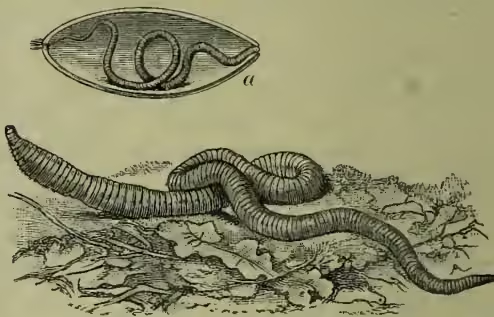
a, young worm escaping from the cocoon.
Habits.—Earthworms are shy of the light, and keep underground during the day. Of the activity of their nocturnal peregrinations the abundant trails left on the damp soil bear witness. At night they often keep their tails fixed in the mouth of the burrow, while they explore with their bodies in a circle round about. They feed on vegetable matter in the soil, on leaves, &c.; the food is chemically acted on by the gullet-glands, ground up in the gizzard, digested in the intestine; the debris is expelled in the familiar castings. A number of eggs, along with spermatozoa and albumen, are surrounded by a common cocoon, which is formed from a secretion of the skin. The cocoon is stripped off towards the head of the worm by contractions of the body, and when it is freed the ends close. There is no asexual reproduction, but the animals are able to regenerate a lost head or tail. Some species of Lumbricus exhibit superficial Phosphorescence (q.v.). Leaves are frequently carried below ground, sometimes for food, but also for making the burrows comfortable. Darwin's observations showed that the earthworms display considerable dexterity in seizing even strange leaves in the manner most convenient for transport. Stones of relatively large size are cleverly moved along, and used to protect the mouths of the tunnels. Moles and birds are their chief enemies. Gregarines (q.v.) are always found parasitic in the male reproductive organs, and little threadworms are common in the kidney-tubes.
Related Forms.—Besides Lumbricus—the earthworm par excellence—of which several species occur, widely distributed in Europe and North America, there are many other related genera. The list of over one hundred species of terrestrial Oligochaeta is continually being increased. Some exotic forms are very long, others very thick. There are giant earthworms over 3 feet in length, and an Australian species (Megascolex gippslandiensis) measures towards 6 feet, and produces a gurgling noise as it retreats underground.
Geological Importance.—Earthworms have strong claims to be ranked as the most useful animals. They were ploughers before the plough. In the long past they have made a great portion of our most valuable soil, and now they are improving and renewing it without ceasing. They burrow and open the way alike for the rain-drops and the plant-roots; they bruise the soil particles in their gizzard mills, and liberate the mineral elements. They are continually burying the surface by triturated castings brought up from below. The importance of their humble labour is sublime. This was long ago appreciated by Gilbert White and Jenner, but was only realised after Darwin's marvellously patient observations. Some of these lasted about thirty years. The result was to show that earthworms have been the principal agents in the formation of vegetable mould. In some cases vegetable mould does seem to accumulate without much aid from earthworms, and the constant rain of dust, as Richthofen emphasised, must not be overlooked; yet there is not a shadow of a doubt as to the momentous action of earthworms as soil-makers. Darwin showed that there are on an average over 53,000 worms in an acre of garden, that ten tons of soil per acre pass annually through the bodies of the inhabitants, that they bring up mould from below at the rate of 3 inches thickness in fifteen years. Greater results have seldom been demonstrated by the adding up of infinitesimal items. Darwin's loving patience included many most interesting observations on the habits of earthworms, and his whole work most clearly shows that the truth of nature is stranger than romance. The archaeologist owes the worms thanks for the way in which they have buried and thus preserved tessellated pavements and other antiquities. The use of worms to anglers needs no comment.
'Earthworms, though in appearance a small and despicable link in the chain of nature, yet, if lost, would make a lamentable chasm. . . . Worms seem to be the great promoters of vegetation, which would proceed but lamely without them, by boring, perforating, and loosening the soil, and rendering it pervious to rains and the fibres of plants, by drawing straws and stalks of all kinds into it; and, most of all, by throwing up such infinite numbers of lumps of earth. . . . Worms probably provide new soils for hills and slopes where the rain washes the earth away. . . . The earth without worms would soon become cold, hard-bound, and void of fermentation; and consequently sterile.'—Gilbert White, 1777.
'It may be doubted whether there are many other animals which have played so important a part in the history of the world as have these lowly-organised creatures.'—Darwin, 1881.
See Darwin, The Formation of Vegetable Mould through the action of Worms (Lond. 1881); Vejdovsky, System und Morphologie der Oligochaeten (Prague, 1844); Perrier, 'Lombriciens Terrestres,' Nouv. Arch. Mus. Hist. Nat. (Paris, viii. 1872); zoological text-books, especially Hatchett Jackson's edition of Rolleston's Forms of Animal Life (1883); for recent progress, see studies by Beddard and by Benham; and Beddard's Monograph of the Oligochaeta (1895).