Ecl, a name somewhat widely applied in popular usage, but justifiably extended to all the members of the family Murænidae, which is included in the order Physostomi of bony fishes. The family is a large one, with representatives in almost all fresh waters and seas of temperate and tropical zones. As is well known, the body is much elongated, cylindrical or ribbon-shaped; the usual scales are absent or rudimentary; and there are no pelvic fins. If unpaired fins are present, they unite in a long fringe. Teeth are usually well developed. Over two hundred species are known, all carnivorous, and preferring to keep near the bottom, sometimes at great depths.
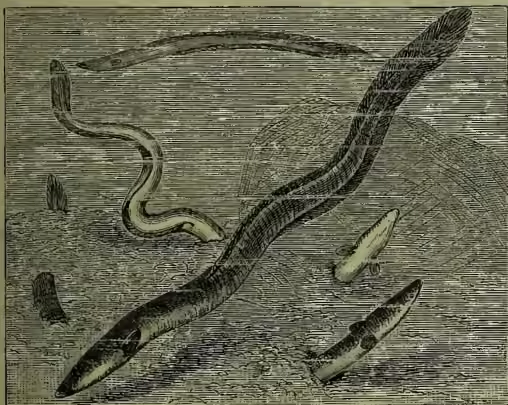
The genus Anguilla includes the eels par excellence, some twenty-five widely distributed species in all, the Common Eel (A. vulgaris) among the rest. The skin exhibits minute rudimentary scales, the upper jaw does not protrude, the tongue is free, the teeth small, the unpaired fins united in a continuous fringe. The common eel, though not without its mystery, is known to every one. The wide gape, the protruding lower jaw, the variable forms of head, the body cylindrical in front and then compressed, the long tail, the very varying colour, are familiar features. It occurs throughout most of Europe, frequenting, however, sluggish streams. Authorities usually distinguish two British species, A. vulgaris and A. latirostris, but the differences are slight. Stealthy in its habits, the eel lies in the mud during the day, and wriggles about at night in search of small water-animals, spawu, and dead carcasses. It is also certain that the eel often leaves the water, especially when grass meadows are overflowed or wet with dew, and travels by night over the moist surface in search of food; its small external gill-aperture helps it to remain some time without water. In cold weather it hides itself in the mud. The mystery concerns its life-history, which as yet is somewhat uncertain. The sexes are separate, and the reproduction oviparous. In autumn some of the larger females migrate seawards, while others probably remain in the rivers in winter somnolence. The migrating females meet the males in the sea, and there reproduction takes place (proved by Grassi in 1896). In spring the female young migrate up the rivers in large persevering shoals, overcoming all obstacles, such as flood-gates. The flesh of the eel is eaten, both fresh and preserved. They are caught by eel-spears, eel-pots, baskets, and in various other ways. In the blood of Anguilla, Muræna, and Conger, which is scantier than in most fishes, there is a powerful poison. The blood is exceedingly acrid to the taste, and though rapidly fatal when injected under the skin, is not markedly injurious in the stomach. The virulence of the poison is destroyed by heat.
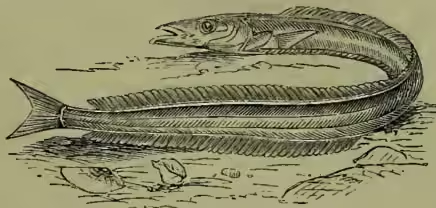
The genus Muræna includes a large number of marine species, mostly well coloured, some of great length (6 feet), and with formidable biting powers. One widely distributed species (M. helena) was highly prized by the Romans, and is still fished. The genus Conger (q.v.) is separately discussed. Murænosex, Myrus, and Ophichthys are other important genera within the family Murænidae.—The Electric Eel (Gymnotus electricus) belongs to a different though adjacent family (see ELECTRIC FISHES). The sand-eels (Ammodytes), which are often sought for bait, and are familiar to shore-wanderers, belong to quite a different set of bony fishes, and are also called lance. They are allied to the cods, and classified in the Anacanthini order. The marvellous adroitness with which they jerk themselves about in a pool, making use of the slightest cover of sand, is often admired.
A superstition has lingered through many centuries, finding typical expression in the works of Albertus Magnus, and repeated to-day in the experiments of country schoolboys, that horse-hairs left to soak in the brook grow into small eel-like animals. The fact at the root of this fancy is the frequent and sudden appearance of one of the Nematodes—the horse-hair worm.
The so-called 'eels' in paste, vinegar, fermenting and decaying substances, or stagnant water, are minute threadworms or Nematodes, often belonging to the genus Anguillula. Their bodies have the usual threadworm shape, and are almost transparent, though with thick cuticle. The rate of multiplication is very rapid; both eggs and adults have considerable power of reviving after Desiccation (q.v.). Adults have been known to reawaken after a maximum desiccation of fourteen years. See ASCARIS, NEMATODES, THREADWORMS, &c.