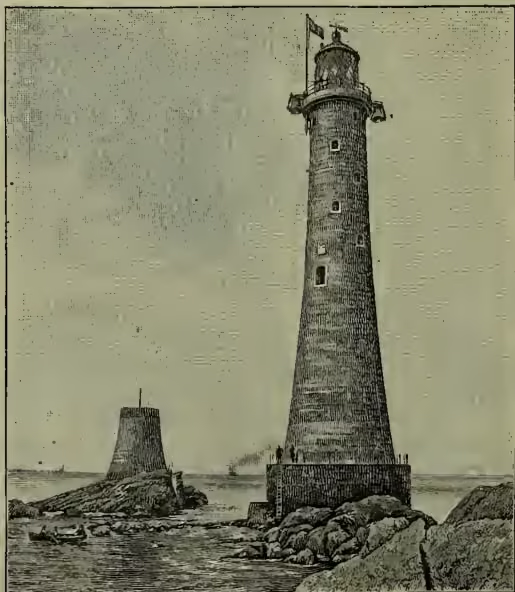
Eddystone. a group of gneiss rocks, daily submerged by the tide, in the English Channel, 9 miles off the Cornish coast, and 14 SSW. of Plymouth Breakwater. The rocks lie in 50° 10' 54" N. lat., and 4° 15' 53" W. long., and have 12 to 150 fathoms water around. The frequent shipwrecks on these rocks led to the erection of a lighthouse on them by Winstanley, 1696-1700. It was a wooden polygon, 100 feet high, with a stone base; but the great storm of 20th November 1703 completely washed it away, with the architect. Another lighthouse was built, 1706-9, also of wood, with a stone base, and 92 feet high, by Mr Rudyard, a silk-mercer. This erection was burned in 1755. The next, noted for its strength and the engineering skill displayed in it, was constructed by Smeaton in 1757-59, on the model, it is said, of the trunk of the oak-tree. It was built of blocks, generally one to two tons weight, of Portland oolite, incased in granite. The granite is dovetailed into the solid rock, and each block into its neighbours. The tower, 85 feet high, had a diameter of 26½ feet at the base, and 15 feet at the top. The light, 72 feet above the water, was visible at a distance of 13 miles. As the rock on which this tower was built is undermined and greatly weakened by the action of the waves, the foundation of another was laid on a different part of the reef in 1879. The new lighthouse, completed in 1882 by Sir James N. Douglass, F.R.S., is, like its predecessor, ingeniously dovetailed throughout. Its dioptic apparatus gives, at an elevation of 133 feet, a light equal to 159,600 candles, and visible in clear weather to a distance of 17½ miles. Owing to the state of the foundation, Smeaton's lighthouse was taken down to the level of the first room as soon as the new one was completed. The removed upper portion was re-erected on Plymouth Hoe, while the lower portion, as shown in the picture, remains intact on the rock as a distinguishing mark, an iron pole being fixed in its centre. See LIGHTHOUSE.