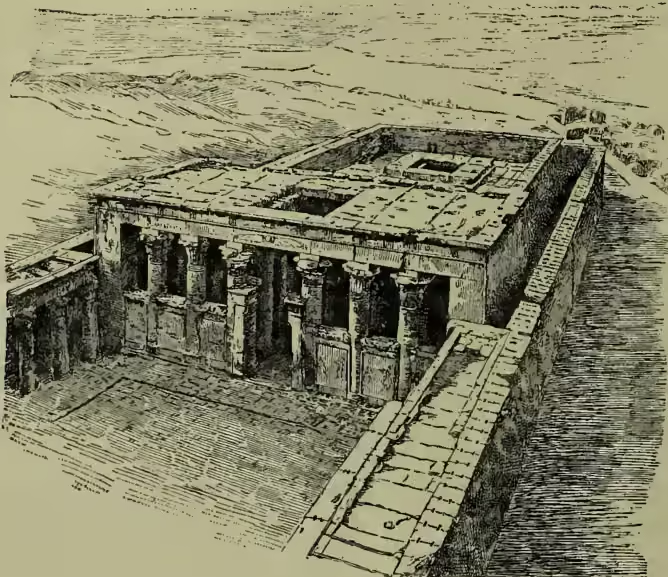
Edfu (Coptic Atbô, Egypt. Teb, Gr. Apollinopolis Magna), a town of Upper Egypt, is situated on the left bank of the Nile, in 25° N. lat., and 32° 45' E. long. It contains the remains of two temples, the larger of which is the best preserved monument of its kind in Egypt. It was founded by Ptolemy IV Philopator rather more than two centuries before Christ, and added to by his successors down to Ptolemy XIII Dionysus, a period of 170 years. The general plan of the temple resembles that of Dendera (q.v.). Its length is 451 feet, the breadth of its façade is 250 feet. Its entrance is by a gateway 50 feet high, between two immense truncated pylons, 37 feet wide at the base, and 115 feet high, the whole surface covered with sculptures and inscriptions in low relief. This splendid façade is visible from a great distance, and is one of the most commanding sights in the Nile valley. Passing through this entrance, a court is reached; it is 161 feet long, and 140 feet wide, inclosed by a splendid colonnade of 32 columns of every variety of capital, and surrounded by walls, between which and the pillars there is a stone roof, forming a covered portico. The interior of this court was to a great extent filled up with rubbish, and occupied by wretched dwellings, many of which also were built upon the roof of the temple; but these were all cleared away by Mariette in the khedivate of Ismail, and now the effect of the whole is grand and imposing, impressing the mind with the harmony and beauty of the design. From this court opens a hypostyle hall of 18 columns, joined by an intercolumnal screen, through which access is obtained to an inner hall of 12 columns, leading to the sanctuary, where a great monolith of gray granite was evidently intended to encase the hawk, the sacred emblem of Hor-Hud, the local Horus (q.v.), to whom the temple was dedicated. The sanctuary and surrounding chambers, together with the outer and inner halls, are separated by an open corridor from the outer wall of the temple, and both sides of this passage are covered with elaborate but monotonous reliefs and numerous inscriptions which present a sort of encyclopædia of ancient Egyptian geography, ritual, and ecclesiastical topography, with calendars of feasts, lists of divinities in the various names and cities, and even a species of church directory, including the names of singers and other temple officials. The smaller temple, erected by Ptolemy Physcon and Lathyros, consists only of two chambers. Edfu has at present a population of about 2000. Its manufactures are blue cotton cloths, and earthenware similar to the ancient Egyptian pottery.—Wilkinson, Ancient Egyptians; Brugsch, Reiseberichte, and Hist. Egypt.; Lepsius, Egypt and Ethiopia, Mariette, Monuments of Upper Egypt.