Edible Birds'-nest, a nest chiefly composed of the salivary secretion of several species of Swiftlet (Collocalia), which are almost wholly restricted to oriental regions—Java, Borneo, Ceylon, &c. The nests are made into soup and much prized as luxuries by the Chinese; both on this account and because of their unique origin they have been subjects of not a little inquiry. The nest, when clean and of the best quality, has a white colour and a somewhat fibrous texture. It is small, shallow, and bluntly conical. Mr E. L. Layard has vividly described those of the Ceylon species (C. nidifica), noting the vast numbers which hang close together on the sides of dim caves, the varying quality at different seasons, and also the nonsense that has been talked about them. 'The white nests,' he says, 'are supplied entirely by the inspissated saliva of the bird, and are the first produced. They are taken and sold for their weight in silver. The next made by the birds are mixed with rootlets, grasses, &c., and often show traces of blood from the efforts of the birds to produce the saliva. These are esteemed second quality. The third nest is composed of extraneous substances cemented together to the rock with a little saliva—these are generally left for the bird to breed in, and are destroyed at the end of the season to compel the birds to build fresh white ones after their powers are recruited by a year's rest and stimulated by the breeding impulses.' Mr Pryer, a naturalist of Yokohama, gives a graphic account of a visit to the Borneo caves, but it is quite impossible to credit all his results. He describes the myriads of birds which return home as myriads of bats emerge, the birds of prey which make victims of both, the unexhausted supply which is known to have persisted for seven generations, the yield of three crops of nests in the year, and so on. But he proceeds to give the bats (!) some share in the credit of nest-making, and refers the main constituent of the edible morsel to a fungoid growth on the walls of the cave.
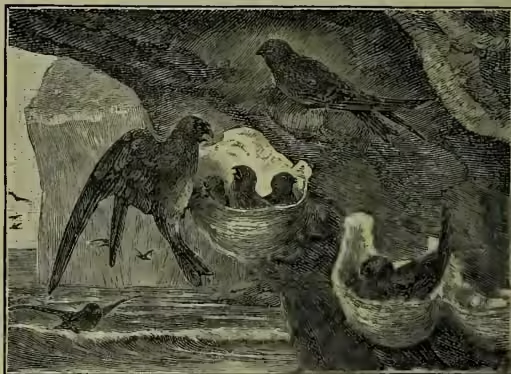
There is no doubt that Layard's account is correct. At the breeding season, the sub-lingual salivary glands in these swiftlets become enlarged and very active. They pour forth a viscid secretion, which soon hardens in the air. This is the chief constituent of the white nests. The first supposition was that of Horne, who supposed the secretion to be gastric; Bernstein, however, showed that it was salivary, and this is without doubt true in spite of more than one assertion as to the vege- table character of the nest. It is probable that the discrepancy is explained in the existence of the three qualities noted by Layard. Mr J. R. Green analysed the product, which was one of the curiosities of the Health Exhibition in London (1884), and found that the main constituent is closely akin to mucin, a not uncommon secretion of many animals. It is for instance with a similar substance, derived from a very different source, that the male stickleback weaves his nest together.
There are some ten species of swiftlet, which all exhibit this profuse salivary secretion, though in different degrees. Thus one of the Javanese species (C. fuciphaga) builds a similar nest, which is not edible because so much mixed up with plant-fibres and the like. The birds are sometimes called Salangane, from one of the islands which they frequent. The luxury is a very costly one; the nests are but small, and worth 'their weight in silver.' To Canton alone about 25 million nests are sent annually, and the price of a million has been estimated at about £35,000. The taste for the costly soup is said to require cultivation.
See J. R. Green, Nature, xxxi. (1884), xxxiv. (1886); Jour. of Physiol. vi. (1885); E. L. Layard, Nature, xxxi. (1884); Report of Pryer in Nature, xxx. (1884).