Edinburgh, capital of Scotland and county town of Midlothian or the county of Edinburgh, has since 1482 been itself a county of a city. It stands 393 miles NNW. of London by rail, and 47½ E. of Glasgow (43 direct distance), in 55° 57' N. lat. and 3° 11' W. long. More than most capitals, Edinburgh has concentrated in and around itself a large part of the national history, and is the pride of the country in virtue of beauty of situation, the romantic events that have taken place within its walls, the fame of its citizens in literature, science, and art, and the glamour shed on place and people by the writings of its most faithful son and citizen, Sir Walter Scott. Edinburgh has been called the 'Modern Athens' in reference partly to the situation on hills near the sea and to its literary distinction in the 18th century. The town stands about two miles from the sea on a series of ridges, and is overlooked by Arthur Seat (q.v.) and other hills (see EDINBURGHSHIRE), to the foot of which it has now extended. Of hills within the city itself the highest are the Castle Rock (437 feet) and the Calton (349). Although the Castle Rock, which for centuries was considered an almost impregnable fortress, must have been a place of refuge and of arms from the earliest times, the city is not con- spicuous very early in the history of this part of the country, which in Roman times was unquestionably occupied by British or Welsh (not Gaelic) people, the Otadini, apparently a branch of the Brigantes. On the removal of the Romans it was doubtless exposed to the incursions of the Picts from the north, and may have been occupied by them. But about 617 it was conquered and held by Edwin, king of Northumbria, was doubtless fortified as an outpost against the northern raiders, took its name from the Anglian king, and for centuries formed an integral part of the great Northumbrian kingdom. It is doubtful if during the Danish troubles in the 10th century Edinburgh was taken possession of by the Scoto-Pictish kings; it did not formally become part of the northern kingdom till after the battle of Carham in 1018, when the Northumbrian kingdom had been destroyed by the Danes and Canute was king in the south. Lothian was ceded by the Northumbrian earls to the king of Alba, but remained then and since Anglian in speech and population. The Gaelic name Dun-
Edin is merely a Gaelic translation of Edwinesburg or Edwinesburch, the name we find in the charters of David I. (1128-47) and the history of Symeon of Durham. The old Pictish name seems to have been Dyn Mynedd or Mynyd Agued; the late tradition that the castle was called Castrum Puellarum, and was a place of safety for Pictish princesses, is a fable. Christianity is believed to have been introduced, as into other parts of Lothian, in the reign of Oswald (634-642); the first church of the oldest Edinburgh parish is said to have been built on the site where St Cuthbert's Church now stands about the end of the 7th century. In the end of the 11th century, its castle figures in the story of St Margaret, queen of Malcolm Canmore, and the little Norman chapel on the summit of the rock, dedicated to her memory, is the oldest building connected with the city. In 1128 David I. founded the abbey of Holyrood, about a mile east of the castle, and round it grew up the little burgh of the Canongate, which maintained its separate municipality until 1856, when it was incorporated with Edinburgh. The Canongate for centuries retained an ecclesiastical flavour.
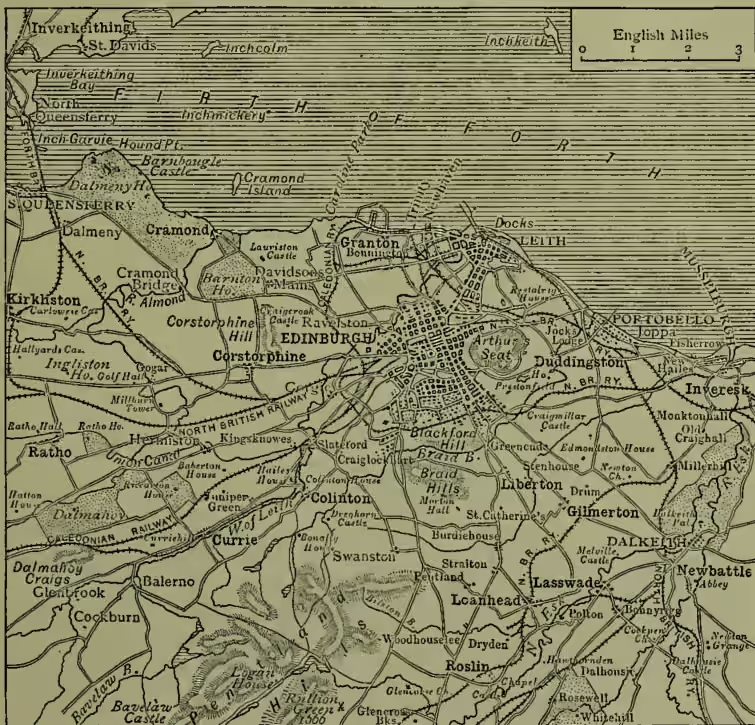
To the east of the castle, where the ground slopes down from the rock in a narrow 'hog's back' (see the article CRAG AND TAIL, and the cut there), there grew up the town of Edinburgh. In 1329 it was made a burgh by Robert the Bruce, by a charter which also granted the town the right of establishing a port at Leith, 2 miles distant; thus began the vassalage of the port to the capital town, which continued until 1833, when Leith was by Act of Parliament made a burgh. It was, however, during the 15th century, under the Stewart dynasty, that Edinburgh began to be recognised as the capital, and parliament regularly met here; at first within the great hall of the castle, and afterwards in the City Tolbooth, until in 1631 the Parliament House, which still stands, was erected. James V. further confirmed its choice as the capital by building a palace within the abbey of Holyrood; and by establishing in it, in 1532, the Court of Session, as a supreme court of justice for Scotland. In 1450, the first wall was built; and in 1513, after the defeat at Flodden, an extended wall was erected to include the suburb of the Cowgate, which had meantime arisen in the valley to the south. For two centuries and a half the town remained stationary in size, consisting of two long streets, the High Street (which was continued without the walls by the Canongate) and the Cowgate; while from these branched off numerous narrow lanes, called 'wynds,' which were also lined with houses. The town was defended on the west by the castle; on the north by a morass, called the 'Nor' Loch; and on the east and south by the city wall. As the population increased, the houses rose higher and higher, being built of the splendid freestone of the surrounding country, until the town abounded in great 'lands' of houses, which, being erected on the steep sides of the 'hog's back,' had entrances from two levels, and rose to ten, twelve, and even fourteen stories in height. This is the historic city; and it entered on the most remarkable period of its history with the birth of Queen Mary. In 1544 it was burned to the ground by the English under Hertford, scarcely a building outside the castle, save St Giles' Kirk, escaping. In 1560 the drama of the Reformation began in Edinburgh, and John Knox became the city minister; in 1561 Queen Mary returned a widow from France, and there was acted, chiefly in Edinburgh, the striking tragedy of her short reign, which has given subject-matter to historian, poet, dramatist, and novelist. It was at Holyrood Palace that Rizzo was murdered, and in the castle James VI. was born; in the Kirk-of-Field, where the university now stands, Darnley was killed, and in the Chapel Royal of Holyrood Mary was married to
Bothwell. In 1583 the university was founded, and the town which George Buchanan had already made known to the learned began its intellectual life. In 1603 James I. left Scotland to ascend the English throne, and although parliament still continued to meet in it, the town was shorn of much of its importance. It was the scene of many of the fiercest episodes in the long ecclesiastical struggle of the 17th century; and its Cross witnessed the execution of Montrose in 1650, and of Argyll and his brother Covenanters after the Restoration.
The Union of 1707, which emptied the Parliament House of its legislators, and drew away the Scottish nobility from their Edinburgh mansions, was very unpopular, and the citizens long remained discontented. The Porteous mob, which Scott has made famous in the Heart of Midlothian, showed the spirit abroad, and so the town was ready to welcome the Pretender, and to rejoice for a brief season in the glories of the court which he held at Holyrood Palace, in 1745. But the Rebellion was followed by the inroads of modern enterprise. Shortly after the middle of the century, the Town Wall was broken down in every direction, until but little now is left, save one of the towers built into the west boundary wall of Heriot's Hospital; the Nor' Loch was drained; and when the North Bridge was erected, in 1763, access was given to the northern slopes, on which arose the New Town (a new iron North Bridge was built in 1895-96). In 1785 the valley to the south, in which lies the Cowgate, was bridged, and the town spread southwards. In 1815-19 another bridge was thrown over a deep hollow on the north-east, and the Calton Hill was connected with the city; while a few years later a bridge was built across the Cowgate parallel to the one already erected. Thus the city connected the country on north and south with the narrow ridge topped by the castle, on which she had stood for centuries. Meanwhile a greater intellectual revolution had awakened the deadness of the early 18th century. There spread northwards the wave of scientific research which rose in England in Charles II.'s reign, and resulted in the establishment of the Scottish school of medicine, of which Alexander Monro was the founder; he was a man worthy to head even its long roll of fame. In this important movement the town assisted materially by the foundation, in 1738, of the Edinburgh Royal Infirmary, the joint work of Monro and Lord Provost Drummond. Closely following the scientific came the great literary revival which has made the town known over the world. Early in the 18th century lived Allan Ramsay and Robert Fergusson, the forerunners of Robert Burns, and then followed Robertson the historian, David Hume and Adam Smith, Professors Dugald Stewart and John Playfair, Sir Henry Raeburn, and many lesser celebrities, such as Henry Mackenzie and Tytler, Lord Hailes and Hugh Blair. But her greatest literary period was reached when Walter Scott was writing his novels, and when the Edinburgh Review was started by Jeffrey, Sydney Smith, Brougham, and Horner, and Blackwood's Magazine by the brilliant coterie led by John Gibson Lockhart and John Wilson (Christopher North).
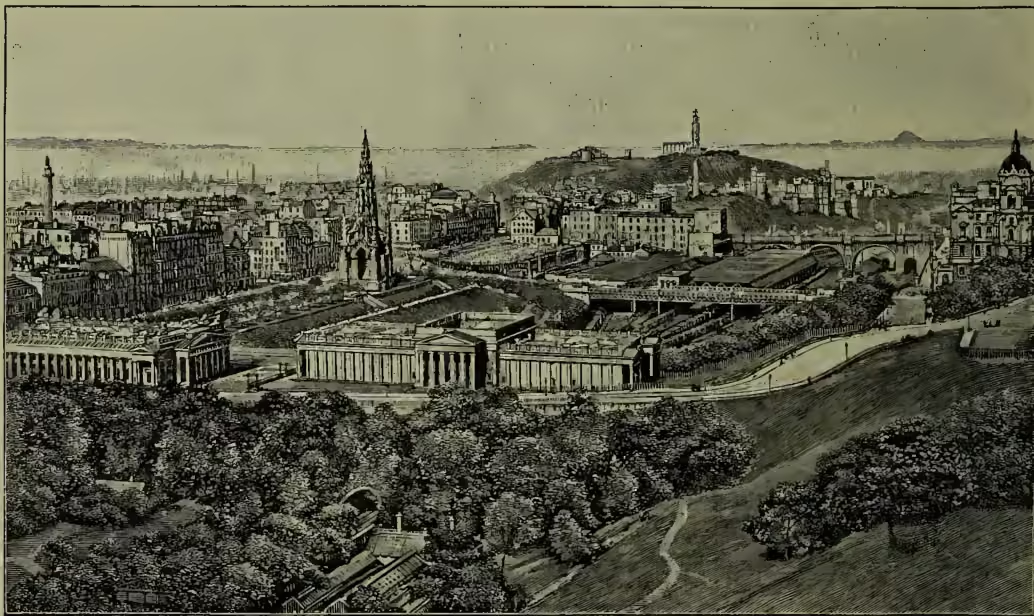
The modern city now spreads on every side round the steep ridge to which for centuries she was confined. Northwards she has spread to the sea, eastwards she touches the basaltic cliffs of Salisbury Crags (see ARTHUR'S SEAT), southwards and westwards she is creeping round the base and up the slopes of the picturesque hills which try to shut her in. But her most remarkable feature is the line formed by the mass of the Castle Rock, continued by the great houses and spires of the ridge of the Old Town, looking across the valley, in which was once the Nor' Loch, to the noble modern terrace of Princes Street. The old historic houses of the Old Town have been largely cleared away by much-needed City Improvement Acts. The New Town is regularly laid out; it contains many handsome streets and squares, ornamented with gardens; and its houses are mostly lofty and built of fine freestone. The suburbs, especially the southern, contain a great extent of villa-houses, so that the town covers a wide space for its population. It is also especially fortunate in its open spaces and public parks. The Princes Street gardens occupy the site of the old Nor' Loch, at the foot of the
Castle Rock; the range of the Meadows and Links—the remains of the once extensive Burgh Muir—divides the town proper from the southern suburbs; the old royal hunting-ground attached to Holyrood—the Queen's Park and Arthur's Seat—is open to the citizens; while on the north the Arboretum has been acquired, and on the south Blackford Hill and the Braids have been added to the town property devoted to recreation. The view obtained from the top of either Arthur's Seat or Blackford Hill is a very noble and extensive one; that from the latter eminence is finely described in Scott's well-known verses in Marmion.
Edinburgh is still in some measure the capital of Scotland: it is the seat of the Supreme Courts and of some of the departments of government; in it are held the General Assemblies of the Scottish churches; and the military headquarters for Scotland are also stationed in it. It contains the head-offices of the principal Scottish banks; of some of the largest of the Scottish insurance companies, which are among the greatest institutions of their kind; and of many other financial companies trading in Scotland and even more largely in the colonies. It is the centre of much of the intellectual life of Scotland, being the home of the Royal Society of Edinburgh, of the Royal Scottish Academy of Fine Arts, of the Scottish Society of Antiquaries, and of many other literary and scientific societies. Its leisured class, which is a large one, is partly composed of Scottish landed proprietors, but much more extensively recruited from those who have returned from abroad after acquiring affluence; while the tone of its society is in great measure given by the legal bodies which practise before its Supreme Courts, and by the staff connected with the university. At the head of its legal bodies is the Faculty of Advocates or barristers, which has always included many of the most distinguished Scottish writers and politicians; then come the Society of Writers to the Signet, and the Solicitors before the Supreme Court. There are also important societies of Accountants and Actuaries. Since the middle of the 18th century it has been celebrated for its physicians and surgeons, many of whom have been known for strong character as well as scientific knowledge. These and other circumstances tend to make Edinburgh very much a place of residence, with a large well-to-do population, a fact shown by its returns to the imperial revenue for house duty levied on houses above £20 rental, which are, after London, probably the largest in the kingdom.
It has been long known for its educational institutions, and these draw many inhabitants to the city for the benefits they offer. At the head of these is, of course, the university, and there are besides theological halls connected with the Free, United Presbyterian, and other churches, and normal schools for training teachers. The High School and Academy, and many of its private schools, have also attained a high reputation; but the most noteworthy feature perhaps is the exceptionally large sum which is annually derived for educational purposes from bequests left by citizens. These endowments have been largely diverted for secondary education during the last thirty years. Among the principal is the trust founded by George Heriot in Charles I.'s time, which now yields £30,000 per annum, applied by the Act of 1885 to the Heriot-Watt Technical College, and to the maintenance of a Science and Technical School; the trusts under the charge of the Merchant Company of Edinburgh, with an annual income of £40,000, applied principally to middle-class education; and the Fettes endowment, applied to higher-class education on the English model. In Libraries (q.v.) Edinburgh is rich, having besides the Uni- versity Library, the magnificent collection of over 330,000 volumes belonging to the Faculty of Advocates, and the valuable library of the Society of Writers to the Signet, amounting to nearly 90,000 volumes; a free public library was also erected in 1887-89, the building being a gift of Mr Andrew Carnegie of Pittsburg, U.S. The city is known for its many religious, charitable, and philanthropic societies. Perhaps the greatest of these is the Royal Infirmary, 'open to the sick and hurt of all countries.' During an average year it now relieves over 9000 patients, with an annual expenditure of over £30,000. It has received within the last generation great sums from gifts and legacies, and may be almost said to be the ultimus hæres of all connected with the city who die without immediate heirs. It is a necessary adjunct to the great medical school, and is considered one of the most admirably appointed hospitals in Europe.
The city ranks as a county in itself, and is under the management of a corporation of forty-one members, who elect from their number a Lord Provost and six magistrates, called bailies. The Lord Provost, who serves for three years, takes the title of 'Right Honourable,' is Lord-lieutenant of the city and Admiral of the Firth of Forth, and nominates deputy-lieutenants and justices for the city.
Edinburgh, as a residential town, is probably the most important shopkeeping centre out of London; it is not in any great measure a manufacturing town, its most important industries being brewing and publishing. Something like three-fourths of all the beer made in Scotland is produced in Edinburgh; much of it being sent abroad. It has been known for its printers since the early years of the 16th century, when Walter Chepman, under the patronage of James IV., set up the first Scottish printing-press. The publishing of books, with the subsidiary businesses of printing, lithography, bookbinding, and typefounding, is now a most important industry; much printing is done here for London houses (as by Clark, Constable, Ballantyne, and others); the publications of Messrs Blackwood, Chambers, Nelson, Clark, Douglas, and other firms are well known; and the book-factories are exceptionally large and well appointed. It is also a centre for the paper-trade, as there are many important paper-mills in the immediate neighbourhood. See BOOK-TRADE. There are also very important distilleries, and large india-rubber manufactories, tanneries, and extensive nurseries for trees and shrubs. Edinburgh is a great railway centre, and, besides a suburban railway, has both a horse and cable system of tramways.
Edinburgh has many buildings famous in history, or important from their architectural merit. The Palace and Abbey of Holyrood (q.v.) are a memorial of the old Scottish monarchy; of the castle, the earliest portion, the old Parliament Hall, was restored (1889-92) by the late Mr William Nelson, publisher, while the Queen Mary portion contains the Scottish regalia; St Giles' Church, the old parish church of Edinburgh, dating most of it from the 15th century, was restored by the late Dr William Chambers (q.v.), the work being completed in 1883; the Parliament House, erected in 1633 for the Scottish parliament, is now used as the 'Outer House' of the Supreme Courts, and adorned with many fine portraits and statues belonging to the Faculty of Advocates; John Knox's House was perhaps occupied by the great Reformer whilst minister of the town; the beautiful 17th-century building of Heriot's Hospital is now used as a technical school. Many of the modern buildings are fine. The Episcopal Cathedral of St Mary's, opened in 1879, is one of the largest churches built in Britain since the Reformation; and many of the other churches are handsome buildings. The new Medical Schools and the Infirmary occupy a noble range of buildings; while many of the museums and galleries, banks, insurance-offices, clubs, and public schools are fine buildings, and occupy sites made remarkable by the broken nature of the ground on which the city is built. Among its many monuments stands out the Gothic cross in memory of Sir Walter Scott. The electric light was introduced in 1895; and in 1900 horse-traction on the tramways was superseded by an extensive cable-system. Pop. (1831) 136,548; (1881) 236,002; (1891) 263,646. Edinburgh is divided, for municipal purposes, into sixteen wards, Portobello (q.v.) having been incorporated in 1896, and Granton in 1900. It is divided into four divisions for parliamentary representation, and returns four members.
See Histories by Maitland (1753) and Arnot (1779); Sir D. Wilson's Memorials (1847; new ed. 1892) and Reminiscences (1878); Chambers's Traditions (1825); Drummond's Old Edinburgh (1879); R. L. Stevenson's Edinburgh; Picturesque Notes (1878); Grant's Old and New Edinburgh (1880-82); Lees' St Giles (1889); Mrs Oliphant's Royal Edinburgh (1890); Harrison's Memorable Edinburgh Houses (new ed. 1898); and Geddie's Romantic Edinburgh (1900).
THE UNIVERSITY OF EDINBURGH, the youngest of the Scottish universities, is in a very special manner the child of the Reformation. In 1561 the town-council moved in the matter, and a few years after it obtained from Queen Mary a grant of the ruins of the Kirk-of-Field, an old collegiate church; this holding it afterwards extended by buying out several of those who had taken possession of parts of the grounds of the church. The long civil war retarded the project, but in 1582 the town-council obtained a charter from King James authorising it to establish a college; it was at the same time empowered to recover a sum of 6000 marks Scots, which had been left as far back as 1558 by Robert Reid, Bishop of Orkney and Abbot of Kinloss, for the purpose of founding a college in Edinburgh, according to lines laid down by the testator. The college was opened in 1583 in very humble buildings, and on a very small scale, its staff consisting of one regent, Robert Rollock, a young scholar brought from the college of St Andrews, with one assistant. In 1587 the staff was increased, Rollock becoming principal and professor of Divinity, with four regents, who each taught all the subjects of the curriculum, and conducted students through their four years' course. Such the college continued, without much material change, until the beginning of the 18th century; it was principally a school for training the Scottish Presbyterian clergy, although many of the Scottish nobility also attended its classes. In 1708, however, under the enlightened guidance of the principal, William Carstares, the regents became professors, teaching but one subject, and a possibility was opened up for a great extension of the scope of the college. In 1724 a beginning was made of a medical faculty, when Alexander Monro became professor of Anatomy; other chairs in the same faculty rapidly followed, and with such teachers as Monro, Cullen, and Gregory, the fame of the school soon rose. The reputation of the university was extended when, towards the close of the 18th century, Robertson, the distinguished historian, became principal, and Dugald Stewart and John Playfair drew students in crowds to its arts classes. During the 19th century the number of students increased till 1880-90, but has since decreased. In 1888-89 there were 3561, in 1894-95, 2939 (1572 in medicine, 750 in arts, 446 in law, and 69 in divinity). There are about 8000 members of the General Council.
The great influx of students during Principal Robertson's time rendered an increase of college accommodation absolutely necessary, the growth of numbers having been met up to this time by buildings erected from time to time by the town-council from city funds, or by the generosity of private donors. In 1789 the foundation of the present university buildings on the South Bridge was laid, being begun partly by subscription, but mainly on promise of aid from government; these buildings were not completed till 1827, the grants from the national treasury being withdrawn during the French war. A classical edifice, from designs by the elder Adam, it was completed only in 1887 by the addition of a dome. Some years ago the greatly augmented numbers, especially of the medical classes, called for a further increase of buildings, and a separate medical school was opened in 1884, erected at a cost of £250,000, of which £80,000 was supplied by government, the rest by private subscription. In 1887-89 a students' union was built; and in 1889-96 a college hall was erected at the expense of Mr M'Ewan, M.P. for one of the divisions of the city.
From its foundation in 1583 down to 1858 the university was entirely controlled by the town-council, which in its early days was much guided in its choice of teachers by the city clergy. It was felt, however, that it had outgrown its original constitution, and after a Royal Commission had reported, the Universities (Scotland) Act, 1858, made the university of Edinburgh a corporation 'consisting of chancellor, rector, principal, professors, registered graduates and alumni, and matriculated students.' Its government was vested in a Senatus Academicus, subject to the review of a University Court consisting of eight members, appointed partly by the university authorities and partly by the town-council of Edinburgh. The patronage of the chairs, which, with the exception of a small number vested in the crown, had remained up to this date with the town-council, was transferred to seven curators, four appointed by the town-council and three by the University Court. The lord rector is elected by under-graduates. A Students' Representative Council was founded in 1884 as a means of expressing the opinion of the body of students on university matters. Since 1868 the chancellor, professors, and members of the University Courts and General Councils of Edinburgh and St Andrews Universities conjointly elect a member of parliament.
Among the alumni of the university are numbered Hume, Blair, Akenside, Goldsmith, James Thomson, John Home, Thomson of Duddingston, James Bruce, John Leyden, David Mallet, Mungo Park, Lord Dundonald, Hutton the geologist, Walter Scott, Brougham, Lord Palmerston, Earl Russell, Carlyle, Darwin, Sir Richard Owen, Balfour Stewart, Clerk Maxwell, Cooke the electrician, Robertson of Brighton, J. F. M'Lennan, Joseph Thomson, Barrie, Crockett, and R. L. Stevenson; while of its famous principals and professors may be mentioned Carstares and Robertson, MacLaurin, Dugald Stewart, Thomas Brown, Joseph Black, Robison, Leslie, J. D. Forbes and Edward Forbes, and Charles Bell, John Playfair, Sir William Hamilton, John Wilson, Thomas Chalmers, the Monros, Gregory, Cullen, Christison, Syme, Simpson, Lord Playfair, Goodsir, W. E. Aytoun, David Masson, P. G. Tait, Sir W. Turner.
The university comprises the Faculties of Arts, Science, Divinity, Law, and Medicine, and Music, with upwards of 40 chairs, six of which date from 1583, while three (Celtic, History, and Public Health) date from 1882, 1894, and 1898 respectively. The university recognises as qualifying for its degrees the lectures of a large body of distinguished extra-mural lecturers; distinct degrees are granted by the Royal Colleges of Physicians (q.v.) and Surgeons (q.v.).
Libraries, Museum, Societies.—The University Library originated in a bequest of books made in 1580 by Clement Little to the town and church of Edinburgh. This little library, consisting of about 300 volumes, was transferred by the town-council to the college on its opening. It has gradually increased. From 1709 it enjoyed the right of receiving every book entered in Stationers' Hall, but a composition of £575 per annum in lieu of the privilege was accepted in 1837. The University Library contains about 200,000 printed volumes, and 5000 volumes of MSS. The university also contains subsidiary libraries, such as the Theological Library, the Humanity Class Library, &c. The Natural History Museum was established in 1812, and received a government grant of £200 per annum. It was in 1854 transferred to the new Museum of Science and Art, where it forms a Natural History Department, of which the professor of Natural History is the regius keeper. The Anatomical Museum, now exhibited in a fine hall in the new Medical School, was founded by the town-council and the Senatus Academicus in 1826. The Botanical Museum is stationed in the Botanic Garden, which is in connection with the university. The numerous societies for literary or scientific discussion play an important part in the training of the students. The Speculative Society was founded in 1764, and the Royal Medical in 1737. The Dialectic, Scots Law, Diagnostic, Philomathic, and Celtic constitute the Associated Societies of the university. Some 100 bursaries or exhibitions are awarded to students, and about 80 scholarships; while for graduates there are several fellowships.
There are histories by Bower (1817–30), Dalzel (1862), Sir A. Grant (1884), and the present writer (1886).