Egg, the female reproductive cell from which the embryo is developed—a process which, in all but parthenogenetic animals (see PARTHENOGENESIS), begins only after fertilisation by the male sperm. Using the word as equivalent to ovum, we may talk with equal accuracy of the egg of any animal, whether sponge, butterfly, fish, bird, or elephant. The essential part of the ovum is generally minute, and the entire element often so remains, alike in the lowest and the highest animals; the presence of extrinsic material, however, often makes the egg large and conspicuous. The most important and frequent extrinsic addition is the yolk, which serves as nutritive capital for the embryo or young animal. Next in importance are the various sheaths which surround the egg, especially when the outermost of these forms a chitinous, horny, or limy shell. Gristly fishes, reptiles, and birds afford very good examples both of abundant yolk and firm shells. We commonly associate eggs with (oviparous) animals which bring forth their young in that form, but this is a question of degree, for oviparous and viviparous forms often occur among nearly related animals; the common ringed snake, which usually lays eggs, may be artificially induced to bring forth its young alive, and even among mammals, where the connection between mother and offspring is characteristically intimate and prolonged, the two lowest genera (see ORNITHORHYNCHUS and ECHIDNA) are oviparous. For technical details in regard to the egg, the reader is referred to the articles BIRD, CELL, EMBRYOLOGY, and REPRODUCTION; attention will be directed here only to four points—size, shell, colouring, and economic interest, all with special reference to the eggs of birds.
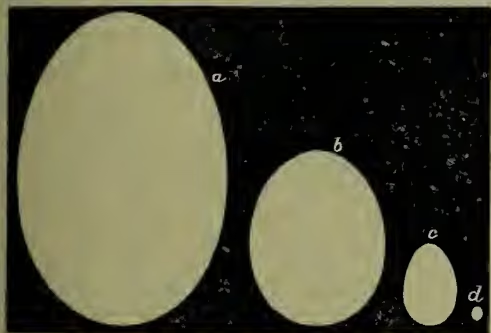
Size of Egg.—The accompanying diagram shows the striking contrast in relative size between the eggs of four birds—the extinct moa, a, the ostrich, b, the hen, c, and a humming-bird, d. A moa's egg has been found measuring 9 inches in diameter, 12 in length, 27 in circumference. Ernst Krause mentions, in his most vivid of all general natural history books, that in the 17th century the inhabitants of Madagascar used to come to the Île de France to buy rum, which they received in great vessels formed from the egg-shells of the extinct Epyornis. These shells, some of which are to be seen in European museums, measure 3 feet in circumference, and hold over 2 gallons—i.e. some six times as much as an ostrich egg, or 150 times as much as a fowl's. In contrast to the above, the weight of the humming-bird's eggs is computed in grains. (Of European birds, the largest are those of the swan, the smallest those of the golden-crested wren.) It is not in birds alone that we find striking contrasts in the size of eggs; those of a skate contrasted with those of a salmon illustrate a striking difference. The difference in the size of eggs means a difference in the amount of yolk and other extrinsic substances present, but what conditions this difference is a difficult question. The size of the egg can only be said to be generally proportionate to the size of the bird, thus the cuckoo is much larger than the lark, but the eggs of the two are about the same size; the guillemot and the raven are of about equal size, their eggs vary as ten to one; and many other examples of disproportion might be given. Hewitson has noted that the eggs of birds whose young are rapidly hatched and soon leave the nest are large. Professor Newton remarks that 'the number of eggs to be covered at one time seems also to have some relation to their size.' From what one notices in the poultry-yard, and from comparing the habit of different birds, it seems probable that a highly nutritive, sluggish bird will have larger eggs than one of more active habit and sparser diet.
The shell varies in composition in different classes. That of insects is chitinous (see CHITIN), of gristly fishes horny; a varying amount of lime is always present in reptile eggs, and predominates of course in birds. A bird's egg-shell consists almost wholly of carbonate of lime, but there is a little phosphate of lime and both salts of magnesia. Mr Irvine of Granton has made the interesting experiment of keeping fowls entirely without carbonate, allowing them only other salts of lime; the result was, however, that a normal carbonate of lime shell was still formed. The exact mode of formation of the limy shell is obscure; one can say little more than that the shell is secreted round the egg by the walls of the uterus or lower part of the female duct. In shape the egg is generally oval, but may be almost spherical, as in the kingfisher and owl; or pear-shaped, as in some of the auk family; or even doubly conical, as in the grebe. In its surface texture the shell varies greatly, enamel-like in the kingfisher, oily in the ducks, pitted in some of the ostrich order, rough and incrusting in pelicans. Less conspicuous, but apparently to some extent characteristic of different families, is the minute structure of the shell.
Colour.—During the formation of the shell in the lower part of the oviduct of the bird, pigment is also deposited. This occurs at various stages, producing the ground colour, the deeper, and the more superficial markings. The spots are normally circular, and most abundant on the anterior, larger, 'head' end, which first protrudes. As the egg is moved onwards, rubbing against the walls of the duct, the spots become in varying degrees blotched and diffused. The pigments themselves are numerous (Mr Sorby distinguishes seven), and are allied to the red colouring matter of the blood and to the pigments of the bile. Thus two of the most important, oörhodein and oöcyan, are allied, according to Sorby, to hæmoglobin and bile-pigment respectively. See PIGMENT.
The real import of the pigment cannot be said to be understood. The coloration varies in a single nest, and sometimes widely in a species. In quantity and quality the pigments change with the constitution of the bird, and Professor Newton inclines to the opinion that the richest coloration is produced by birds at their prime. In eggs which are much exposed, like those of some marine birds, a bleaching action can be detected, and M'Aldowie has recently maintained that the colouring varies in direct ratio to the amount of light to which the eggs are exposed. One of the most interesting facts in connection with the colouring of birds' eggs is their frequent similarity to their surroundings. Conspicuous eggs are usually in covered nests; and where the nests are rude and unconcealed, the eggs are very often like the colour of the ground. The advantage of this is obvious, but the mode in which the advantage would operate so as to establish specific colours is far from clear. Mr A. H. S. Lucas, in discussing how the colouring comes to be protective, considers that the effect of the surroundings, during the time of the formation of the shell, upon the mental or nervous constitution of the mother-bird, is a very important factor.
Economic Import.—As the eggs of birds contain all the essentials for the nutrition of a young animal, they form, like milk, a highly nutritious diet for adult organisms. The contained albumen, fat, lecithin, and phosphates are all advantageous; and it need hardly be said that both man and animals are well aware of this fact (see POULTRY). The shells are occasionally turned to account—e.g. those of ostriches, for decorative purposes.—The enthusiasm for egg-collecting, shared by so many naturalists, has probably not been equalled in any other department of natural science. Only a few quests, such as that for the eggs of the birds of paradise, have baffled the perseverance of collectors. The high prices paid for some treasures—e.g. the eggs of the great auk (£225 was paid for one in 1888) are only surpassed by those of some mollusc shells. This so-called sub-science of 'oölogy' has not, of course, been prosecuted without results of interest both in regard to the classification and general life of birds, but inquiry has largely passed from the collection and contemplation of egg-shells to the investigation of the embryo, and the deeper penetration has been richly rewarded. For some further particulars as to the egg-trade, imports of eggs into Britain, &c., see POULTRY.
Brewer, North American Oölogy (Washington, 1859); Cassell's Book of Birds; Hewitson, Coloured Illustrations of the Eggs of British Birds (3d. ed. Lond. 1856); Lucas, Trans. Roy. Soc. Victoria, xxiv. (1888); M'Aldowie, Jour. Anat. Phys. xx. (1886); Newton, article 'Birds,' Encyclo. Brit.; Sorby, Proc. Zool. Soc. (Lond. 1875); Carus Sterne (Ernst Krause), Werden und Vergehen (3d. ed. Berlin, 1886); Thienemann, Fortpflanzungsgeschichte der gesamten Vögel (Leip. 1845-56); Wolley, Oötheca Wolleyana (Lond. 1864). See articles AUK, EIDER, OSTRICH, &c.