Eider-duck (Somateria), a genus of birds in the duck family (Anatidae), included under the larger division of geese or Anseres. The bill is as long as the head, laterally compressed, and bears on each side of the root an unfeathered peak extending backwards; the point of the bill bears a large hooked horny nail; the tail is short and pointed. The birds are restricted to northern regions, where they breed socially.
(1) The Common Eider-duck (S. mollissima) lives on the Arctic and northerly shores of the Atlantic in both hemispheres, being common, for instance, in Nova Zembla, Spitzbergen, Iceland, and Greenland; various species also are found in Alaska and the neighbouring islands. It breeds as far south as the Fern Islands off the Northumbrian coast, and the Bay of Fundy in America. In cold winters it travels farther south, for instance, to the mouth of the Elbe. The eider measures about two feet in length, but is heavy for its size. The male is slightly the larger. Of the females and young males it may be said that the colour is predominantly rusty brown, with dark streaks and spots. The adult males, however, have as usual a more complex plumage, especially in the breeding season. The crown of the head, the under surface, and tail are black; the cheeks are sea-green; while white prevails over the neck and upper surface. After breeding, the white colour almost disappears from the upper parts, and black prevails.
The nest among the rocks is formed of fine sea-weeds, often matted along with mosses and twigs. The bird frequently shows a preference for low islets, where it is insulated from the hungry foxes. There are usually five eggs of a pale-green colour, and the number is said to be sometimes increased by thefts from other nests. The female does the brooding, but the male seems to take a kindly interest in preserving her peace of mind by warning off intruders. To man, who after all gives them most trouble, they are tolerably indifferent. When the brood is hatched, the mother pillages her breast for down to serve as covering. The down is often twice removed for human purposes, and then the male may pluck off his slightly inferior feathers if the mother has no more to spare. Nordenskiöld says that the bird, when frightened, tries to conceal the contents of the nest, and sometimes ejects a fetid excretion over the eggs. He also refers to the huge number of nests on a given area; they are often so close together that it is difficult to walk without trampling upon them. In the islet of Vidoë, a valuable Icelandic breeding-place, almost every little hollow between the rocks is occupied; the birds readily tenant holes cut out for them in rows on the sloping hillside, and many even utilise garden-walls and buildings. In Scotland the young eiders are sometimes called brattocks, and in Orkney and Shetland the bird is commonly called the Dunter Duck. Another title, St Cuthbert's Duck, refers to the name of one of the Fern Islands where the eider abounds.
The eider-duck is of great economic importance. The flesh, though not without suggestion of train-oil, is much eaten by Greenlanders and others. The eggs are more esteemed, and those of the next species, the King's Eider, are still daintier. Domestication, where farinaceous food is added to the usual diet of molluscs, crustaceans, &c., is said to render the flesh more palatable. The skins are used for winter underclothing. But the down collected from the nests is most important, both for local use and for export.
The fine elastic gray down, so much used, especially on the Continent, for bed-clothes, is chiefly developed on the breast of the bird. The best quality is not taken from the bird directly, but gathered from the nest. What formed or ought naturally to have formed the blanket of the young eider-ducks becomes the quilt of the human bedstead.
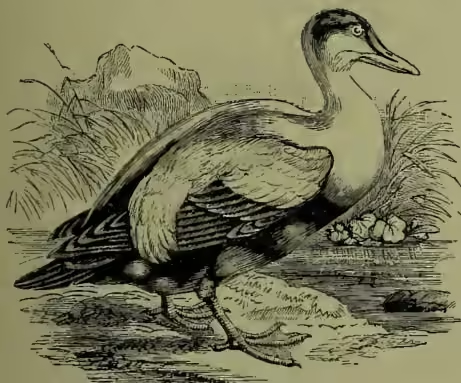
Each nest is said to furnish annually about a quarter of a pound. The common practice in Norway and Iceland is to take away the eggs and down twice, leaving the third set of eggs to continue the species. The nests are carefully protected, and are transmitted as valuable inheritances from father to son. Cattle may be removed from an islet for the eider's sake, or a promontory may be formed into an island to induce the bird to breed there, and to secure immunity from foxes and the like. The eiders appear to be singularly unaffected by the way in which they are exploited, and show little alarm on the approach of visitors. Domestication has proved successful by the seashore. The eider-duck is of course now protected in Britain by the Wild Birds Protection Act, but too little care seems to be taken of them. Nordenskiöld refers strongly to their wanton destruction in Spitzbergen regions. It seems probable that with a little care they might be both multiplied and extended on some of the Scottish islands. In Iceland, where the eider is strictly preserved, its numbers have greatly increased in recent years, and the people do all in their power to attract the bird to their property by hanging up cloths of a glaring colour, and bells worked by the wind or by water, and by keeping bright-plumaged fowls.
(2) The King's Eider (S. spectabilis) is another species, whose down is also collected. It lives in the far north of Asia and America, a few breed in Iceland and the Faroe Islands, and rare visitants have been seen in Britain. In size the king's eider is about equal to the more familiar species, but the bill and feet are reddish-brown instead of grayish-green, and the male is gray on the crown of its head, pale flesh-coloured on the breast, and more restrictedly white on the back. There is a large protuberance on the root of the upper part of the bill. The female is of a light reddish-brown colour, very like the female of the common eider. Much of the down from Greenland is obtained from this bird, and the skins are locally used for winter garments. There are three other species.