Elder (Sambucus), a genus of plants of the natural order Caprifoliaceæ, sub-order Sambuceæ, consisting chiefly of shrubs and trees, with pinnate leaves, small flowers of which the corolla is wheel-shaped and 5-cleft, and 3-seeded berries. The species are very widely distributed.—The Common Elder (S. nigra), the Bourtree of the Scotch, is a native of Europe, the north of Asia, and the north of Africa. It is found in all parts of Britain. It is a very large shrub, sometimes a small tree, with rather large leaves, and large terminal cymes of cream-coloured flowers, which are followed by small black—or rarely whitish—berries.
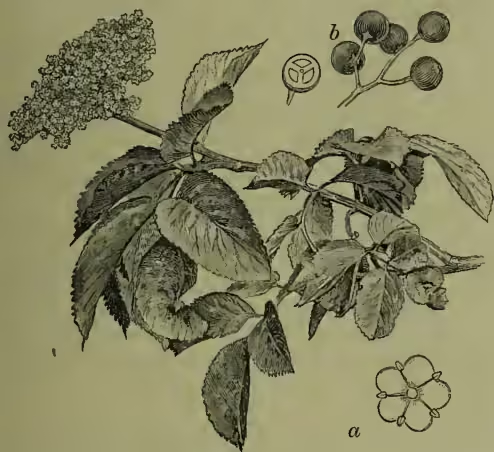
a, a flower; b, berries.
Its leaves and young shoots diffuse a narcotic odour, and it is said to be dangerous to sleep under its shade. The young leaf-buds are so violently purgative as to be considered dangerous. The inner bark has a bitter acrid taste. The leaves possess the same properties in a rather milder degree. The flowers have a peculiar sweetness and rather sickening smell, but are used for making a distilled water—Elder Flower Water—which has a very agreeable odour, and is employed both in perfumery and confectionery. Distilled with water alone, they yield a volatile oil, which, on cooling, assumes a buttery consistence. A popular cooling ointment is made by boiling them in lard. They are also used for imparting a flavour to currant-wine and jelly. The clustered flower-buds are pickled, and used like capers. The French put layers of them in heaps or casks of apples, to which they impart an agreeable odour. A grateful wine, well known in England, especially about Christmas, is made from the berries; and in some places there are plantations of elder to supply the London market. It is generally drunk hot or mulled. The berries are snacid and sweetish, with a rather unpleasant flavour. A Rob (q.v.) made from them is an agreeable domestic remedy with country-people for colds, coughs, and sore throats, and is slightly purgative; it has some reputation also in a concentrated form as a cure in rheumatic, gouty, eruptive, and syphilitic disorders. In some parts of Germany the poorer people use them as an ingredient in soups. They are said to be used to no small extent in England in the adulteration of port wine and the manufacture of spurious port wine.—The wood of the elder is yellow; that of old trees is very hard and tough, takes a fine polish, is used by turners, and as a substitute for boxwood in making mathematical instruments and other articles. Tops of fishing-rods are sometimes made of it. The pith of the young shoots being very light, is generally used to make pith-balls for electrical experiments. Toys for children are also made of it; and few boys are unacquainted with the use of elder branches, from which it has been expelled, for making popguns. A musical instrument named by the Latins sambuca is supposed to have been made from the wood of this tree on account of its hardness. The elder is very useful as a screen-fence near the sea and in other exposed situations, as it grows with remarkable vigour, and makes great shoots, the destruction of the more tender and less matured parts of which in winter only tends to make it more bushy and useful for shelter. It is readily propagated by portions of its shoots stuck into the ground.—The Scarlet-fruited Elder (S. racemosa), a native of the south of Europe and of Siberia, much resembles the common elder, but has softer and more herbaceous shoots, remarkably large buds, and racemes of greenish-white flowers, which are followed by scarlet berries. It is a frequent ornament of shrubberies in Britain.—The Dwarf Elder, or Danewort (S. Ebulus), is a rather rare British plant, a coarse herbaceous plant, with fetid smell. The inner bark has been employed in drop-sick complaints as a hydragogue cathartic. The leaves are avoided by cattle, moles will not come near any place in which they are laid, and they are said to drive mice and rats from granaries if strewed plentifully about their haunts for a time. White elder ointment is procured by boiling equal weights of lard and elder flowers, and pressing through a cloth.—S. canadensis and S. pubens are North American species; the former, which is the common American kind, much resembles S. nigra, and the latter in like manner approaches S. racemosa. Larger than either are the S. glauca of the Pacific states, and the S. mexicana of the south-west.
The elder is very prominent in European folklore, and innumerable superstitions cling to the tree, its twigs and leaves. The cross was reported to have been made of this wood. Judas was said to have hanged himself on an elder-tree; lightning will not strike an elder; twigs growing from the edge of decayed hollows in an old elder will ward off teething fits from children; in Denmark a spirit called the Elder-mother protects the tree and avenges injuries offered to it; warts are removed by being rubbed with elder twig; and, generally, the tree or a twig of it protects against witches and witch-craft.