Electric Light. The electric light, like light from most other sources, is produced by raising a body to a temperature so high that some of the radiations it throws out have a wave-length short enough to affect the retina. A slightly heated body gives radiations of long wave-length only; they may be detected, as any radiations may, by their heating effect when they fall on an absorbent surface, but the eye is not sensitive to them. When the body is made hotter the whole energy of the radiations increases, but the short waves increase in greater proportion than the long waves, and when the temperature is sufficiently raised the body begins to give out light. So long as the source is just hot enough to be luminous the light is nearly all red; as the temperature rises there are added more and more of the other colours, of shorter wave-length, towards the violet end of the spectrum. In the flame of a candle or of a gas-jet particles of solid carbon form the luminous source: their temperature, which is determined by the condition that they radiate energy as fast as work is done upon them by the process of combustion, is so low as to make the red and yellow constituents of the light preponderate. A higher temperature has the double advantage of giving whiter light, and of giving it accompanied by a smaller proportion of non-luminous infra-red rays, and therefore with less expenditure of energy in proportion to the amount of light produced.
One way of heating a body to a high temperature is by forcing a strong current of electricity to pass through it. The energy expended depends on the strength of the current and on the electromotive force which is required to make it pass, and this energy takes the form of heat. By selecting a conductor which offers considerable resistance to the passage of the current, it is practicable to produce so much heat in a small space that the temperature reached is only limited by the melting or volatilising of the heated body. In all actual electric lamps carbon is used, first and mainly because of its great infusibility, and second, because of its emissive power. Carbon is in fact the luminous body in nearly all sources of artificial light.
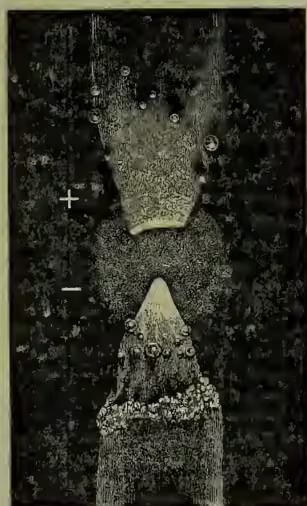
Arc Lighting.—The earliest means of applying the electrical current to the production of light was discovered in 1810 by Sir Humphry Davy, who found that when the points of two carbon-rods, to which the terminals of a powerful battery were connected, were brought into contact and then drawn a little way apart, the current continued to pass across the gap, forming what is known as the electric arc. The electric arc (fig. 1) is brilliantly luminous. The points of the carbon- rods become highly incandescent, and in addition the space between them is filled by a sort of flame, or cloud of particles of white-hot carbon. As the temperature of the arc is much higher than that of any ordinary flame, its efficiency as a source of light is exceptionally great, and it is specially rich in highly refrangible (or short wave-length) rays. The carbon-points being exposed to the air gradually burn away, and in addition to this there is a transfer of carbon particles across the arc from the positive to the negative rod, which has the effect of making the positive rod waste about twice as fast as the negative rod. The end of the negative rod becomes somewhat pointed, and a crater-like hollow forms on the end of the positive rod. As the points waste away the arc lengthens, and would presently break and the current would cease to pass if the rods were not pushed nearer together. Should the arc break it can be re-established by bringing the rods again into contact, and again drawing them a little way apart. Arc lamps are devices for holding the carbon-rods, so that they are first brought into contact and drawn apart, to establish or 'strike' the arc, and are then 'fed' together, continuously or at short intervals, to prevent the distance between the points from growing too long.
It was not until the development of the Dynamo-electric Machine (q.v.) as a means of producing the electric current economically on a large scale, that the electric light came to be of commercial importance. Before that, however, various contrivances had been devised for automatically striking the arc and regulating its length. As early as 1847 a lamp was patented by W. E. Staite, in which the carbon-rods were set vertically one over the other, the upper one being held fixed, while the lower rod was fed upwards by the intermittent action of clockwork, which came into gear whenever the current across the arc became reduced below a certain limit of strength through the lengthening of the distance between the carbon-points. Similar devices were proposed by Foucault and others; but the first really successful arc lamp was Serrin's, patented in 1857, which has not only itself survived, but has had its main features reproduced in many later forms. In 1858 a lamp designed by Duboseq was used to show the electric light, for the first time at sea, from the South Foreland Lighthouse, where the current to feed the lamp was generated by the large magneto-electric machine of Holmes; and this experiment was followed a few years later by the permanent establishment of electric lighting there and at Dungeness and other lighthouses. The invention of the self-exciting dynamo in 1867 paved the way for the development of electric lighting on a commercial scale. The Jablochkoff candle (1876), in which the arc was formed between the ends of a pair of parallel carbon-rods separated by a layer of insulating material which was slowly consumed as the carbon burned down, did good service in accustoming the public to the new illu- minant, and the invention of simple and effective arc lamps by Brush and others, brought about its wide adoption in 1878-79 for lighting large rooms, streets, and spaces out of doors. In the following year the future of domestic electric lighting was secured by the introduction of the incandescent lamp.
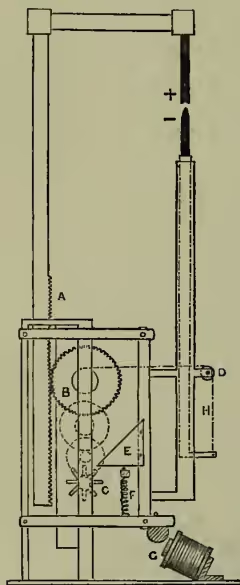
In modern arc lamps, of which there are so many forms that it would be impossible even to classify them in the space at our disposal, the arc is generally struck by the action of the current in an electro-magnet or solenoid, which is connected in series with the carbons, so that when the current passes the armature of this magnet is attracted, and its motion is caused to separate the carbons. This sets the lamp in action, and then, as the carbon-points are consumed, the resistance to the passage of the current gradually increases. If the source of electricity is such as to maintain a constant, or nearly constant, difference of potential between the terminals of the lamp, the effect will be that the current will gradually become reduced. On the other hand, if the source is such as to maintain a constant or nearly constant current through the lamp, the effect will be that the difference of potential will increase. Either of these effects may be made use of to regulate the length of the arc. Generally the carbons (which are round rods formed by making powdered coke into a paste and baking it) stand in a vertical line, and the upper one is fixed in a heavy holder, which tends to slide down until the points touch. But its motion downwards is checked by a clutch or brake of some kind, which allows it to descend little by little, and only when the length of the arc has become unduly great. Fig. 2 is a skeleton diagram showing the mechanism of Serrin's arc lamp, which was one of the earliest successful forms. Here the upper carbon-holder, A, has rack teeth on it, which gear into the first of a train of toothed wheels, BC, so that the train must revolve as the carbon descends. The last wheel in the train, C (which moves much for a very small movement of the holder), is a star-wheel, whose projecting limbs hit or miss a detent, E, the position of which is controlled by an electro-magnet, G, pulling against a spring, F. When the arc is struck the star-wheel is locked, so that the upper carbon-holder is fixed.
As the arc lengthens, the current in the controlling electro-magnet becomes weakened, and this goes on until the detent rises far enough to release the star-wheel. The holder, A, then descends until the current is again strong enough to make the electro-magnet draw the detent down and lock the wheel. Here the control depends on variations in the strength of the current passing across the arc, and the controlling electro-magnet is in series with the carbons (being in fact the magnet which also strikes the arc); if, however, the lamp were to be used with a constant current, the control could easily be effected by variations in the difference of potential between the carbons. The controlling magnet must then form a shunt to the arc itself, and be set so that when the shunt current in it is weak the star-wheel is locked, and when the shunt current exceeds a certain limit the detent is raised and the star-wheel is released. The lamp shown in fig. 2 has this peculiarity, that the descent of the upper carbon-holder makes the lower holder rise, through half the distance, by means of the pulley D, and chain H. The effect is to keep the arc burning always at one and the same place, the lower carbon being the negative one, which consumes half as fast as the other. Lamps with this feature are called 'focussing' lamps, and are useful in lanterns where the luminous centre must be maintained in the focus of a lens. For ordinary uses the focussing arrangement is not necessary, and is omitted.
In many modern lamps the controlling electro-magnet is double, consisting of a series and a shunt portion, combined in such a way that the holder is released, and the carbons are caused to approach by either a weakening of the current or an increase of the potential, or both. Such lamps may be used either with constant current or with constant potential.
In place of the train of wheels in Serrin's lamp, a single brake-wheel has been used, turned by a rack on the upper carbon-holder, and stopped or checked by a brake-lever which is pressed against or withdrawn from its circumference by the controlling electro-magnet. Some very successful modern lamps, such as those of Brush and Thomson-Houston, use a still simpler device. The upper carbon-holder slides through a loose collar or ring, which can be tilted by the controlling magnet, so that it clutches the holder. When the current falls or the potential rises this clutch collar is untilted, so that the holder slips through it and shortens the arc. A dash pot is employed to prevent the fall of the holder from being too rapid.
When a number of arc lamps are to be used together they are generally connected in series; a constant current is sent through the group, and the control of the carbons is effected by shunt electro-magnets, taking advantage of variations in the difference of potential between the carbons. To prevent the whole group from being extinguished should the feeding mechanism in any one lamp fail to act, a device is added by which any lamp that fails is short-circuited—i.e. the current passes through it by another path. They may, however, be grouped in parallel, if the control is arranged to depend on variations in the strength of the current. Parallel grouping is usual when the lamps are to be served with alternating electric currents.
The rate at which energy is expended in the electric arc is measured by the product of the current and the electromotive force required to maintain it passing across the gap. If the current be measured in ampères and the electromotive force in volts, their product gives the rate of expenditure of energy in watts, and may be reduced to horse-power by dividing by 746. It is found that the electromotive force between the points is nearly constant whether much or little current is passing, which shows that the opposition to the passage of the electric current across the gap is different in kind from the resistance of an ordinary conductor. However short the arc be it requires an electromotive force of from 30 to 40 volts to maintain it; when the arc is lengthened the electromotive force necessary to keep up the same current is increased, but not in proportion to the length. It is not found practicable to maintain the arc with less than a certain strength of current. Hence the power consumed in an arc lamp is necessarily considerable, and the lamp can be employed to advantage only where a large amount of light will be serviceable. The arc lamps which are most extensively used take from three-quarters to one horse-power, and have an illuminating effect equivalent to something like 1000 candles. It is impossible to speak with any precision of the candle power of an arc lamp, because its light differs enormously in colour from that of a standard candle. A comparison of the blue rays of the arc with the blue rays of the candle will give a figure nearly three times more favourable to the arc than if the comparison be made between the red rays.
Incandescent Lighting.—In early attempts to produce light by the incandescence of a heated conductor, wire of platinum and of other refractory metals was employed; but these become melted or disintegrated at too low a temperature to let them serve as efficient sources of light. Carbon rods also had been used, but the matter was not brought to a practical issue till 1879, when Mr Edison (and, almost at the same time, Mr Swan) made lamps in which the incandescent conductor was a fine thread or filament of carbon, inclosed in a glass globe, from which the air was exhausted as completely as possible. The filament was originally formed by carbonising a thread of paper, cotton, bamboo, or other vegetable fibre: it is now more usually made by forcing a semi-fluid preparation of cellulose through a die, bending and drying the thread, and heating it to a very high temperature, surrounded with plumbago, in a crucible. The ends of the filament are attached to short conducting wires of platinum, which are sealed into the globe. By making the filament longer or shorter, thicker or thinner, the lamp is adapted to be used with more or less electromotive force, and to give more or less light. The lamp has a limited life, for the filament undergoes a slow process of disintegration, which finally breaks it. As in the case of an arc lamp the power consumed is measured by the product of the current and the electromotive force or difference of potential between the terminal. In ordinary use incandescent lamps consume from three to four watts per candle of light, and last for some 1000 hours. One may force them to a higher efficiency by increasing the electromotive force, so that the temperature of the filament is further raised, and the light is much increased with the expenditure of but little additional power. But this shortens the life of the lamp, and tends also to make a deposit of carbon particles form on the inside of the glass. The temperature of the filament is in no case so high as that of the electric arc; hence incandescent lighting is less efficient than arc lighting as regards the proportion of light to power, and the colour of the light is more yellow. But in point of steadiness and pleasantness, facility for distributing light, and convenience in placing and management, incandescent lamps have many claims to be preferred for indoor use.
An interesting part of the manufacture of lamps is the process of 'flashing' invented by Messrs Sawyer and Mann, which means the electric heating of the filament for a short time in a hydrocarbon atmosphere. The high temperature of the filament causes the dissociation of the gas in contact with it, and the carbon of the dissociated gas is deposited on the filament. This forms a convenient means of adjusting its thickness and resistance; it also tends to make the filament more uniform, for the process of dissociation and deposit goes on most actively at those places which are thinnest to begin with, and therefore hottest. Incandescent lamps work well with either continuous or alternating currents. They are now made of all sizes, from the miniature lamps of one candle power or less which are employed in surgery, up to two or three thousand candle power. When a number of them are used together they are almost always grouped in parallel. In the electric lighting of a house, for instance, positive and negative main conductors, consisting of insulated copper wire, are led from the dynamo, and to these the positive and negative branches are respectively connected, whose ramifications extend to every room. Wherever a lamp is to be placed a positive and a negative leading wire must come, and each lamp forms as it were a bridge between the positive and the negative side of the system. The difference of potential is nearly the same for all; it is a little less in the case of the more distant lamps, because a certain fall in the difference of potential is incurred through the resistance which the leading wires themselves offer to the passage of the current. This loss has to be kept within reasonable limits by making the sectional area of the leading wires great enough, and no serious difficulty is experienced in doing this when the lamps all lie within a few hundred feet of the source. But the difficulty becomes serious when distribution is attempted on a large scale. Not only is the loss of energy in the conductors then a large part of the whole energy supplied, but it may give rise to wider variations in the potential than can be tolerated. If the number of lamps in use in any district were nearly constant, so that a nearly constant current would flow through the mains leading to that district, it would be easy to allow for the fall of potential in those mains. But this fall is itself a variable quantity, depending on amount of the local demand; and to keep the potential sufficiently constant requires mains of large size, the cost of which becomes prohibitory when the area of distribution is much extended.
In such cases it is necessary to resort to other methods of distribution than by a simple system of parallel mains and branches. A sufficient number of sub-centres may be taken over the area to be lighted, and each of these made the starting-point of a system of parallel conductors, the sub-centres themselves being fed from the central source, through independent mains, with currents which are regulated to produce the necessary potential at each sub-centre. Even then, however, if the sub-centres are widely distant from the source the loss of energy in the mains will be serious. In distribution over a large area there is an obvious advantage in very high potential, for the same amount of electrical energy is then conveyed by a smaller volume of current, and consequently with less loss in the conductors. This advantage may be secured if we convey the electric energy to sub-centres in the form of small currents at a high potential, and convert it there into low-potential currents suitable for domestic use. Two plans of doing this have been put in practice—one, by means of storage batteries, is suitable for continuous currents; the other, by means of transformers, is suitable for alternating currents.
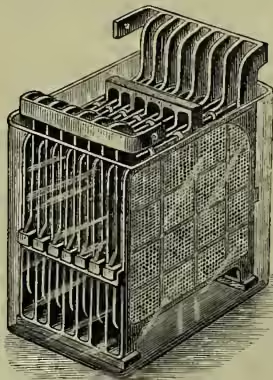
Storage Batteries are cells consisting of large sheets or grids of lead, superficially coated with oxide, which are immersed in dilute sulphuric acid, and are polarised by the passage of the current. Peroxide of lead is formed on the positive plates, and spongy metallic lead on the negative. After being charged by the passage of the current the cells will act for a time as electric generators, giving a current in the opposite direction until the plates again become inactive, when they may be again charged. The electric energy given out when the cells are discharging is somewhat less, but need not, if the cells are slowly charged, be very much less than the energy expended in charging them. Each cell has an electromotive force of about two volts, and its internal resistance is made low by grouping a number of pairs of plates in parallel within a single cell (fig. 3).
When such cells are used to convert an electrical supply from high to low potential, they are grouped in series while they are being charged, and the groups are then broken up into sections which may be discharged separately or connected in parallel for discharge. Apart from this use of storage batteries in electric lighting, they form a most valuable, but unfortunately very costly adjunct in domestic and other installations for steady the electromotive force of the supply when used as a shunt across the terminals of the dynamo, and for storing electricity for use during intervals when the dynamo is not running. Small storage batteries have been successfully employed as a means of providing portable electric lamps for use in houses, carriages, and especially in mines. The miner's lamp is a small storage battery weighing a few pounds, and is inclosed in a watertight case no bigger than an ordinary lantern, in the front of which is fitted a small incandescent lamp protected by a stout glass cover. Primary batteries have also been used, in place of storage batteries, to supply electricity to portable lamps.
Transformers are induction coils, consisting of a core of soft iron on which two coils of insulated copper-wire are wound. When alternating currents are made to pass through one of these, called the primary coil, they produce corresponding periodic alternations of magnetism in the iron, and induce alternating currents of corresponding period in the other or secondary coil. The effect of the iron is to increase the coefficient of mutual induction between the two coils. When the number of windings in the secondary coil is small compared with the number of windings in the primary coil, the electromotive force induced in it is correspondingly smaller than the electromotive force impressed upon the primary; and this is taken advantage of in practice in the conversion of a high-potential into a low-potential supply for electric lighting. In order that the iron core should have as much magnetic susceptibility as possible, it is made in the shape of a ring or some other closed (poleless) magnetic circuit, and to prevent waste of energy by the induction of currents in the substance of the iron, the core is laminated by being built up of thin plates or of wire. Even then, however, there is some waste of energy in the core on account of what is called magnetic hysteresis in the periodic changes of magnetism it undergoes, and some further waste occurs through the heating of both the primary and secondary coils in consequence of the resistance they offer to the conduction of the currents. Notwithstanding these sources of loss the efficiency of a transformer working under favourable conditions is very high, as much as 90 and even 95 per cent. of the energy expended in the primary coil being given off in the converted currents from the secondary. In practice the direction of the current is reversed about 150 or 200 times per second.
Distribution of electricity for the purpose of lighting by means of transformers, high potential being used in the conveyance of the currents from the distant source, with conversion to low potential before use, has been effected on a fairly large scale in many places, especially in America, where the system has later taken practical shape in the hands of Mr Westinghouse. In London the same method has been successfully employed for some years over a pretty wide area by the Grosvenor Gallery Company, and in 1889 elaborate arrangements were completed for its being applied on a formerly unprecedented scale by the Electric Supply Corporation, from whose central station at Deptford alternating currents are conveyed to all parts of London at a potential of 10,000 volts, to be reduced to 100 volts or so by two successive conversions in transformers before they reach the lamps of the consumers.
Among the minor adjuncts in electric lighting, an important part in guarding against possible risk of fire is played by the 'cut-outs,' whose function is to interrupt the current in any main or branch conductor should it ever exceed a safe strength—as might happen in the event of an accidental cross-connection or short-circuit being formed between the wires. The usual form of cut-out is a safety fuse, consisting of a short piece of foil or wire made of lead or of some fusible alloy which any dangerous excess of current will melt, and so interrupt the current, in that portion of the system which is guarded by the cut-out, before any damage is done. Cut-outs are generally put at the junction of branch with main wires, as well as in the mains themselves. Where the amount of current to be passed is large, an electro-magnetic cut-out is often preferred to a fuse.
Numerous forms of meter have been devised for measuring and recording the quantity of electricity supplied to consumers, some suited for continuous currents only, and others for alternating as well as continuous currents. Space does not admit of any description of the ingenious meters invented by Ferranti, Aron, and others. In Edison's meter for continuous currents, which has done good service in central station lighting on the parallel system in New York, the amount of electricity which passes is measured by the deposit of metal in an electrolytic cell. In Forbes's meter, which acts equally well with continuous or alternating currents, the current heats a small coil of wire so that a stream of warm air rises from it; this is made to turn a little windmill, whose number of revolutions is registered, and is found to be a good index of the amount of current which has passed.
References.—The literature of electric lighting consists mainly of papers published in the scientific and technical journals, for the most part since 1878. In the article DYNAMO-ELECTRIC MACHINES (q.v.) reference has already been made to Professor S. P. Thompson's treatise on Dynamo-electric Machinery. A lecture by the same author (Journal of the Society of Arts, March 1889) gives a comprehensive account of various types of arc lamps. Much descriptive and historical matter regarding dynamos and arc lamps will be found in Electric Illumination, by J. Dredge. Reference should also be made to papers by J. Hopkinson in Inst. Civ. Eng. Lectures (1883), and Proc. Royal Society (1887); by G. Kapp, in Proc. Soc. of Telegraph. Engineers (1888), and Min. Proc. Inst. Civ. Engineers (1889); and by G. Forbes, in Journal of the Society of Arts (1885, 1886, and 1889). See also Urquhart, The Electric Light (1890); Salomons, Electric Light Installations; and Prof. Fleming, Electric Lamps and Electric Lighting (1894).