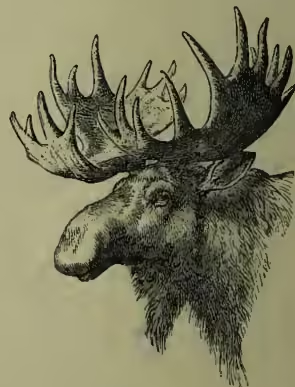
Elk, or MOOSE (Alces machlis, or palmatus), the largest living deer, a magnificent animal of circumpolar distribution, in Europe, Asia, and especially in America. It is the only species of its genus or sub-genus, but is nearly allied to Cervus (see DEER). It must be distinguished from the Wapiti (Cervus canadensis), with which it is often, verbally at least, confused. The adult elk usually stands about six feet high at the shoulders, and may exceed even this noble stature. The male bears very broad (palmate) divergent antlers, with which it has been known to kill a wolf at a single blow. The general colour is dark reddish-brown, but becomes slightly lighter and grayer in winter. The limbs, especially the fore-legs, are very long, and as the elk browses more upon bushes and the like than upon the ground herbage, which it is but little adapted to reach. The tail is very small. More detailed characters are the broad hairy nostrils, the overhanging upper lip, the small eyes and tear-pits, the long and broad ears, the low stiff mane on the back of the neck, the loose mane on the lower side of the neck and on the breast, the long brittle hair, &c. The antlers form between them a sort of basin, for each broadens out in a great shovel-shaped expansion, with marginal prongs or snags, increasing as usual with the years of life. The entire 'head'—i.e. the pair of antlers, sometimes weighs 40 lb., while adult animals are said to weigh in all about 10 cwt. The young male elks do not begin to acquire antlers till they are nine months old, and growth seems to go on for fourteen years. The younger elks are also marked by a large goitre-like swelling under the throat.
Elks are for the most part solitary in their habits, except at the breeding season. They delight in marshy places and in forests. The widely separating halves of the hoof enable them to find firmer foothold in soft ground or among snow. In the forest, their magnificent antlers, as Mr Darwin notes, must sometimes be rather in the way than otherwise. When walking leisurely, they carry themselves so well that entanglement is avoided, but it is easy to see how the case is altered when, with head thrown back, they flee before the wolves. The usual gait is a shambling trot, but the elk can also gallop rapidly. Only when the deep snow impedes it are the hunters, aided with snow-shoes, able to run it down. The usual method of hunting is to steal upon the elk as it rests, but as its senses are extremely acute and the trails often confused, successful capture is regarded as a feat. Naturally timid and inoffensive, the disposition changes in the breeding season. The male elks fight with one another, and are at that season sometimes decoyed to the hunter, who imitates the sounds of a rival. As the elk is then furious, this device demands strong nerve and sure aim.
The European and Asiatic distribution of the elk is now much restricted. In Germany, for instance, they were abundant in the time of Cæsar, but are now all but extinct. In the Baltic provinces, in
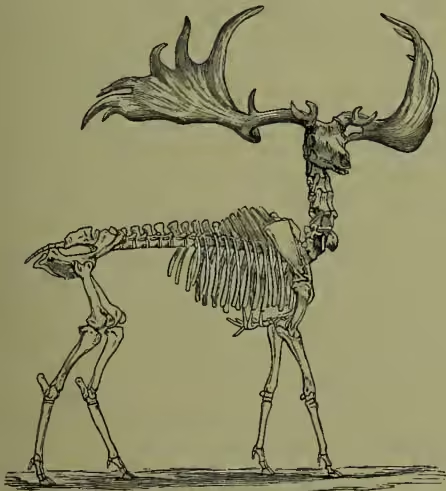
Height to summit of antlers, 10 feet 4 inches.
Northern Russia, in Norway and Sweden, they still occur, but not in the abundance which is still exhibited in North America. Domestication has been tried with success, and the animal trained to the sledge. The flesh is esteemed a good kind of venison; the fat is remarkably soft; the nose and tongue are reckoned delicacies. The skin is used for a variety of purposes. As the elk feeds largely on leaves, buds, and bark, it does considerable damage to forest trees.