Ely, a city of Cambridgeshire, crowns a low eminence on the left bank of the Ouse, amid the fen-land, 16 miles NNE. of Cambridge, and 30 SE. of Peterborough. Here, in 673, St Etheldreda (q.v.) founded a mixed monastery, which, burned in 870 by the Danes, was refounded in 970 as a Bene- dictine abbey by Ethelwold, Bishop of Winchester. That abbey a century later became Hereward's 'camp of refuge,' until, in 1071, after a long and obstinate defence, Abbot Thurstan had to surrender to the Conqueror. In 1083 the first Norman abbot laid the foundation of the present church, which was made a cathedral in 1109, and which, as we see it to-day, is one of the most glorious shines in Christendom. A cruciform structure, 537 feet long by 179 feet across the great transepts, it offers examples of all styles of Gothic, from early Norman to late Perpendicular, and is a growth of more than four centuries. There is the Early English 'galilee' or western porch (circa 1200); the western tower, 225 feet high, Transition Norman and Decorated (1174-1382); the south-west transept, now the baptistery; the late Norman nave (1150-89), 208 by 78 feet, with modern painted ceiling; the great transepts (1083-1170), Norman, with Perpendicular insertions; the richly sculptured choir (1234-1533), Early English, Decorated, and Perpendicular; the Decorated north-eastern Lady Chapel (1321-49); and at the crossing, the exquisite Decorated 'octagon' and lantern (1322-42), built by Alan de Walsingham on the fall of the great central tower. This, 'the only Gothic dome in existence,' rises to a height of 170 feet. Since 1845 the whole pile has been ably restored, mainly under the supervision of the late Sir G. G. Scott.
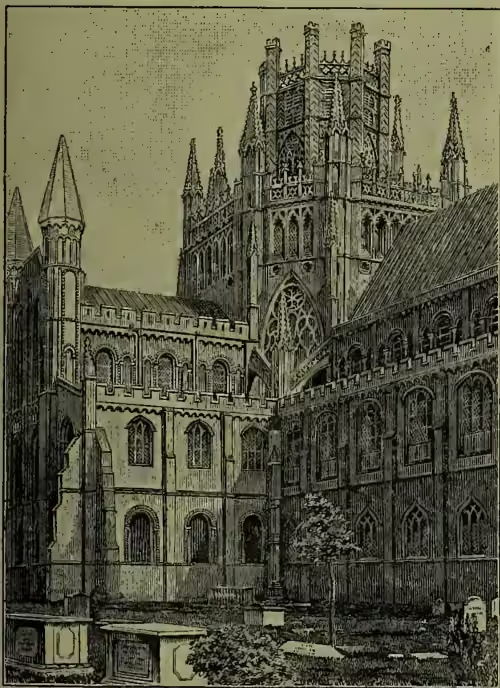
It wants the north-west transept, the cloisters, and the chapter-house; but the 13th century Guesten Hall is now the deanery, and the 'Ely Porta,' or great gateway (1380), houses a grammar-school founded by Henry VIII. in 1541. The Bishop's Palace is a fine brick Tudor building. Among the bishops, nearly sixty in number, have been Langham, Bourchier, and Morton (archbishops of Canterbury), Arundel (archbishop of York), and Andrewes, Wren, Patrick, and Harold Browne. Of great laymen also, Ely has its memories, from Canute to Cromwell, who lived here 1636-40. There is a weekly market; and oil, earthenware, and clay-pipes are manufactured. Pop. (1851) 6176; (1891)
8017.—The 'Isle' of Ely, for which see the articles CAMBRIDGESHIRE and BEDFORD LEVEL, contains also March and Wisbeach, and is 355 sq. m. in area, with 63,328 inhabitants. Till 1837 it was a county palatine.
See Bentham's History of Ely Cathedral (2d ed. 1812); J. H. Clement's History of Ely (1868); Canon D. J. Stewart's Architectural History of Ely Cathedral (1868); Dean Merivale's Bissexcentenary Festival of St Etheldreda (1874); and Murray's Eastern Cathedrals (new ed. 1881).