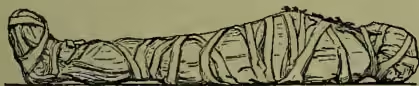
Embalming (so named from the balm or balsam often employed), the art of preserving the body after death, invented by the Egyptians, whose prepared bodies are known by the name of mummies, and are called in the hieroglyphs sahu, and by St Augustine gabbaree. This art seems to have derived its origin from the idea that the preservation of the body was necessary for the return of the soul to the human form after it had completed its cycle of existence of three or ten thousand years. Sanitary reasons may also have influenced the ancient Egyptians; and the legend of Osiris, whose body, destroyed by Typhon, was found by Isis, and embalmed by his son Anubis, gave a religious sanction to the rite. The art appears as old as 4000 B.C. at least, for the bodies of Cheops, Mycerinus, and others of the age of the 4th dynasty, were embalmed. One of the earliest embalments recorded in literature is that of the patriarch Jacob; and the body of Joseph was thus prepared, and transported out of Egypt. The process has been described by Herodotus and Diodorus; but their accounts are only partially confirmed by an examination of the mummies. A scribe marked with a reed-pen a line on the left side beneath the ribs, down which line the paraschistes, or ripper of the district (an officer of low class), made a deep incision with a rude knife of stone; he was then pelted with stones, and pursued with curses. The tarichcutes, or salter, next proceeded to remove the entrails and lungs, with the exception of the heart and kidneys, while a colleague extracted the brain through the nose. The body was ready for the salts and spices necessary for its preservation, the quality of which depended upon the sum to be expended. When Herodotus visited Egypt, three methods prevailed: the first, accessible only to the wealthy, consisted in passing peculiar drugs through the nostrils into the cavities of the skull, rinsing the belly in palm-wine, and filling it with myrrh, cassia, and other substances, and stitching up the incision in the left flank. The mummy was then pickled in natron for seventy days, and then washed and elaborately bandaged up in rolls of linen, cemented by gums, and set upright in a wooden coffin against the walls of the house or tomb. This process cost a silver talent, perhaps equal to £725 of our money. A cheaper process, by means of an injection of cedar-oil, cost a mina, relatively worth about £243. The poorer classes washed the corpse in myrrh, and salted it for seventy days. When thus prepared, and covered with a pictorial representation of the deceased, attired as a labourer in the world to come, and duly labelled as a 'justified Osiris,' the mummy was placed in a costly coffin (see SARCOPHAGUS) ready for sepulture, but was frequently kept some time before being buried—often at home—and even produced at festive entertainments, to recall to the guests the transient lot of humanity. All classes were embalmed, even malefactors; but various methods were employed besides those mentioned by Herodotus. Some mummies are found merely dried in the sand; others salted by natron, or soaked in bitumen (Jew's pitch) with or without the flank incision, having the brains removed through the eyes or base of the cranium, with the viscera returned into the body, placed upon it, or deposited in jars in shapes of the genii of the dead, the skin partially gilded, the flank incision covered with a tin plate, the fingers cased in silver, the eyes removed and replaced. So effectual were some of these processes that after 2000 or 3000 years the soles of the feet are still elastic and soft to the touch. The sacred animals were also mummied, but by simpler processes than men. It has been computed that since the practice began in 4000 B.C., down to 700 A.D., when it practically ceased, probably as many as 730,000,000 bodies were embalmed in Egypt; of which many millions are yet concealed. Important finds are made from time to time, as in 1881, when upwards of thirty mummies of potentates, including that of Rameses II., were discovered together at Deir-el-Bahari. Mummies, it may be observed in passing, were used in the 15th and 16th centuries of the Christian era for drugs and other medical purposes, and as nostrums against diseases, and a peculiar brown colour, used as the background of pictures, was obtained from the bitumen.
Other less successful means of embalming were used by nations of antiquity. The Persians employed wax; the Assyrians, honey; the Jews, aloes and spices; Alexander the Great was preserved in wax and honey, and some Roman bodies have been found thus embalmed. The Guanches, or ancient inhabitants of the Canary Isles, used an elaborate process like the Egyptian; and desiccated bodies, preserved by atmospheric or other circumstances for centuries, have been found in France, Sicily, England, and America, especially in Central America and Peru. In Burma the bodies of priests are stuffed with spices and honey and coated with wax and gold-leaf. The art of embalming was probably never wholly lost in Europe; De Bils, Swammerdam, Clauderus, Gooch, Bell, and others attained great success in the art; and a mode of embalming by incisions all over the body is detailed by Penicher. Ruysch, and after him William Hunter, injected essential oils through the principal arteries into the body. Boudet embalmed the bodies with camphor, balsam of Peru, Jew's pitch, tan, and salt. The discovery of Chaussier of the preservative power of corrosive sublimate, by which animal matter becomes rigid, hard, and grayish, introduced a new means of embalming by Beclard and Larrey; but owing to the desiccation, the features do not retain their shape. The discovery of the preservative power of a mixture of equal parts of acetate and chloride of alumina, or of sulphate of alumina, by Gannal in 1834, and of that of arsenic by Tranchini, and of pyroxic spirit by Babington and Rees in 1839, and of the antiseptic nature of chloride of zinc, have led to the application of these salts to the embalming or preparation of bodies required to be preserved for a limited time. The latest method, by injection of a fluid into the arteries, is described by Dr B. W. Richardson, who has himself embalmed fifty bodies. The process is very common in the United States.
See Pettigrew, History of Mummies (1834); Gannal, Traité d'Embaumement (1838); Magnus, Das Einbalsamiren (1839); Richardson, The Aselepiad (1888); Wallis Budge, The Mummy (1893); and HEART-BURIAL.