Embryology is that department of biology which reads the development of the individual organism. It is a succession of studies in anatomy and physiology which, when read into unity, give the history of the organism from its earliest individual appearance on to that vague point when it may be said to exhibit all the main features of adult life. The investigation necessarily takes two forms: a description of the structure of successive stages (morphological), and an analysis of the vital processes associated with each step (physiological). Nor is any embryological investigation complete which does not link the everyday development of individuals with the historical evolution of the race.
History.—Although the development of the chick, so much studied in embryological laboratories today, was watched 2000 years ago in Greece, it was only in the scientific renaissance of the 17th century that observation began to grow strong enough to wrestle with conjecture. Harvey, who towered as a strong genius above his contemporaries, and saw much farther, sought in 1651 to establish two main propositions: (1) that every animal was produced from an ovum—ovum esse primordium commune omnibus animalibus; and (2) that the organs arose by new formation (epigenesis), not from the mere expansion of some invisible preformation. These valuable generalisations were not, however, accepted, and even observations like those of Malpighi seemed for the time to tell against Harvey's prevision. The time was past for absolutely fanciful theories, and yet the domi- nant doctrine which persisted even into the 19th century was mystical enough. The germ, whether egg or seed, was believed to be a miniature model of the adult. 'Preformed' in all transparency, the organism lay in nuce in the germ, only requiring to be 'unfolded.' Just like a bud which hides within its hull the floral organs of the future, so was every germ. 'There is no becoming,' Haller said; 'no part of the body is made from another; all are created at once.' But the germ was more than a marvellous bud-like miniature of the adult; it included all future generations. That germ lay within germ, in ever smaller miniature, after the fashion of an infinite juggler's box, was the logical corollary of the theory of preformation and unfolding. One of the controversies of the time was whether ovum or sperm was the more important. The ovists asserted the claims of the ovum, which only required to be awakened by the spermatozoon to begin its unfolding. The animalculists, on the other hand, maintained that the male element contained the preformed germ, and that the ovum was merely for its preliminary nutriment.
All this was virtually shattered by Wolff (1759), who reasserted Harvey's epigenesis, and showed that the germ consisted of almost structureless material, and that the process of development was a gradual organisation. Yet Wolff's work had not the effect of entirely demolishing preformationist conceptions. They lingered on, and had this much truth in them that the germs are indeed potential, though not miniature, organisms. To some extent Wolff reacted too far against the mystics in his emphasis on the simplicity of the germ, so that a correction was necessary when the cellular character of the reproductive elements was realised about a hundred years later. The observation of structural progress was slow in gaining self-confidence, for it was not till 1817 that Pander took up Wolff's work virtually where he left it. He was immediately reinforced and soon left behind by Von Baer, whose results laid a firm foundation for modern embryology. Since the establishment of the Cell-theory (see CELL) in 1838-39, and the associated researches which showed that the organism starts from a fusion of two sex-cells, and that development consists in the division of the fertilised ovum and differentiation of the results, progress has been both sure and rapid. The more modern demonstration of the fact of evolution has afforded a fresh impulse by its interpretation of the present as the literal child of the past.
The egg-cell or ovum is in all organisms the starting-point of the embryo, but development can rarely begin till this female element is supplemented by the male cell or spermatozoon. These sex-cells are liberated units of the parent-organism, but in most cases they stand in marked contrast to the great congeries of cells which form the 'body.' All the component units of the organism are indeed lineal descendants of a fertilised ovum, but the 'body'-cells become greatly changed into muscle, nerve, skeleton, and the like, while the reproductive cells retain with more or less intactness the characters of the original parent germ. It is this fact which makes the reproduction of like by like possible.
The unicellular animals or Protozoa, having obviously no 'body,' are directly comparable to the sex-cells of higher animals. The 'body' is the addition which makes the difference. In a few Protozoa, however, the results of the division of a unit remain associated together, and a loose colony of cells arises. Such a Protozoan behaves like an ovum or like a primitive male-cell in any of the higher animals. The loose colony may be very unstable, and may soon resolve itself into its component units, exactly as the primitive male-cell, which has divided into a clump of spermatozoa, breaks up and sets these active units free. But the colony may be more stable and retain its continuity (like a segmented ovum), thus bridging the gulf between unicellular and multicellular organisms. In such cases certain cells are set apart as reproductive, and eventually set adrift to start a fresh colony. This is the beginning of the differentiation of special reproductive cells. At first these were probably all alike and able to develop of themselves, but in a manner which does not concern us here (see SEX) they became differentiated as male and female elements, mutually dependent and complementary.
The ovum has all the essential characters of an ordinary animal cell. The cell-substance consists of Protoplasm (q.v.) and of material ascending to or descending from that climax. As in other cases, the cell-substance may be traversed by a network, —one of the intricacies which modern microscopic technique has revealed. Like other cells, the ovum includes a central differentiation or nucleus, technically called the germinal vesicle. This exhibits the essential nuclear elements in the form of rods, bands, or network, and other minute features described in the article CELL. The nucleus plays a most important part in the history of the ovum, and is believed to be the bearer of the hereditary characteristics.
As to the precise origin of the ova, it is enough here to state that in sponges they are simply well-fed cells in the general substance (middle stratum) of the sponge; that in Cœlenterates they may originate from outer or from inner layer; while in other animals they are almost always associated with the middle layer of the body, and as we ascend are more and more restricted to a distinct region or to a definite organ—the ovary.
The very young ovum is often at least like an Amœba (q.v.), and in Hydra (q.v.) this character persists. The first chapter in its history is one of nutrition and growth. This often occurs at the expense of neighbour cells, and the ovum may be the successful survivor of a clump. In other cases the nutriment, for immediate or future use, may be derived from the vascular fluid of the animal, or from special glands, which are sometimes simply degenerate portions of an originally larger ovary. The capital of nutriment thus derived is distinguished as the yolk. It varies greatly in quantity and disposition, and has great influence in determining the precise form which the future division of the ovum will take. It may be small in quantity and uniformly diffused through the cell, as in mammalian ova; there may be a larger quantity, which sinks to the lower part, as in frog spawn; there may be a very large amount, which quite dwarfs the genuine living matter, as in birds' eggs; or there may be a central accumulation, as in crustaceans and insects. The egg is very generally surrounded with some membrane, sheath, or shell, made by itself, or contributed by surrounding cells, or the product of special glands. In such envelopes there is often a special aperture (micropyle) through which alone the spermatozoon can enter. Hard shells like those of birds' eggs must obviously be formed after fertilisation has taken place.
The Male-cell or Spermatozoon.—In the unicellular organisms, among which we find the key to all beginnings, two cells, unable apparently to live independently, unite, and thus make a fresh start. In such cases the two units are usually similar in appearance, though doubtless different in chemical state. Sometimes, however, a small active cell unites with a larger and more passive neighbour, and here we find the first hint of the profound difference between the sexes—a difference of which the contrast between spermatozoon and ovum is literally a concentrated expression.
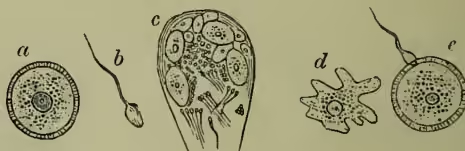
The spermatozoon is a true cell, though the nuclear portion often predominates over the cell-substance. It is one of the smallest animal cells, as the ovum is one of the largest; it is highly active, while the ovum is peculiarly passive; it rarely bears any nutritive material, while the ovum is very generally weighted with yolk. In its minute size, active locomotor energy, and persistent vitality, the sperm-cell resembles a flagellate Monad among Protozoa, while the ovum is strictly comparable to an Amœba or to one of the yet more passive or encysted forms. In most animals the spermatozoon exhibits three distinct parts: (a) the 'head,' or essential portion, consisting almost wholly of nucleus; (b) the mobile 'tail' of contractile protoplasm which drives the 'head' along; and (c) a small middle portion connecting the head and tail.
In its origin the male-cell resembles the ovum, and the two cells are of course the physiological complements of one another. In history, however, the ovum is strictly comparable not to the sperm, but to the cell which divided to give rise to the sperms. The primitive-male-cell, or mother-sperm-cell, is the homologue of the ovum. Just as the latter divides in segmentation, so the mother-sperm-cell divides, and the divisions exhibited in what is technically called spermatogenesis are closely parallel to the various modes of segmentation exhibited by ova. The mother-sperm-cell segments, but the results have no coherence; they go asunder as spermatozoa. Thus, though all cells may be said to rank as equals, the sperm-cell has a longer history behind it than the ovum. The differences both in form and history express the great differences in chemical constitution which are summed up in the words male and female.
Maturation of the Ovum.—The egg-cell having attained its definite size or limit of growth, usually exhibits a somewhat enigmatical phenomenon known as the extrusion of polar globules. In the great majority of cases it buds off two tiny cells, by a true process of cell-division, in which the nucleus plays its usual orderly part. This extrusion is probably universal, but has not yet been observed in bird or reptile eggs. The polar cells come to nothing, though they may linger for a while in the precincts of the ovum. Their expulsion usually takes place before fertilisation has even begun, but sometimes is subsequent to the entrance of the spermatozoon into the ovum. The result of the twofold budding is that the mass of the nuclear elements is reduced by three-fourths, though their number appears to remain constant. In many parthenogenetic ova, which develop without fertilisation, Weismann has recently shown that only one polar globule is formed, and this he believes to be constant, and essentially associated with parthenogenesis.
The import of the process is much disputed.
Cells do indeed usually divide at the limit of growth (see CELL), but the division here is peculiarly unequal so far as cell-substance is concerned. The marked inequality suggests the theory proposed by Minot, Balfour, and Van Beneden, that the polar globules are male extrusions from the predominantly female egg-cell. The retention of one in parthenogenetic ova is supposed to be what makes independent development possible. The retained polar globe replaces the otherwise necessary sperm. Bütschli looks at the matter rather historically than physiologically, and interprets this premature division of the ovum as the survival of an ancient habit which the mother-sperm-cell still retains. The polar cells are thus rudimentary or abortive female germs. This, however, hardly explains why they should so constantly occur. Weismann supposes the two polar globules to be very different from one another: the first extrudes a nuclear substance which was only useful while the egg was a-making; the second gets rid of half of the essential germ-plasma, the bearer of hereditary characteristics, all in order to make room
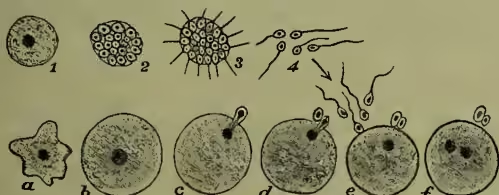
1-4, Division of a mother-sperm-cell or primitive-male-cell into a ball of spermatozoa which breaks up; a-f, maturation and fertilisation of ovum; a, amoeboid young ovum; b, later stage; c, budding off of a first polar cell; d, budding off of a second; e, spermatozoa round ovum, one entering; f, male and female nuclei about to fuse on completion of fertilisation. for the addition of a corresponding quantity by the spermatozoon. Parthenogenetic ova only give off the first, and retain all their germ-plasma. Thus they are as able to start in development as fertilised ova which exhibit the circuitous process of first giving half of their germ-plasma away and then getting a similar quantity back from another source. There is no proof that the two extrusions are different in character, and Weismann's theory seems to invest ova with a prevision of the benefits of fertilisation. The simplest view is that the ovum divides at the limit of growth, that the inequality of division expresses an opposition between what is extruded and what is retained, and that this means the getting rid of some waste or male elements. In the differentiation of the male elements both among plants and animals, a parallel but reverse antithesis is often demonstrable.
Fertilisation.—The 'ovists' thought that the ovum was all-important, and only required the sperm's wakening touch to unfold its preformed model. The 'animalculists' were equally certain that the spermatozoon was all-important, and only required to be fed by the ovum. Even after the mutual dependence of the sex-elements had been recognised, the opinion prevailed that contact of the two was unessential, and that by an aura seminalis fertilisation was possible. In 1677 Hamm and Leeuwenhoek first distinctly saw spermatozoa; in 1780 Spallanzani showed by artificial fertilisation that the eggs must come into contact with the seminal fluid; in 1843 Martin Barry observed the spermatozoon in union with the ovum of the rabbit; in 1846 Kölliker proved the cellular origin and nucleated character of the male elements; and in
1872-75 Bütschli and Auerbach observed two nuclei in fertilised eggs. The dates of these representative discoveries show how gradually the result has been reached that the essence of fertilisation is the intimate union of a male and female cell.
It is needless to cite the numerous investigators who have made the following statements possible: (1) Only one male element really unites with the egg-cell. By a sudden change after the entrance of one sperm the ovum usually ceases to be receptive. The entrance of more than one occasionally occurs, but the result is pathological. (2) The union is very intimate; the nuclei are at least as important as the protoplasm, and according to most authorities much more so. (3) The two nuclei are attracted or drawn to one another, and fuse intimately to form a single nucleus of double origin. (4) Intimate as the union is, its orderliness is not less conspicuous; half of the result is still traceable to the male and half to the female.
While these are the demonstrable structural facts, what the union means is another matter. Some compare the action of the sperm to a ferment, others to stimulating waste products, while Weismann virtually denies sex differences altogether, and maintains that the union is a mere quantitative addition of the amount of germ-plasma lost in extruding the second polar globe. That the spermatozoon furnishes half of the architectural nuclear substance and thereby half of the hereditary characteristics is certain, that it also affords a chemical stimulus to division it is difficult to doubt. In single-celled animals fertilisation is essential to the continued vitality of the species; in all cases the intimate mingling of sex-elements, different in constitution and past experience, secures both an average constancy and minor variations.
Segmentation.—Soon after the essential act of fertilisation has been accomplished in the intimate union of the nuclei, the egg begins to divide. What physical and chemical attractions and repulsions operate in this process we do not know. It is certain that the nuclear elements, which play a very important part throughout, have what we cannot but call a strong individuality of behaviour. It is certain too that the cell-substance plays an important part, and that it is not merely passive material with which the nucleus operates. Recent observers, led by Van Beneden, have elucidated something of the marvellous interaction between nuclei and cell-substance. It would seem that there is an intracellular muscular system, that from certain centres in the protoplasm strands radiate which moor themselves to the nuclear elements and move them about. It has been further established that the double nucleus of the fertilised ovum is accurately composed half of female and half of male elements. When the egg divides into two, the nucleus of each daughter-cell is again half male and half female, and it is probable that this exact dualism persists yet further.
The different ways in which ova divide depend mainly upon the quantity and disposition of the passive yolk-material. (1) When there is very little nutritive capital, and that uniformly diffused, the whole ovum divides, vertically and horizontally, till a sphere of approximately equal cells is formed. This total segmentation occurs for instance in the ova of sponge, starfish, lancelet, and mammal. (2) In the ova of the frog, where the actual process of division may be most conveniently watched, there is more yolk, which has chiefly sunk to the lower hemisphere of the egg. Division is still total, but after a few segmentations it will be seen that the upper hemisphere cells are dividing more rapidly and are becoming markedly smaller than those in the lower part. The segmentation is total but unequal. (3) In the ova of birds and reptiles and many fishes there is a large quantity of yolk, and the formative substance lies like a drop on the upper surface of the nutrient mass. Division is
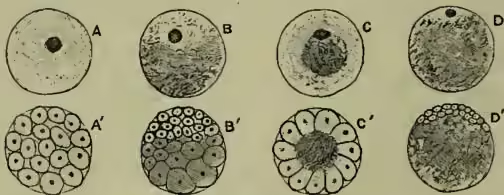
Relation of Yolk to division of Ovum (diagrammatic):
| A, little and diffuse yolk. | A', total equal division. |
| B, more yolk at lower pole. | B', total unequal division. |
| C, central yolk. | C', peripheral division. |
| D, much yolk. | D', partial division. |
restricted to the formative protoplasm, and thus the segmentation is conspicuously partial. (4) In the ova of crustaceans, insects, and their allies, the yolk usually accumulates in the centre of the ovum as a more passive, nutritive core, surrounded by the active, formative protoplasm. The latter divides, and forms a sphere or ellipsoid of cells around the less markedly divided yolk. In Peripatus—the survivor of ancestral insects—the whole ovum segments, but the cells are not for a while defined off from one another, so that the result looks like a giant Protozoan with numerous nuclei. Hints of this are seen in other cases.
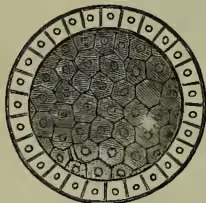
Morula and Gastrula.—The result of segmentation is a ball of cells, differing according to the above described modes of division. When a wide cavity has been left, between the cells as they multiplied, a hollow sphere is formed, technically called a blastosphere; if no such conspicuous 'segmentation cavity' has been left the result is an almost solid mulberry-like ball of cells—a morula. When the division is partial, mainly confined to an area of formative protoplasm lying upon a nutritive mass, the result is a disc of cells which by and by spreads round the yolk. Such a segmented area is generally known as the blastoderm. (See D', fig. 3.)
The next decisive chapter is one of infolding, or the formation of a gastrula. In the simplest cases one hemisphere of a hollow ball of cells is dimpled
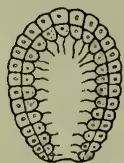
Gastrula:
Showing ectoderm, ciliated endoderm, blastopore, and central cavity. or invaginated into the other. More accurately, the one hemisphere sinks into and becomes surrounded by the other. The sphere becomes a two-layered sack or gastrula, with an opening technically called the blastopore. In many other cases—e.g. fishes, reptiles, and birds—owing to the yolk, complete invagination is not possible. An infolding still occurs, but it is no longer conspicuous, and the gastrula-stage is thus disguised. It must also be noted that the two-layered condition may arise by arrangement of the cells, without there being any process that can be called invagination. Thus, in the oval ciliated embryo or planula of most Hydrozoa, the two layers have been frequently observed to arise by a process of internal differentiation, known as delamination.
The Germinal Layers.—Even in a simple colony of cells like a Volvox all the units do not remain alike. Inside cells are in different conditions from outside cells, and division of labour with consequent difference of structure is bound to occur. So again, in the ball of cells into which the ovum divides, the one hemisphere with heavier material is usually different from the upper hemisphere, which is specifically lighter and less encumbered with reserve material. Even in the morula or blastosphere differentiation has begun.
But we have just seen that by the folding of one hemisphere into the other, or in other ways, a gastrula often more or less modified arises. The embryo thereby attains definitely differentiated layers—outer and inner. The preformationists spoke of development as an unfolding; we now insist on an infolding. The layered character of the embryo was early recognised by Wolff, and yet more clearly by Pander and Von Baer, but its fundamental import can hardly be said to have been realised till Huxley in 1849 compared the outer and inner cell-layers of Cœlenterates (hydroids, jellyfish, &c.) to the outer and inner layers which embryologists had begun to demonstrate in development. Soon afterwards Allman gave to the outer and inner layers of Cœlenterates the names ectoderm and endoderm, which are now universally used for the outer and inner layers of every embryo. The results reached by Huxley and Haeckel, Kovalevsky and Ray Lankester, and many others, have made it certain that the formation of these two germinal layers is constant in animals, that they are exactly comparable throughout the series, and that with few exceptions they give rise to precisely the same adult structures.
In sponges and Cœlenterates only two genuine layers of cells are developed. A middle stratum, seen in faint suggestion in the common Hydra, may indeed appear between outer and inner layers, and may be of the greatest importance in the structure of the animal, but embryologists are not inclined to allow this middle stratum—the so-called mesogloea—to rank as a distinct layer beside the other two.
In higher animals, however, there is a definite middle layer or mesoderm between the other two. Its history involves much greater difficulty than that of the ectoderm and endoderm; it seems as if it might arise in some half-dozen different ways. One common mode of origin has been emphasised by the brothers Hertwig in what they call the 'Cœlome-theory.' The inner layer arises by an infolding of the outer, and a primitive gut-cavity (archenteron) thus results. Now begins an out-folding. From the gut-cavity two sacks (cœlome-pockets) grow out, one on either side, insinuating themselves between the first two layers. The cavities of the sacks form the future body-cavity of the animal; the outer and inner walls form the corresponding two divisions of the mesoderm. However this middle layer arises, it finally exhibits an inner and an outer division, so that the Hertwigs speak of four germinal layers. The outer (parietal or somatic) portion of the mesoderm clings to the external body-wall, forming muscles and the like; the inner (visceral or splanchnic) portion cleaves to the internal organs.
Origin of Organs.—With few exceptions, the same organs and structures arise from the same layers—e.g. the nervous system from the ectoderm, the lining of the mid-gut from the endoderm. (a) The ectoderm or epiblast gives origin to outer skin or epidermis, external skeleton, superficial glands, sense-organs, nervous system, the infoldings at both ends of the gut, and probably to the primitive excretory (segmental) duct. (b) The endoderm or hypoblast forms the lining of the mid-gut, and necessarily, too, of outgrowths from it, such as the lungs and various glands. In verte- brates it also gives rise to that important skeletal axis—the notochord—which always precedes the 'backbone.' (c) The mesoderm or mesoblast gives rise to all the rest. That is to say, the under-skin, the muscles, the connective tissue, the internal skeleton, the lining of the body-cavity, the heart and the blood, and the like are all mesodermic. The reproductive organs, though to some extent structures by themselves, also arise, in the great majority of cases, in connection with the mesoderm. It must be noted, further, that while the main part of a structure is referable to one of the three layers, the entire structure is very often composite. Thus, the eye of vertebrates mainly arises as an outgrowth from the brain, but some of the less essential parts are furnished by the mesoderm. The outgrowths from the mid gut are in origin endodermic, but they too are always aided by the middle layer.
Physiological Embryology.—The immense progress of embryology within recent years has been almost wholly morphological. Of the physiological conditions of development we know relatively little. The later stages of embryonic life in higher animals have been studied by Preyer and others with much success, but this is but the threshold of investigation. A few luminous results as to the architectural conditions are due to the courage of His and Rauber, who have followed the earlier suggestions of Pander and Lotze. The task, which is involved in stupendous difficulties, has been continued in the experimental investigations of O. Hertwig, Fol, Pflüger, Born, Roux, Schultze, Gerlach, and others. Observations as to the actual dynamics of cell-division, such, for instance, as those of Van Beneden and Boveri, are beginning to appear; while the title of a recent work by Berthold—Protoplasmic Mechanics—shows how the biologist persistently seeks the aid of the student of physics in order to explain the architecture of the living organism. 'To think that heredity will build organic beings without mechanical means' is, according to His, 'a piece of unscientific mysticism;' while Pflüger insists on the conception of development as 'an organic crystallisation.' The laws of growth, which express how each fertilised egg-cell must divide, and how the resulting units must arrange themselves first in layers and thereafter into organs, must be expressed in terms of physical and chemical conditions. But this is the task of the future.
Generalisations.—(1) The Ovum-theory.—In all cases of ordinary sexual reproduction among plants or animals the offspring develops from a fertilised egg-cell. This is the ovum-theory prophesied by Harvey in 1651, again almost realised by Wolff in 1759, but only demonstrated about a hundred years later when the organism was at length analysed into its component cells (see CELL). The fact that every plant or animal begins at the beginning again, at the level of the Protozoa or single-celled organisms, Agassiz does not hesitate to call one of the greatest discoveries in the natural sciences in modern times.
(2) The Gastræa-theory.—The simplest animals are single cells; these occasionally form loose colonies or balls of cells; next come sack-like two-layered organisms, such as the simplest sponges. These are the first three grades among living animals, but they also correspond to the first three chapters in the life-history of each organism. The single cell (the ovum), the ball of cells (the morula or blastosphere), the sack of cells in two layers (the gastrula), we have seen to be the first three stages in development. As this gastrula-stage always occurs, though sometimes disguised by the yolk, in the life-history of animals, Hæckel justly emphasised it as the individual's recapitulation of an ancestral state. The simplest, stable, many-celled animal he believed to be like a gastrula (see fig. 5), and he called this hypothetical ancestor of all higher animals a gastræa. A few living animals are still almost at this level; all animals pass through it in
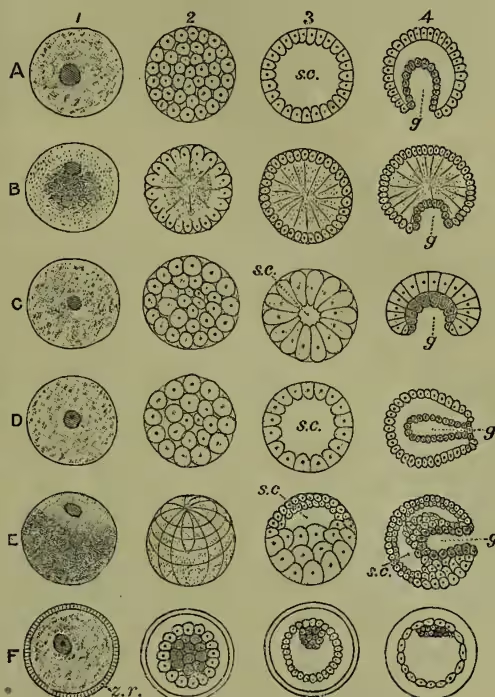
The First Stages in Development (not drawn to scale): 1, fertilised ovum; 2, ball of cells; 3, the same still more divided, or in section; 4, the gastrula (except in F); A, sponge, coral, earthworm, or starfish; B, crayfish, or other arthropod; C, river snail, or other mollusc; D, lancelet, tunicate, &c.; E, frog, or other amphibian; F, rabbit, or other mammal; s.c., segmentation cavity; g, gastrula invagination; z.r., zona radiata, or porous envelope. Darkly shaded cells are endoderm, lighter are ectoderm, dots are yolk granules. their gastrula-stage. The gastrula is a recapitulation of the ancestral gastræa. Rival conceptions of what the first stable, many-celled animal was like have been since proposed, but the gastræa theory still holds the field.
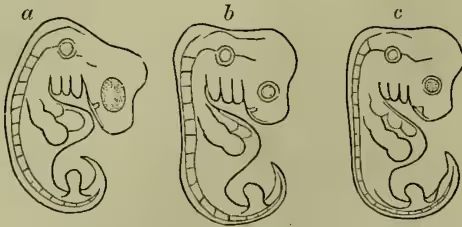
(3) The Fact of Recapitulation.—The gastræa-theory is only a special case of a more general proposition—that the individual recapitulates the history of its kind. That the past lives in the present, or that we individually retread, for instance in our intellectual development, the paths made by our ancestors, is a familiar idea which it is one of the charms of embryology to realise in the life-history of each organism. At an early date Von Baer expressed this in his law, that structural progress or differentiation in development was from a general to a special type. 'In its earliest stage,' he said, 'every organism has the greatest number of characters in common with all other organisms in their earliest stages; at each successive stage the class of embryos which it resembles is narrowed.' In the life history of a mammal it is possible to trace how the germ at first lingers as it were among the Protozoa; how it divides and passes quickly through the transitional 'ball of cells' stage; how the embryo undergoes its first great differentiation, like all other multicellular animals, in becoming a two-layered gastrula, taking its place beside the ancestral Metazoa; how it by-and-by acquires some of the characters of a young worm, and then of a very simple backboned animal, like a primitive fish; how with increasing complexity it ranks with reptilian embryos; and lastly, how the fœtus acquires mammalian features, vague and general at the outset, but gradually becoming like those of nearly related forms. Von Baer himself confessed, as every embryologist would do, that with three embryos of higher Vertebrates at the same stage before him, he could not, without close examination, tell one from the other. The accompanying figure of the embryos of a bird, a mammal, and the human species clearly illustrates this close resemblance in early life.
Spencer expressed the progress from simple to complex, from general to special, as a differentiation from homogeneous to heterogeneous, in which the individual history runs parallel to that of the race. The most luminous reading of the fundamental fact is that of Haeckel. The individual development is a recapitulation of the historic evolution of the race. A curve symbolising the turns and twists in the life-history of one of the higher Vertebrates, for instance, is seen to be a reflection of the great bends and branches of the genealogical tree which expresses the historic lineage. The development of the individual microcosm is a summary—often a shorthand summary—of the evolution of the macrocosm of the race. Most pithily, though most technically, he sums up his 'fundamental biogenetic law' in the words 'Ontogeny recapitulates phyto-geny.' The fact is very vividly illustrated in many of the more patent life-histories, such as those of crustaceans, insects, and amphibians, where the hatched young follow the rails laid down by their respective ancestors (see AMPHIBIA, CATERPILLAR, CRUSTACEA). Parker happily compares watching development—in which he is one of the modern masters—to reading a palimpsest; below the superficial script there are older and ruder characters, and below these more primitive still. Two cautions must be emphasised. The development is often shortened in its path; circuitous twists, in what we believe to have been the historic course, are skipped by the individual; the momentous steps, however, are always paralleled in the two histories. The individual development may be said to follow the main line of progress, but does not go off into side-lines. Thus the resemblance is between embryos. The embryo bird is hardly like a reptile, but it is always in its development like an embryo reptile. Nor must it be imagined that this fact of recapitulation exactly explains itself. That the present is child of the past does indeed shed great light on the individual's recapitulation of ancestral stages, but the metaphors are apt to suggest that the developing organism has somehow a feeling for history, or that the hand of the past is literally upon it as it grows. It is necessary to get beyond mere metaphors of unconscious memory and the like, and to realise that the same internal conditions which in the long past led to certain momentous changes are still really present doing the same for the individual. The fundamental problem is to elucidate the chemical and physical conditions which represent the living hand of the past upon the development of the present, or to understand how the living matter of the embryo is at each stage both the material and the architect of its upbuilding.
(4) Continuity of Germinal Protoplasm.—In flowering plants there is a conspicuous contrast between the reproductive system and the general 'body.' In all organisms this antithesis is fundamental, and the recognition of the fact has shed much light upon the problems of development and heredity. In the simplest animals a portion of the cell is separated off to start a new individual; and as this is virtually continuous with the parent the reproduction of like by like is natural and necessary. In a few animals (some worm-types, crustaceans, insects, &c.), when the ovum has multiplied to a limited extent, by the usual process of division, certain of its descendants, as yet very like the original ovum, are set apart to form the reproductive cells of the offspring, and take no share in building up the 'body.' The germ-cells of the offspring, thus early insulated, are in a real sense continuous with the parental ovum; they retain some of the living capital intact, continue the protoplasmic tradition unaltered, and when themselves liberated will naturally do what the original germ-cells did. Thus the reproduction of like by like becomes more intelligible, and we reach the conception of a continuous necklace-like chain of immortal germ-cells from which the mortal bodies of successive generations are budded off. This conception has been more or less clearly suggested by numerous naturalists—Owen, Haeckel, Jäger, Brooks, Galton, Nussbaum, and others, but has been elaborated by Weismann in his theory of the continuity of the 'germ-plasma.' A continuous chain of germ-cells is only demonstrable in a few cases; often they become distinct only at a relatively late stage in the development of the offspring. Therefore Weismann insists not on a continuity of germ-cells from those of the parent to those of the offspring, but only on a continuity of 'germ-plasma.' 'In each development a portion of the specific "germ-plasma" which the parental ovum contains is not used up in the formation of the offspring, but is reserved unchanged for the formation of the germ-cells of the following generation.' The germ-plasma which keeps up the continuity has its seat in the nucleus, is a substance of definite chemical and special molecular constitution, has an extreme power of persistence and enormous powers of growth. The general idea is simple enough—an offspring starts with a capital of living matter which is virtually the same as that from which its parents started. Therefore the results are in a general way the same, and the constancy of the species is sustained. How this is modified by variations is not here relevant.
See BIOLOGY, CELL, EGG, FœTUS, HEREDITY, PLACENTA, REPRODUCTION, SEX; also F. M. Balfour, Comparative Embryology (2 vols. Lond. 1880); M. Foster and F. M. Balfour, The Elements of Embryology (2d ed. by Sedgwick and Heape, 1883); A. C. Haddon, Introduction to the Study of Embryology (Lond. 1887); E. Haeckel, The History of Creation (trans. Lond. 1876), and Anthropogeny (trans. Lond. 1878); W. His, Unsere Körperform (1874); O. Hertwig, Entwicklungsgeschichte (1888); Preyer, Physiologie des Embryo (1884); Milnes Marshall, Vertebrate Embryology (1893); Korschelt and Heider, Embryology of the Invertebrates (trans. 1895).