Ephemera ('day-fly' or 'May-fly'), a genus of well-known insects which appear in vast numbers on summer evenings from rivers, canals, and ponds, and after a short merry life disappear as suddenly as they came. The genus Ephemera is type of the family Ephemeridæ or May-flies in the wide sense. The family is often ranked within the Pseudo-neoptera sub-order of Orthoptera, not far from Dragon-flies.
A thin delicate body, with filmy wings, of which the anterior are much the larger and sometimes the only pair; rudimentary mouth-parts in the adults, which fast throughout their short aerial life; a long-lived voracious larval existence in the water, with so-called tracheal gills for aquatic respiration, are striking features of the Ephemerids. The antennæ are short and awl-shaped; the eyes of the males are very large; the head-shield is enlarged, covering the rudimentary mouth-parts; the middle ring of the thorax is exaggerated; the legs are delicate; the thin abdomen ends in two or three long filaments.
The life-history of these delicate ephemeral insects is very interesting. The eggs are laid in the water and give rise to aquatic larvæ, which live sometimes two or three years, moulting many times.
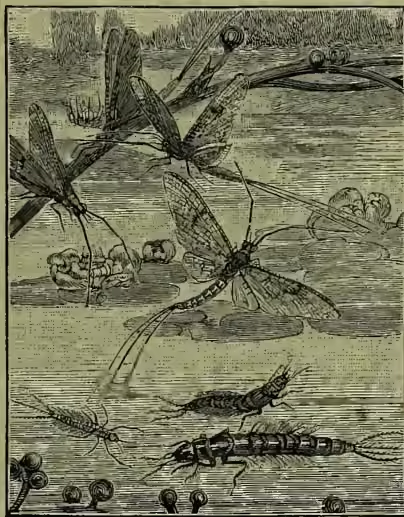
They prefer running water, hide under stones or make burrows in the mud, have well-developed mouth-parts, and feed hungrily enough on other insects. The tracheæ or air-tubes, as the figure shows, are expanded in plate-like or tuft-like paired structures down the sides of the posterior body. A pupa stage eventually follows, during which the larva acquires wings and other adult structures, but the insect which emerges and leaves the water is, curiously enough, not yet ready for its short adult life. Though it has wings, it is still encumbered by a delicate robe. This sub-imago, as it is often called, finds some resting-place on grass stem or tree trunk, gets rid of its last encumbrance, and begins its life of a day. The cast-off ghost-like exuviae are found in great numbers. In the summer evening the males and females enjoy a brief merry love-dance. The females are fertilised, the eggs are dropped into the water, and then sometimes in a single day the bright crowd is gone. It is literally true that at the moment of their climax they die.
The most familiar species is Ephemera vulgata, the common May-fly, the green drake (sub-imago) and gray drake of anglers. Palingenia, Heptagenia or Bætis, Cloë, Caenis, are almost common genera. The adult larvae are used for bait; the corpses of the adults are sometimes abundant enough to serve as manure. The Ephemerids date back to the Devonian epoch. See ANGLING.