Eskimo, the name of a nation which constitutes the aboriginal inhabitants of the whole northern miles of the nearest Asiatic coast. Only in the southern limits of the American Eskimo region do their abodes touch the northern limit of wooded land, while on the other side their tracks have been met with as far as Arctic discoverers have hitherto advanced towards the pole. They prefer, however, the vicinity of the seashore, from which they rarely withdraw more than 20, and hardly ever 80 miles. Their number is not ascertained with exactness, but it scarcely amounts to 40,000. Nevertheless they are scattered as the sole native occupants of regions stretching from east to west as far as 3200 miles in a straight line, to travel between the extreme points of which would necessitate a journey of no less than 5000 miles. This distance, taken in connection with their homogeneous nature and manners, makes their small bands the most thinly scattered people of the globe. Their extraordinary persistency in maintaining their language and habits must be due to the difficulties they have had to face in procuring subsistence where no other nation can live, and to the consequent obligation of preserving as a precious inheritance all the contrivances, and of maintaining the hardiness, developed by their ancestors during their first settling on the Arctic shores.
As to their bodily form, they used to be classed most generally among nations of the Mongolian stock, but now they are considered by some almost as much akin to the American Indians, the coast tribes serving as an intermediate link. Their height nearly equals the average of the North-west Indians. They appear comparatively taller sitting than standing. Their hands and feet are small, their faces oval, but rather broad in the lower part; their skin is only slightly brown; they have coarse black hair and very little beard. The skull is high and mesaticephalic, with a tendency in some individuals to the dolichocephalic type.
Though occasionally they find food by pursuing the chase on land, and by fishing, the Eskimos get their subsistence mostly from hunting by sea, using for this purpose their skin-boats where the sea is open, and their dog-sledges on the ice. From the skin, blubber, and flesh of the seal and the cetaceous animals, they procure clothes, fuel, light, and food. Their most interesting as well as important invention for hunting is the well-known small skin-boat for one man, called a kayak. It is formed of a framework covered with skin, and, together with his waterproof jacket, it completely protects the man against the waves, so that he is able to rise unhurt by means of his paddle, even should he capsizes. A Greenlander's kayak is almost 18 feet long and 2 feet broad, and can carry 200 lb. besides the man. The special weapon of the kayak is the large harpoon, connected by a line with an inflated bladder. The hunter throws it when but 25 feet from the seal, and at once drops the bladder overboard, thus retarding the speed of the wounded animal, which runs off with it until finally killed by a lance-thrust.
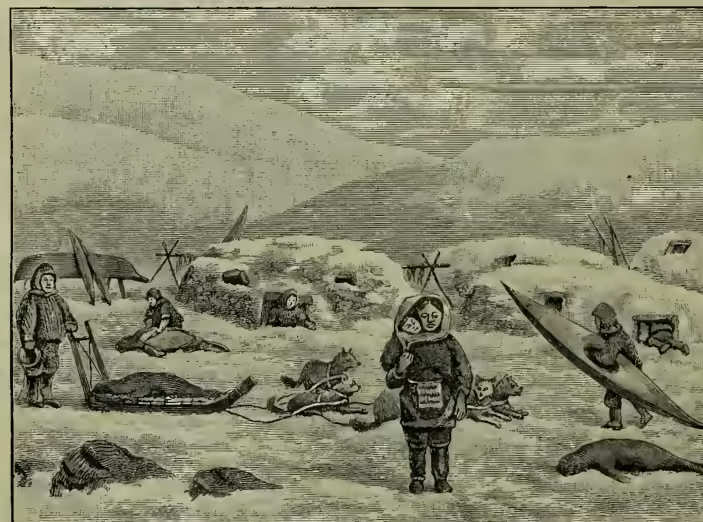
(From a Drawing by the Author.)
In winter the Eskimos are undoubtedly stationary in their habits. But during the summer, when sufficient open water is found, they roam about in their coast of the American continent down to 60° N. lat. on the west, and 55° on the east, and is spread over the Arctic Islands, Greenland, and about 400 large skin-boats, the umiaks, which are from 25 to 37 feet long, 5 feet broad, and 2½ feet deep, and are capable of carrying from 1½ to 3 tons— the tent, with all the necessary implements for the summer household.
The winter dwellings vary with regard to the materials of which they are built, as well as in their form. In the farthest west they are constructed mostly of planks, covered only with a layer of turf or sod; in Greenland the walls consist of stones and sod; in the central regions the houses are formed merely out of snow. In Alaska the interior is a square room, surrounded by the sleeping-places, with the entrance on one side, while a hearth with wood as fuel occupies the middle of the floor. In Greenland the room is heated only by lamps, and the sleeping-places or family stalls are arranged in a row occupying one of its sides. The house for this reason is lengthened proportionally to the number of its inhabitants. Nowadays, however, the houses are not made so long as formerly—a curious fact corresponding to the disuse of the Indian 'long houses,' and like it a result of contact with civilisation. In East Greenland, in the autumn of 1884, the isolated pagan tribe of Angmagsalik numbered 413 individuals, inhabiting thirteen houses, of which one had fifty-eight inmates; while on the semi-civilised west side, where formerly houses with fifty persons also were frequent, the average number has now sunk to ten persons per house. In Alaska, on the other hand, the wintering stations have communal buildings for common use and public assemblies, the so-called kagses and kashim. In East Greenland a house of ordinary size accommodated thirty-eight persons, divided into eight families, each having its part of the sleeping-bench assigned and separated from the next by a low curtain, but all comprised in the same one room of the whole dwelling, which was 28 feet long, 15 feet broad, and 6½ feet high along the ridge line. The number of inhabitants at an Eskimo station is most frequently under forty, but in rare cases more than two hundred are found. A funnel-shaped, half-underground passage forms the entrance of the narrow dwellings.
The dress is almost the same for women as for men, consisting of trousers or breeches and a tunic or coat fitting close to the body, and covering also the head by a prolongation that forms the hood. For women with children to carry, this hood is widened so as to make it an excellent cradle, the amaut. Tattooing has been general among all the tribes, but only in the west is found the curious custom of wearing labrets, or lip-ornaments of bone or stone, inserted in holes of the lip, pierced for the purpose. The ordinary materials of which clothes are made are the skins of seals, land animals, and birds. Besides these, the intestines of seals are utilised in manufacturing an outer clothing used for waterproof coats.
The Eskimo language exhibits in a high degree the polysynthetic structure of the American tongues, characterised by the power of expressing in one word a whole sentence in which are embodied a number of ideas which in other languages require separate words. This is effected by means of radical words, to which affixes or imperfect words are attached. The Greenland dictionary contains 1370 such radicals and about 200 affixes, of which from one to ten, rarely more, can be appended to one of the former. As far as a rough estimate seems to prove, in many cases a radical may in this way be made the foundation of, strange to say, many thousands of derivatives, and a word can be composed which expresses with perfect distinctness what in our civilised languages might require twenty words. In Greenland and Labrador the missionaries have adapted the Roman letters for reducing the native language to writing. The printed Greenland literature, including what has been published by the Moravian
Brethren, amounts with pamphlets and the like to what might make seventy to eighty ordinary volumes. About half of it is of a religious character. A sort of journal has been published annually since 1861, containing many articles by native writers. The Labrador literature, as far as we know, contains about ten books. The two dialects, of course, show some difference, but probably less than, for instance, Danish and Swedish. A similar difference may prevail between the idioms of Greenland and Alaska, without rendering them mutually unintelligible. Works in which the Eskimo language is occasionally treated are numerous.
As to sociology, it is doubtful whether an organisation like that of the Indian 'families,' in a stricter sense, has been discovered among the Eskimos, although a tendency to it certainly may be traced. Its maintenance must probably have been found incompatible with the extraordinary dispersion and isolation of the race. But a division into tribes, each with their separate territories, is ascertained as actually existing. The tribe again is divided into groups constituting the inhabitants of the different wintering-places. Finally, in the same station, the inhabitants of the same house are closely united with regard to common housekeeping. In this, and perhaps similar ways, their general communism in living, characteristic of their stage of culture, is governed by rules for partnership in householding, for distribution of the daily game during the winter, and for the possessions of the individual, the family, the house-mates, and the place-fellows. One of the oldest and most respectable men, called in Greenland itok, in Labrador ungajorkak, is obeyed as chief of a house or wintering-place, although his authority, perhaps, may rest on tacit agreement only. In a similar way, more or less public assemblies constitute councils, and may be considered the courts of justice. Social organisation has been more highly developed in Alaska than in Greenland, altogether apart from the later European influence.
The inhabitants of Danish West Greenland, numbering about 10,000, the greater part of the Labradorians, and the Southern Alaska Eskimos are Christianised. As for the rest, the religion of the Eskimos is what is generally designated as Shamanism. According to the traditions of the Greenlanders, their heathen ancestors had a very distinct belief in the existence of the soul as independent of the body, and able to continue its existence after death. The souls of the deceased were venerated as guardian spirits of their surviving offspring, but besides them numbers of invisible rulers, called inue, or owners of things, filled the universe. The religious observances, with the aim of propitiating or calling for assistance on these supernatural powers, consisted of serranek ('prayer'), kernainek ('invoking'), and the use of amulets. Moreover, many regulations were observed concerning modes of life, fasting, abstinence, and sacrifices (aitsuinek). Some people were endowed with a peculiar skill (nalussaerunek, 'clairvoyance') in discerning the spiritual beings and influencing them. The highest stage of this kind of knowledge was that of the Angakoks, or Shamans, who invoked their guardian spirits (tornat) by means of torninek ('conjuring'). A supreme being, tornarsuk, ruler of the tornat, is also spoken of, but in very indistinct terms. In Alaska religious festivals, performed by large assemblies, and with the use of masks, were held in high esteem as a means of propitiating the invisible powers. The opposite of religious actions and angakok wisdom was iliscenek ('witchcraft'), also consisting without doubt in an application to supernatural powers, but that secretly, for selfish purposes, to the detriment of others.
The Christianised natives still preserve their ancient folklore. It represents at the same time their original poetry, religious ideas, and history, praising the deeds of their great men in braving the dangers to which their race has been continually subjected. The Tales and Traditions of the Eskimo (Edin. 1875), collected and translated by the writer of this article, comprise a collection of 150 tales founded on versions supplied by about fifty narrators from different parts of Greenland, and a few from Labrador. A valuable collection has since been acquired from East Greenland, some tales from Baffin Land, and a number of the simplest fragments of the same from Behring Strait.
The name Eskimo is said to be formed by corruption out of an Indian word signifying 'eaters of raw meat.' They call themselves Inuit, in Greenland partly Kaladlit. Their origin most generally has been derived from Asia, but now they are believed by some to have come from the interior of America, and, following the river-courses, to have arrived at the Arctic Sea, where they have developed their abilities as an Arctic coast people. The writer is inclined to believe that this development has issued from the north-western corner of America, while others suggest that the same process has been going on around Hudson Bay too. In Alaska they almost appear to form a continuation of the North-west Indians—a gradual one, as towards the north and east they have become a more exclusively maritime and Arctic people; their relation to the inland people takes a decidedly hostile character, and murderous fights have been frequent on the borders of the Mackenzie and the Coppermine rivers. The Eskimos may now be divided into the following groups with a roughly estimated census: (1) The Western Eskimos, inhabiting the Alaska Territory and the Asiatic side of Behring Strait, rated at 13,200 souls; (2) the Mackenzie Eskimos, or Tchiglits, from Barter Island to Cape Bathurst, 2000; (3) the inhabitants of the central regions, including the Arctic Archipelago, 4000 (?); (4) the Labradorians, 2200; (5) the Greenlanders, upwards of 11,000. A side branch, moreover, inhabits the Aleutian Islands, numbering 2400; their habits and mode of life are almost like those of their Inuit neighbours, but their language, except its grammatical system, differs widely from the Eskimo.
As to the influence of the Europeans, the missionary work is mentioned above. In Greenland much care has been bestowed by the Danish government to avert the hurtful influence of contact with civilised strangers. But communism forms as essential an element in the native life as does even hunting, and, since the traditional obligations which counterbalanced its ill effects have fallen gradually into desuetude, the general result has been impoverishment. The curtailment of the houses mentioned above is owing to a rather ineffectual attempt by the natives themselves to escape this calamity.
See the article GREENLAND; also, for the books upon the Eskimo, Pilling's 116-page Bibliography of the Eskimo Language (Washington: Government Printing Office, 1883). Among the books enumerated therein may be selected those by Beachy, Craws, Dall, H. Egede, C. F. Hall, Parry, Petiot, Ray, J. Richardson, H. Rink, and J. Ross. Besides these may be mentioned two, not in Pilling, Memoirs of Hans Hendrik, the Arctic Traveller, translated from the Eskimo original by Dr H. Rink (Lond. 1878); also Dr H. Rink, The Eskimo Tribes (in English, Copenhagen and London, 1887).