Esparto (Stipa tenacissima), a grass nearly allied to the well-known and beautiful Feathergrass (q.v.), a native of the south of Europe (especially Spain, between Alicante and Malaga) and North Africa (between Oran and Tripoli).
From very ancient times it was used on both sides of the Mediterranean for the making of carpets, sandals, ropes, baskets, nets, and sacks, and as a substitute for horsehair; but its chief application is now as a material in paper-making (see PAPER), for which it is mostly exported to Britain, which from all parts receives about 150,000 tons of esparto annually. The grass grows wild, requires little rain, and is pulled once a year; but two crops are taken in some parts of Spain, where it has also been the practice to pluck, not cut, the plant. It covers large areas from the seashore up to a considerable altitude, and accustoms itself to the poorest rocky and sandy soils. Its reckless and excessive exploitation, with the resultant injury alike to the supply and to the soil itself, has recently led to official inquiry and governmental regulation in Algeria, as already in Spain, and has also induced the extension of our knowledge of the whole life-history and relations, biological and economic, of this important plant. See Trabut, Étude sur l'Halfa (Algiers, 1889).
The name esparto, the Spanish form of the Latin Spartium, as well as the Arabic name halfa now naturalised in French, is also applied, especially in Tunis and Tripoli, to another somewhat similar and related grass, Lygium spartium, more accurately known, however, in French as Albardine and in Arabic as Sennoc. A third grass, also of similar habit, uses, and distribution, is the Byss (Ampelodesmos tenax). In Egypt the name halfa is applied to Eragrostis cynosuroides, and in Fezzan to
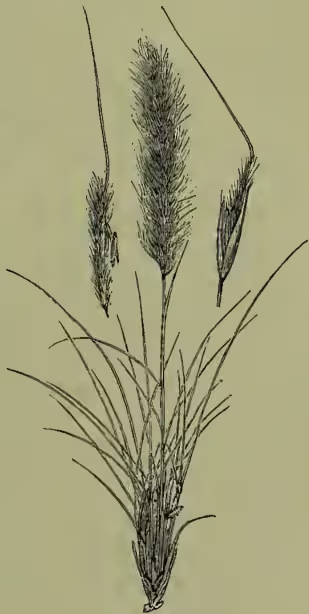
(Stipa tenacissima).
Imperata cylindrica. Esparto is sometimes even confusedly applied to Spartium junceum and other leguminous plants. See BROOM.