Etruria was the country of the Etruscans, a very ancient people of Italy. Etruria Proper lay west of the Tiber and the Apennines, and included the valley of the Arno. In the 6th and 5th centuries B.C. the Etruscans held also the valley of the Po, called Etruria Circumpadana, and a region south of the Tiber, called Etruria Campaniana. Etruria Proper was a confederation of twelve cities or states, the duodecim populi Etrurice. No list of these cities has come down to us, but Veii, Tarquinii, Cære, Clusium, Cortona, Perusia, Vulci, Volsinii, Vetulonia, Volaterræ, and Arretium may probably be included, while the twelfth may have been either Rusellæ, Falerii, or Populonia. To the northern confederation twelve cities are also assigned; among them we may reckon Mantua, Chiavenna, Felsina (Bologna), Ravenna, and Hatria, whose importance is shown deserted sites, marked only by vast cemeteries and the remains of cyclopean walls, while others still retain more or less of their old importance.
Veii, for four centuries the formidable foe and rival of Rome, from which it is only 11 miles distant, is now utterly desolate. It was taken and destroyed by Camillus in 396 B.C. The necropolis, extending over 16 sq. m., attests the splendour of the ancient city and the vast population which must have dwelt within its walls, 7 miles in circuit. Six miles from the sea, midway between
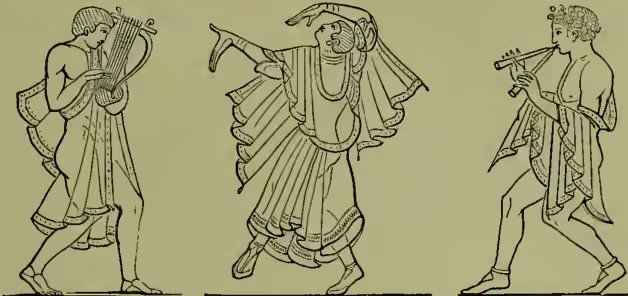
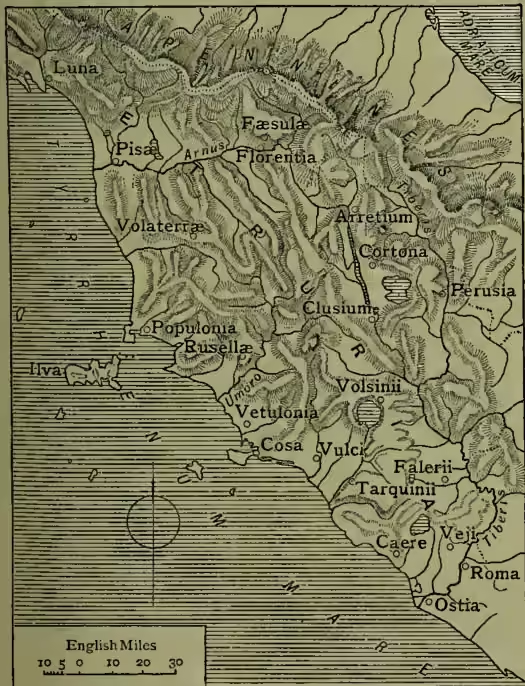
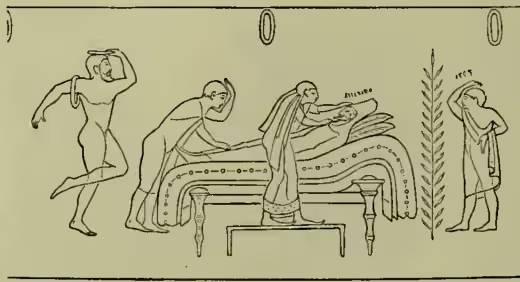
Rome and Civita Vecchia, is the village of Cervetri, which preserves the name and marks the site of Cære, which, under its older name of Agylla, is said to have been a 'Pelasgian' city before the arrival of the Etruscans. On this site inscriptions have been found, written in a language and an alphabet called 'Pelasgic,' and believed to be pre-Etruscan. The paintings in some of the tombs are in a style no less archaic. Of later date is the tomb of the Tarquins, who are said to have fled to Cære when expelled from Rome. Cortona, perched upon a rock, and surrounded by fragments of massive walls, possibly of pre-Etruscan date, occupies the most venerable site in Italy. In the time of Herodotus, Cortona, like Cære, retained its 'Pelasgic' character. Dionysius says it was a great and flourishing city of the Umbrians before it was taken by the Etruscans, who made it their northern capital. The bronze-workers of Cortona were renowned, and the local museum contains noteworthy examples of their skill. The southern capital was Tarquinii, a city purely Etruscan. Corneto, a town 60 miles from Rome, and not far from the sea, occupies a portion of the site. The necropolis of Tarquinii, which extends over many miles, contains several sepulchral chambers, painted in the archaic style of the genuine art of the Etruscans, and giving a curious insight into their religious beliefs. We have scenes from the under-world, representing souls riding on horseback or seated in cars, led away in the charge of good or evil spirits. Elsewhere the daily life of the people is depicted; we see horsemen returning from the chase, chariots, boar-hunts, wrestlers, pugilists, banqueting scenes, dancing girls, and musicians. Fig. 1 represents a dancing girl and musicians from the walls of a tomb called the Grotta del Triclinio, and fig. 2 a death-scene from a tomb called the Camera del Morte. The tombs of Clusium (now Chiusi) exhibit the same archaic character as those of Tarquinii. A vast chambered tumulus called the Poggio Gajella is probably that described by Varro as the tomb of Lars Porsena. Vulci, though barely mentioned by historians, must have been a very wealthy and populous city. The necropolis has yielded a richer treasure of artistic objects than any other Etruscan site. The Cucumella, a huge chambered tumulus like that at Clusium, bears a curious resemblance to the great tomb of Alyattes, by its having given a name to the Adriatic. In the southern province were Capua and Nola, and possibly Salerno. Some of these cities are now king of Lydia, the father of Cræsus, near Sardis. Volsinii gave its name to Lake Bolsena, on whose shores it stood. It was one of the most powerful Etruscan cities, and one of the last to yield to Rome. From Volsinii we have few monuments or inscriptions, the necropolis not having yet been found. On the other hand, Perusia (now Perugia) has yielded 1200 inscriptions, among them the famous cippus, a stone containing the only Etruscan inscription of considerable length. It has not been deciphered, but appears to be the record of the assignment of a sepulchre to the Velthina family.
Velathri (now Volterra), called Volaterræ by the Romans, stands, like Cortona, upon an almost impregnable rock, surrounded by Etruscan walls, five miles in circuit. It held out against the Romans after all the rest of Etruria had been subdued. The people burned their dead instead of burying them, and the local museum contains 400 ash-chests, like miniature sarcophagi, the sides carved with mythological subjects, or with representations of bull-fights, boar-hunts, horse-races, and gladiatorial combats. Cyclopean walls mark the sites of Rusellæ, Cosa, Saturnia, and of Pupluna (Populonia), a seaport, interesting chiefly for its coins. The walls of Fæsulæ (Fiesole), near Florence, are well known to travellers. Orvieto (Urbs Vetus) must have been an important Etruscan site, but its ancient name is unknown. Vetulonia was probably near Magliano, a squalid village in the Maremma. Neither Luna nor Pisæ has yielded any remains of interest. Other Etruscan sites, among them Viterbo (Surrina), Bologna (Felsina), Toscanella (Tuscania), Siena (Senæ), Arezzo (Arretium), Sovana (Suana), and Ferento (Ferentium), are described by Dennis, Cities and Cemeteries of Etruria (2d ed. 1878), to which the reader may be referred for fuller information.
History.—The history of Etruria, like that of Carthage, has to be reconstructed from accounts transmitted by hereditary foes. The Roman legends represent Etruria as a powerful and wealthy state before Rome was founded. According to a tradition preserved by Varro, the Etruscan era commenced in 1044 B.C., nearly three centuries before that of Rome. When legend ceases and history begins, we find the Etruscans a great naval power, allied with Carthage against the Greeks, and dominant throughout northern and central Italy, Rome itself being included in the Etruscan dominion, and ruled by Etruscan kings. The legend of the migration of the Tarquin dynasty from Tarquinii may signify the extension of the domination of that powerful city over the regions southward of the Tiber. A cemetery, believed to be Etruscan, has been discovered on the Esquiline, and the Cælian Hill in Rome bears the name of the Etruscan chieftain Cæles Vibenna. The paintings and inscriptions in a tomb at Vulci give an Etruscan version of the Tarquinian story. We see the hero 'Macstrna' (Mastarna), an
Etruscan appellation applied to Servius Tullius, cutting the bonds of his friend and companion Cæle Vibinas (Cæles Vibenna), while Cneve Tarchunies Rumach (Cn. Tarquinius Romanus) is being killed by an Etruscan. The names of Tarquin, Mastarna, and Cæles Vibenna, thus curiously preserved, prove that Livy's account of the Etruscan kings of Rome is not wholly legendary. But that it was not derived from contemporary sources is indicated by a recent discovery of considerable interest. We learn that in 509 B.C. Lars Porsena of Clusium, as Livy calls him, marched with a great army to the gates of Rome to replace Tarquin on the throne. Now, in a newly-opened tomb at Vulci, a sarcophagus was found, on which is depicted in relief a high official with insignia resembling those of a Roman consul. He is riding in procession on a biga, preceded by two lictors with their fasces, and followed by two servants. The inscription informs us that this deceased magistrate, Tute Larth, was purtsvana thuns, 'five times Porsena.' It is manifest that Porsena was not, as Livy supposed, a proper name, but, like 'Pharaoh' in Egypt, the designation of an office; and that the Etruscan chief who took up Tarquin's cause was the elected 'Porsena' or chief-magistrate of Clusium. In like manner, since the word machs meant 'first' in Etruscan, it seems probable that Macstrna, the Etruscan appellation of Servius Tullius, was not a proper name, but a designation of the kingly office, equivalent, it would seem, to Princeps. We are also told that Tarquin, with his two sons, Titus and Aruns, took refuge in Cære. Not only are Tite and Arnth usual names in Etruscan epitaphs, but at Cervetri, the site of Cære, there is an immense chambered tomb containing mortuary records of forty-six members of the Tarena family, which must have been resident at Cære for many generations.
As an Etruscan city, Rome plainly attained a greater height of prosperity than she regained for two centuries. This is indicated not only by the legends of the splendour of the Tarquinian kings, but by the evidence of such vast constructions as the Cloaca Maxima, the Capitoline temple, and the Servian wall. The state ceremonial of Rome appears also to have descended from the period of Etruscan rule. The insignia of consular authority, the toga prætexta with its purple border, the ivory curule chair, the twelve lictors with their fasces and axes, all of Etruscan origin, are not likely to have been copied from the usages of hereditary foes, but are more probably survivals from the period when Rome was one of the Etruscan cities. An Etruscan origin may also be assigned to the circus, the gladiatorial combats, the horse-races, the triumphal processions, the pipe-players, the lituus, the colleges of augurs, as well as the arrangement of the house, the art of constructing aqueducts and sewers, the division of the as into twelve parts, the beginnings of military science, and some of the Roman weapons. More than all, the high position of the wife, so different from that which she occupied in Greece, was the same as that which she occupied in Etruria.
How feeble was the Roman republic in its infancy appears from the fact that for a century after the expulsion of her Etruscan lords Rome maintained with varying fortunes the struggle with the Etruscan town of Veii, distant 11 miles only from her gates. That Veii fully held her own is shown by the admission that in the year 476 B.C. she captured the Janiculum. At that time the Etruscans were still the greatest military power in Italy. At the height of their prosperity, in the 6th century B.C., they shared with the Phoenicians and the Greeks the maritime supremacy of the Mediter- ranean. In 538 B.C., in conjunction with the Carthaginians, they sent a powerful fleet to expel the Greek colonists from Corsica. They attacked the Greek colony of Cumæ in 525 B.C., and again in 474 B.C., when their naval power was shattered by Hiero I. of Syracuse, in a great battle fought off Cumæ, the first event in Etruscan history as to which we possess contemporary records. The victory was celebrated by an ode of Pindar, then resident at the court of Hiero; while from the inscription on a bronze helmet, found at Olympia in 1817, and now in the British Museum, we learn that it was an Etruscan trophy from Cumæ, dedicated by Hiero and the Syracusans to the Olympian Zens. In 453 B.C. we find the Etruscans still in possession of Corsica, and in 414 they were able to send a contingent of three ships to aid the Athenians at the siege of Syracuse.
But from this time dates the rapid declension of their power. Towards the close of this century the Etruscan dominion in Campania was overthrown by the Samnites and the Greeks of Cumæ, Capua being taken by the Samnites in 423. Then the Gauls swarmed over the Alps, and, after overwhelming the Etruscan cities in the valley of the Po, crossed the Apennines, having destroyed the wealthy city of Melpum in 396 B.C., the year in which the long struggle between Rome and Veii was brought to an end by the capture of the latter by Camillus, after a ten years' siege. The Gauls continued their devastating progress through Etruria, and in 390 plundered Rome, after having vainly laid siege to Clusium. Etruria was fatally weakened by the loss of her two outlying provinces and the devastation of the central province by the Gauls. After a prolonged resistance, southern Etruria submitted to Rome in 351 B.C. In 311 war was renewed; the Romans crossed the natural boundary formed by the Ciminian Forest, and, after repeated defeats of the Etruscans, a decisive contest took place in 283 at the Vadimonian Lake, when Tarquinii lost its independence; and three years later the Romans reached Volaterræ, the northern stronghold of the Etruscans, when the struggle, which had endured for five centuries, came finally to an end.
In the Second Punic War, the chief Etruscan cities furnished supplies for the Roman fleet. It is plain that these cities retained wealth and power as semi-independent allies under the Roman suzerainty. They seem to have been gradually Romanised, and were finally admitted to the Roman franchise in 89 B.C. The great Etruscan families secured leading positions in the Roman commonwealth. Pompey the Great seems to have been of Etruscan lineage, tombs of the Pumpu family having been discovered at Corneto (Tarquinii), Clusium, Cortona, and Perugia. There was a Tarquinian gens at Rome in the time of Cicero, while Mæcenas, who bears an Etruscan name, was from the Etruscan city of Arretium (Arezzo). Families of undoubted Etruscan lineage still linger on in Etruria. The necropolis at Volterra contains the tomb, with Etruscan epitaphs, of the Cæcina (Cæcina) family, members of which distinguished themselves under the early emperors, and whose lineal representative, Nicolas Cæcina, bishop and patrician, was buried in the cathedral of Volterra in 1765.
Origin.—The people of Etruria were called Etrusci or Tusci by the Romans, Tyrrheni or Tyrseni by the Greeks, Tursci by the Umbrians, and Rasena by themselves. Their origin and ethnic affinities have been much discussed. An early tradition, reported by Herodotus, and repeated by twenty-two ancient writers, brings them from Lydia; but Dionysius of Halicarnassus doubts any such migration, because it is not mentioned in the Lydian history of Xanthus, and because the Etruscans differed from the Lydians in language, laws, customs, and religion. Dionysius adds that the Etruscans were a very ancient people, unlike all others in speech and manners.
Modern writers who accept the Lydian tradition point out that Tarquinii, probably the mother-city of the Etruscans, is near the coast, and appeal to striking structural resemblances between tombs at Vulci, Clusium, and Tarquinii, and certain tombs near Sardis. They argue that, if Phocæans settled in Corsica, Lydians may have found their way to Italy, and that, if the Etruscans had entered Italy by the Rhætian Alps, the oldest settlements would be found in the valley of the Po, and not between the Arno and the Tiber. But it must be acknowledged that the migration of so numerous a people by sea is a formidable difficulty. In modern times it has been maintained that their language was Semitic, Celtic, Armenian, Gothic, Basque, or Albanian. Professor Sayce thinks it is sui generis, belonging to a family of speech which has everywhere become extinct. The present writer believes that the affinities are Ugro-Altaic, and of late years this opinion has gained ground. The failure of Corssen's attempt to explain the language as an Aryan dialect, akin to Umbrian, Oscan, and Latin, is a gain in the negative direction, and few scholars would now be found to maintain that it belongs either to the Aryan or Semitic families of speech. It seems rather to have been an agglutinative dialect, approximating, like the Finnic, to the inflectional stage.
Mommsen thinks the Lydian tradition arose from a confusion between the Torrhebi of Lydia and the Tyrrheni of Italy. Fresh light has been thrown on the question by the recent discovery in Lemnos of two inscriptions in a language which, if not Etruscan, resembles it in many points. Thucydides says that Lemnos was inhabited by Tyrrhenians, and Dr Pauli thinks these inscriptions prove that the Tyrrhenians (Etruscans) of Italy belonged to a non-Aryan Tyrrhenian race, which also occupied portions of the Ægean coasts.
Probably there were two elements in the population of Etruria, one autochthonous, numerous, and servile; the other an intrusive conquering aristocracy. Cære and Cortona are said to have been 'Pelasgic' cities before they were occupied by the Etruscans. Certain inscriptions from Etrurian tombs, formerly classed as Etruscan, are now attributed to the more ancient 'Pelasgic' race. Conestabile distinguishes between the tombs of an aboriginal people who practised cremation and those of the later invaders who buried their dead. Livy says that the speech of the country-folk in Etruria differed from the language spoken in the towns, and we may well believe that a conquered race would be left to till the soil for the benefit of invaders dwelling in walled towns. The splendid tombs from which our knowledge of Etruscan speech, luxury, and art is derived cluster round the walls of a few great cities, and are mostly the sepulchres of wealthy nobles. We occasionally meet with the urn of a freedman (lautni) or of a slave, but we know nothing of the tombs of the inhabitants of the villages, who may well have belonged to another race, and have spoken a different language. Again, the abrupt collapse of the Etruscan dominion in Campania and in the valley of the Po indicates that it was a dominion of conquest rather than of colonisation; and the complete effacement of the language in Etruria proper argues that the Rasena were a ruling aristocracy, comparatively few in number, though high in culture.
The physical type of the Etruscans is decidedly not Aryan. Professor Calori affirms that Etruscan skulls differ markedly in shape from all other Italic skulls. The descriptions by ancient authors, 'pinguis Etruscus,' 'obesus Tyrrhenus,' are confirmed by the recumbent portrait effigies on the sarcophagi, which show they were a sturdy race, short and stout, with large heads, thick arms, high colour, scanty beard, and hair black or occasionally chestnut. It has been remarked that they were not unlike the Kheta (Hittites) who invaded Syria from the north, and whose monuments are found in Asia Minor as far west as the neighbourhood of Sardis. In any case we may agree with Dionysius that the language, customs, and religion of the Etruscans differed from those of any nation with which he could have been acquainted, while their physical type, as represented on their monuments, is so unlike that of other Europeans as to incline us to agree with the dictum of Seneca: Tuscos Asia sibi vindicat—'Asia claims the Etruscans as her own.'
Language.—The Etruscans had an extensive literature. The subjects represented on the monuments prove their familiarity with the tale of Troy and the cycle of Greek heroic legend, and we learn that they possessed histories, poems, dramas, and works on augury and divination. But their books have perished, so that in addition to a few doubtful Etruscan words preserved by Hesychius, Varro, and other writers, our knowledge of the language is derived only from inscriptions, of which about 5000 have been discovered. To the meaning of these we have unfortunately no clue, as the few bilinguals consist mainly of proper names. They wrote from right to left, in an archaic form of the Italic alphabet, which was obtained from Etruscan about the 7th century B.C. The Etruscan alphabet differs from the Latin in retaining the letters theta, phi, chi, and san, and in rejecting d, b, g, and o.
Most of the inscriptions are very short, only five containing more than twenty words. The longest, that on the Perugian cippus, extends to forty-six lines. They have been found as far north as the Alps, near Nice, Turin, and the lakes of Como and Lugano. But they mostly come from five or six sites in Central Etruria, one-fourth of the whole number being from Chiusi, and one-third from Perugia. Some vast cemeteries, such as those of Veii and Bologna, have yielded few or none, possibly because they date from a time when the art of writing had not become general.
About 4000 of the inscriptions are short mortuary records, stating usually the name and parentage of the deceased; his age, his condition in life, and the public offices he held being occasionally added. They occur on the walls or over the entrances of vaults, on steles or pillars erected in front of tombs, or on the labels and seals of sepulchral niches, but they are more usually painted on the urns, or cut in the stone of the sarcophagi, a recumbent figure of the deceased frequently reposing on the lid, while the sides are sculptured with mythological subjects or scenes from the life of the deceased.
Working with such materials, German and English scholars have recently made considerable progress in the decipherment of the language, so that most of the short mortuary inscriptions can now be read with tolerable certainty. The inscriptions contain some 200 Etruscan words in addition to the proper names. Of these names a few, such as Caie (Gains), Cneve (Gnaevus), Maree (Marcus), and Tite (Titus), are borrowed from neighbouring or subject races. Of genuine Etruscan names the most usual for men are Arnth (Aruns), Aule (Anlus), Larth (Lars), Sethre, Vele, Velthur, and Vete; and for women, Arnthia, Aulia, Larthia, Sethria, Fastia, Ramtha, Thania, and Thanevil. Many Roman gentile names, such as Spurinna and
Perpenna, were of Etruscan origin, while Pompeius, Petronius, Cafatius, Cassius, Cæcina, Volumnius, and Afinius appear in Etruscan tombs as Pumpu, Petruni, Cahate, Cazni, Ceicna, Velimna, and Afuna. A few Etruscan names have been explained. Thus, Thancvil (Tanaquil) was the wife of Tarquinius Priscus. Thana must have been the Etruscan goddess of maternity (= Juno Lucina), as on a mirror she assists at the birth of Minerva, and civil (or cver) denotes 'gift' or 'dedication,' the word Tinsevil being inscribed on objects dedicated to Tinia (Jupiter). Hence Thancvil would mean 'Thana's gift,' and may be compared with such Christian names as Theodore or Diodorus. Again, Spurie, an Etruscan name, seems to be equivalent to the Latin Publius. The words spural and spurana, inscribed on vessels, armour, and tombs, signify that they were 'civic' or 'public' property; and the phrase amce marunuch spurana, in an epitaph, probably means 'fait curator publicus.'
Relationship is sometimes expressed by words, such as puia, 'wife'; clan, 'son'; sec, 'daughter'; but more commonly by suffixes. Thus, Aulesa is the 'wife of Aule,' Theprisa the 'wife of the Thepri' (Tiberius), Larthial the 'son of Larthia,' Larthialisa the 'wife of Larthia's son.' Velthur is a 'descendant of Vele,' and Velthuritura a 'descendant of Velthur.' Gentile names are formed by the suffix -na, corresponding to the Latin -ius. Thus, Vipna is the equivalent of Vibius, Varna of Varius, Caizna of Cæsius. This suffix is a common formative. Thus suthi, 'sepulcrum,' gives sutnina, 'sepulcralis.' The suffix -l or -al has a similar force—e.g. fuflunsl, 'a Bacchic cup,' from Fufluns, 'Bacchus'; and Truial, 'a Trojan,' from Truia, 'Troy.' Other ethnic formatives are -ach and -ate, as Rumach, 'a Roman,' and Mantvate, 'a Mantuan.'
Six words inscribed on the faces of a pair of dice give the first six digits, and other numerals appear in records of age which occur in epitaphs. The words mach, ci, zal, sa, thu, huth, semph, cezp, mwv are believed to be the digits, while ce-alchl, cezp-alchl, semph-alchl, mwv-alchl, zathrum, and cicm-zathrum must be decades. Ordinals and multipliers are formed from the cardinals. Thus ci, 'two,' gives ci-s, 'second,' and ci-zi, 'twice.'
The detection of the numerals has made it possible to show that the plural ends in r or l. Thus, clan, 'son,' gives clen-ar, 'sons'; as ci clenar, 'two sons,' and clenar zal, 'three sons.' The phrases huth naper, naper ci, naper xii, show that naper is a plural, meaning 'loculi' or 'tombs.' The plural in -l also appears in arce ril lxvii, 'habuit annos lxvii,' and in mursl xx. So tular signifies 'cippi,' and suthinesl 'sepulchral niches.'
The names of men and women already cited, and such forms as lautni, 'a freedman,' and lautnitha, 'a freed-woman,' show that Etruscan was a gender language. There seems to have been no distinction between nominative and accusative. The genitive ended in -s, the dative in -si or -thi; and, as in the Altaic languages, the plural suffix preceded that denoting the case. Thus, from clan, 'son,' we have gen. clen-s, dat. clen-si, nom. and acc. pl. clen-ar, dat. pl. clen-ar-asi; while precuth-ur-asi is the dat. pl. of precus. From tiv, 'moon' or 'month,' we have tiv-r, 'menses,' and tiv-r-s, 'mensium;' from usil, 'sol,' usils, 'solis;' and from suthi, 'sepulcrum,' suthi-thi, 'sepulcro.' The suffixes -c and -m are enclitic conjunctions—thus, vel sethrc puia is the epitaph of 'Vele Sethre and wife,' and arnth vipis serturis puia mutainei that of 'Arnth (son of) Vipi Serturi and (his) wife Mutainei.' According to Dr Pauli, mi means 'this,' or 'this is'; while cehn, cen, or cen means 'here.' The meaning of several substantives, in addition to those already cited, has also been determined with tolerable certainty.
Coming to the verbs, am-ce certainly means 'fuit,' while ma appears to be 'est.' The 3d pers. sing. of the perfect tense ended in -ce, and of the present in -e. We have tur-e, 'dat;' tur-ce, 'dedit;' ar-ce, 'habuit;' tham-ce, 'extruxit;' svat-ce, 'obit;' lupu-ce, 'decessit.' Thus, clenar zal arce is 'filios tres habuit,' and ramtha matulnei scch marces matulnas puiam amce sethres ceisinies may be translated 'Ramtha Matulnei was the daughter of Marce Metulna, and wife of Sethre Ceisinie.' These examples may serve to show that the once apparently hopeless task of translating the Etruscan inscriptions is at last in a fair way of being accomplished.
Religion.—The Etruscans were proverbially a religious people—'gens ante omnes dedita religionibus'—'genitrix et mater superstitionis Etruria.' Their tombs bear witness to a belief in a future life, and a dread of the malignant power of their deities. Affairs of state were regulated by the decisions of colleges of haruspices and augurs, who interpreted, according to established rules, omens and portents obtained from the inspection of the entrails of victims, the flight of birds, and from lightning, of which twelve kinds were distinguished. Varro, Cicero, and Martianus Capella have described the methods of divination, as laid down in the libri disciplina Etruscæ. The heavens were regarded as the templum of the gods, and were divided into sixteen regions, in each of which one or more of the gods presided or resided. By ascertaining the precise 'region' in which an omen, such as a flash of lightning, occurred, the fulgurators determined the name of the god who sent the message, and interpreted it in accordance with his functions. Those gods who possessed the power of sending lightning were called the Novensiles, or 'Thunderers.' In the museum at Volterra is an effigy of an augur, holding in his hand the instrument by which these observations were made, and an actual specimen of the instrument has recently been discovered near Piacenza. It is a bronze model of the liver of a calf, which must have been used like a sextant. Beginning with the north, the rim is divided into sixteen compartments, in each of which the name of one of the gods is engraved. The heavens were observed through apertures which correspond to the blood-vessels which supply the liver. One side of the instrument is dedicated to the sun, the other to the moon, probably for observations by day or by night. The protuberance called the lobus Spigeli was the 'mount of the gods,' and the gall-bladder was dedicated to Neptune. The names of the deities inscribed on this curious instrument, coupled with the account of Martianus Capella, have supplied unexpected information as to the Etruscan Pantheon, and this is supplemented by the names appended to the deities in the mythological subjects painted on the walls of tombs, or engraved on the backs of the polished bronze mirrors used by Etruscan ladies, of which four hundred are known. In many cases the subjects are taken from the Greek mythology, and the names are merely those of Hellenic or Italic deities, conformed to the phonetic laws of Etruscan spelling. Such are Ani (Janus), Uni (Juno), Maris (Mars), Apulu (Apollo), Nethuns (Neptune), Erce (Hercules), Meurva (Minerva), Velch (Vulcan), Satre (Saturnus), Artumes (Artemis), Letun (Latona), Vetus (Vedius), Silvans (Silvanus), Aita (Hades), Pherisnei (Persephone), and Charu (Charon). But besides these borrowed names there are a host of genuine Etruscan deities, such as Tinia, who answers to Jupiter, Laran to Mars, Fufuns to Bacchus, Sethlans to Vulcan, Turan to Venus, Turms to Mercury, Thalna to Juno, Thana to Lucina, Thesan to Aurora, while the sun and the
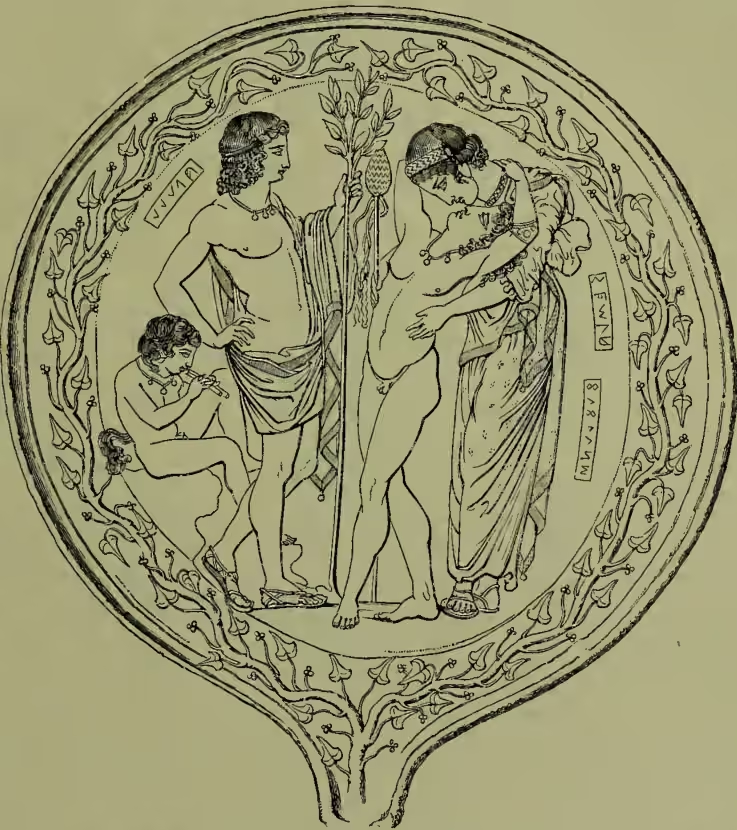
Half size. After a Drawing by Mr George Scharf. moon were called Usil and Lala. Of other deities no analogues have been found in the Greek or Roman Pantheon. Lasa and Mean seem to be recording Fates; Epiur, Snenath, Munthuch, and Malavisch to be guardian spirits; Tuchulcha, Asira, Nathum, and Tarsu avenging Furies; Vanth, Leinth, and Culsu conductors of souls or deities of the tomb. More obscure are the functions of beings called Racuneta, Talitha, Tethum, Thufia, Mlacuch, Achuvitr, Tipanu, Sitmica, and Ethausva. If anything were wanted to prove that the Etruscan mythology differed from that of all Aryan, Semitic, and Hamitic nations, this strange list of names would be sufficient. Classical writers have assigned to the Etruscans other deities whose names are not found in inscriptions, and which may be Sabine, Umbrian, or Faliscan. Among them may be enumerated Mantus and Mania, king and queen of the under-world; Summanus, a god who ruled the night; Vertumnus, the god of autumn; Voltumna, whose temple was the meeting-place of the federated states; Nortia, the goddess of Fortune, in the doors of whose temple at Volsinii nails were driven to mark the successive years; and the Novensiles, a collective name for those gods who hurled thunderbolts.
Civilisation.—The government was a loose federal union of the twelve cities or states, each ruled by magistrates annually elected from a class of hereditary sacerdotal nobles. The titles of these magistrates, Lauchme (Lucumo), Purtsvana (Porsena), and Marunuch, probably correspond to Consul, Emperor, and Curator. The position of the wife was high; she is the social equal of the husband, she takes her place at the feast, her tomb is sumptuously furnished, and descent through the mother is recorded even more uniformly than through the father. The reliefs on the Afuna sarcophagus at Palermo, in which a matron bids farewell to her sorrowing family, afford a touching proof of the affection with which the wife and mother was regarded. Of the high civilisation attained by the Etruscans we have abundant proofs. Till the battle of Cumæ they were one of the three great naval powers of the Mediterranean. They excelled in medicine, astronomy, mining, metallurgy, and such engineering works as the construction of roads, tunnels, and chambered tombs. The walls of their cities, built of huge blocks, admirably fitted together without cement, remain to attest the skill of the artificers. The jewelry, of the Phœnician type, with patterns formed by soldering on minute grains of gold, is unrivalled. The skill of the bronze-workers is shown by the Chimæra and the statue of the Orator at Florence, by the Wolf in the Capitol at Rome, and by a magnificent lamp at Cortona. The earlier coins, which date from the 6th century B.C., show the influence of Asia Minor, while after the repulse of the Athenians in Sicily they are modelled on the coinage of Syracuse.
Many of the painted vases which have been found in such vast numbers in Etruscan tombs were either imported from Greece or made by Corinthian artists who had settled in Etruria, the subjects represented being drawn mainly from Greek mythology or the cycle of Homeric legend. Some of these vases may have been prizes won in the national games, and deposited in the tombs as cherished possessions of the deceased, together with his armour and his weapons. In like manner, the polished mirrors and jewelry of Etruscan ladies were commonly placed in their tombs. But the tombs are themselves the most characteristic works which the Etruscans have left behind them. They are of two kinds: the stone pyramid or cone with interior chambers, which is manifestly a survival of the tumulus, and the rock-cut chamber, which is a survival of the cave. But Etruscan tombs are not merely sepulchres; they are abodes for the spirits of the dead, constructed on the model of the abodes inhabited during life; they are provided with chairs and other furniture; useful and ornamental objects were deposited by the body of the deceased, while the walls were decorated with subjects from daily life, or scenes from the under-world. There is usually an antechamber in which the family could assemble at the annual funeral feast to do homage to the spirits of departed ancestors.
More than a hundred books have been written on the subject of the Etruscans and their monuments. The best general work is Die Etrusker, by K. O. Müller, edited by Dr Deecke (1877), supplemented by Deecke's Etruskische Forschungen and Pauli's Etruskische Studien. The inscriptions have been edited by Fabretti in his Corpus Inscriptionum Italicarum; the tombs are described by Dennis, Cities and Cemeteries of Etruria; the mirrors in Gerhard's Etruskische Spiegel. Corssen's great book, Ueber die Sprache der Etrusker (1874-75), is already obsolete. See also Cuno, Vorgeschichte Roms (vol. ii. 1888); Jules Martha, L'Art Étrusque (Paris, 1888).