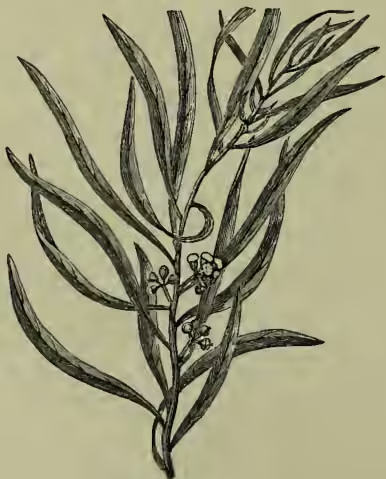
Eucalyptus, a genus of Myrtaceæ, including about 150 species, which form the preponderant and most characteristic vegetation of the Australian forest. Their frequently enormous height (150-200 or even 400 feet, higher than the great Californian Wellingtonia or Sequoia; one fallen specimen recorded by Wallace must have been near 500 feet), their entire leathery glaucous leaves, which turn vertically with their edges to the sun, and so cast no shadow, and their frequently ragged bark and peculiar aromatic odour combine to give a uniquely peculiar and unmistakable character. Many species are known as gum-trees, from their resinous exudations. The Blue Gum Tree of Tasmania (E. globulus) is best known in Europe from its specially high reputation as a hygienic agent in damp, unhealthy, and malarious situations, and has hence been planted extensively in many parts of Italy, &c. Its value has been alternately ascribed to the antiseptic action of its camphor-like odours, and to its rapid growth (which sometimes even exceeds 10 feet per annum), and the consequent drainage of the soil through the enormous transpiration from the leaf-surfaces. The culture of Eucalyptus has also been introduced with good results into Algeria, Mexico, the Cape of Good Hope, &c. The Red Gum Tree, or Iron Bark Tree, yields a red astringent resin, known as Botany Bay Kino; and E. robusta, the Stringy Bark Tree, has also a beautiful red gum. E. mannifera yields a copious sweet exudation from its bark and leaves, which comes into commerce as Eucalyptus manna, and resembles genuine Manna (q.v.) in sweetness and aperient properties. That of E. dumosa is also gathered by the natives from the ground, on which it lies like hoar-frost, and is used as food. E. Amygdalina is remarkable both for its height and its girth. Eucalyptus timber is at first soft and easily worked, but soon hardens, and is often of great value and durability. The bark of some species is useful as a source of tannin; whilst a liqueur made of Eucalyptus is drunk in Italy, and Eucalyptus honey is said to contain the valuable characteristics of the tree. The seeds were first sent from Melbourne to Paris by M. Ramel in 1854, and subsequently distributed to other parts of Europe. See Sir F. Müller, Eucalyptographica (Melbourne, 1881).