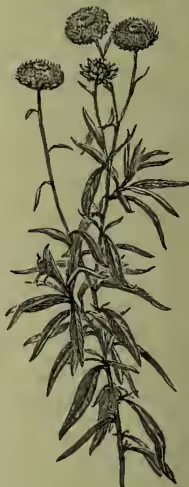
(Helichrysum
bracteatum).
Everlasting Flower, the popular name of certain plants, the flowers of which suffer little change of appearance in drying, and may be kept for years without much diminution of beauty. They are plants chiefly of the order Compositeæ, having their flowers (heads of flowers) surrounded with an involucre, the scales of which resemble the petals of a corolla, but are rigid, membranous, and contain little moisture. Some species of Cudweed (q.v.) (Gnaphalium) are often called everlasting flowers, and the other plants which bear the name belong to nearly allied genera, but particularly to Helichrysum, Rhodanthe, and Acroclinium, which are mostly annuals and natives of Africa and Australia. Helichrysum arenarium is frequent on dry, sandy soils in many parts of Europe and the central latitudes of Asia. It is covered with a gray felted down, and has yellow flowers, which, when rubbed, emit a faint aromatic odour. It is often worn on the continent of Europe as an ornament in the hat, particularly by wagoners. H. angustifolium and H. Stoechas—shrubby species, natives of the south of Europe—have larger yellow flowers. Some of the species have a powerful and pleasant aromatic odour. Several kinds of everlasting flowers are frequently to be seen in our gardens; others, such as Phoenocoma and Aphlexis, natives of the Cape of Good Hope, are of shrubby habit, and choice and beautiful greenhouse plants. As an instance of everlasting flowers in other orders than Compositeæ may be mentioned the genus Staticæ; the coloured calyx in nearly all the numerous species of which it is composed is dry, membranous, and very persistent. The French call everlasting Immortelles, and often weave them into circular wreaths, which are placed beside recent graves, as emblems of immortality or of loving memory. A very extensive trade is now carried on by France, Germany, and Italy in growing and preserving everlasting flowers for exporting to Britain and America.