Evolute, Involute. correlative terms first applied to the tracing of curves by Huygens. Under this distinction every mathematical curve is considered as one of a pair which are mutually produced. To measure the curvature at any point, or the amount of bending or deflection from the tangent, we find a circle which coincides with the curve for an elementary distance. This circle of curvature or 'osculating circle' must evidently diminish its radius as the curvature increases, and increase its radius as the curvature diminishes. The centre of this circle is called the centre of curvature for that point; and the successive points of any given curve have in general different centres of curvature, because the amount of deflection is constantly varying. When we trace, for example, an ellipse, the varying centre of curvature is at the same time tracing a companion curve of quite a different shape. The latter is called the evolute and the former the involute. Or we may begin with the evolute. Take a circular disc of metal or wood and wrap a thread round the circumference, which is now to serve as the generating curve. When the disc is held fast to any plane, and the string unwrapped under tension, any point of the latter will describe on the plane an involute of the circle. At any particular moment of the process the straightened or unwound part of the string is the radius of curvature of the outer curve. Thus, (1) the tangent to the evolute at any point is the normal to the involute at the corresponding point; (2) any curve as involute can have but one evolute, but any curve regarded as an evolute has an infinite number of involute companion curves, which are all parallel; (3) the length of any arc in the evolute is the difference between the tangents at its extremities. When the circle is evolute, its involute (see fig.) is obviously spiral; and, when it is itself involute, the corresponding evolute has the exceptional form of being diminished to a point. The evolute of the cycloid is also exceptional, being another equal cycloid, a fact first observed by Huygens. A practical application of the involute of the circle occurs in theoretical mechanism in connection with the shape of the teeth of wheels, under certain circumstances.
From A, the beginning of the involute, draw a tangent AM = length of circumference of the circle.
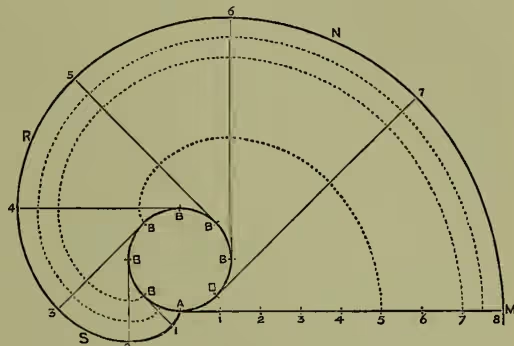
Divide AM into eight equal parts (as figured) and the circumference into the same number at B, B, B, &c. At these points draw tangents so that line B1 = line A1, B2 = A2, B3 = A3, B4 = A4, &c. The extremities of the tangents show the curve called the involute of the circle. The dotted curves of the diagram show three of the companion involutes, all parallel to the first. They obviously admit of indefinite extension, however small the generating circle may be.