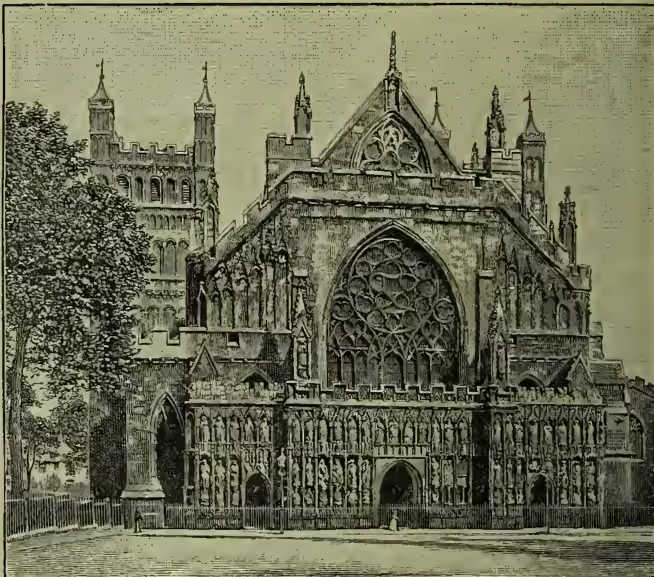
Exeter. the capital of Devonshire, 171 miles by rail WSW. of London, and 75 SW. of Bristol. Dominated by higher hills, it is built on the summit and slopes of a flat ridge, rising 150 feet from the left bank of the Exe; and, having been modernised chiefly in its suburbs, it is a pleasant antique city —‘as good a specimen of an English county town, at once prosperous in business, and with a quiet air of aristocratic distinction, as can be found within the four seas’ (Escott’s England). The quaint old High and Fore Streets, crossed by North and South Streets, still follow the line of the Ickneld Way; and the walls in great part remain, though their four gateways were demolished between 1769 and 1819, and though Rougemont Castle (1068) was almost all swept away in 1774, to make room for an ugly assize-hall. In 932 Athelstan founded here a Benedictine monastery, and hither in 1050 Edward the Confessor translated the western bishopric from Crediton; but St Peter’s Cathedral was not begun till sixty-two years afterwards. Measuring 408 feet by 76 (or 140 across the transepts), and 66 feet high, it is a long, low edifice, with massive transeptal towers—a feature imitated at Ottery St Mary, but otherwise unique. These towers, 140 feet high, are the original Norman ones, but the rest of the pile, rebuilt between 1280 and 1369, is mainly in the purest Geometrical Decorated. The most striking characteristics of the whole are its perfect bilateral symmetry and the grand unbroken line of vaulting. Special features are the exterior western screen (circa 1388), adorned with sixty-seven statues of saints and princes; the beautiful choir-screen (1324), surmounted by the fine organ (1665); the minstrels’ gallery (1353); the misericers, sedilia, and bishop’s throne; the modern reredos, stall-work, and pulpit; a clock, dating from 1317 or earlier; the Great Peter bell, brought from Llandaff in 1482, recast in 1616, and weighing 12,500 lb.; and the chapter-house (1420–78), containing 8000 MSS. and early books. In 1870–77 the cathedral was restored by Sir G. G. Scott at a cost of £40,000; in 1889 the cloisters and library. The picturesque guild-hall (1464) has a cinque-cento façade (1593); of modern buildings, the most noteworthy are the Devon and Exeter Hospital (1743), the Lunatic Asylum (1865), and the Albert Memorial Museum (1868). The chief public walk is Northernhay. A ship-canal (1563–1827) extends 5 miles to the tideway at Topsham; and Exeter has large nurseries and manufactures of gloves, agricultural implements, &c., besides being the chief mart of ‘Honiton’ lace. But its woollen trade, once second only to that of Leeds, is a thing of the past; and as a seat of commerce and industry it has been outstripped by many a younger competitor. The 'ever loyal city' got its earliest charter from Henry II. some time prior to 1162; in 1537 was made a county of itself; and returned two members from about 1300 till 1835, when their number was cut down to one. Pop. (1831) 40,688; (1891) 50,570, of whom 37,580 were within the municipal borough.
The Celtic Caerwisc, the Roman Isca Damnoniorum, and in 876 the Exanceaster of the West Saxons, who till 926 shared it with the Britons, Exeter, in Professor Freeman's words, 'is the one great city of the Roman and the Briton which did not pass into English hands till the strife of races had ceased to be a strife of creeds, till English conquest had come to mean simply conquest, and no longer meant havoc and extermination.' To Mr Freeman's pages reference must be made for its capture by the Danes (876 and 1003), by William the Conqueror (1068), and by Stephen (1136); for its siege by the Yorkists (1470), by Perkin Warbeck (1497), and by the Catholic rebels (1549); for its surrender to Prince Maurice (1642) and to Fairfax (1646); and for the entry of William of Orange (1688). Where to must be added the tragic burning of the new theatre (5th September 1887), with a loss of 188 lives. Among the sixty bishops have been Leofric (1050-72), Bartholomew (1161-84), Stapledon (1308-26), Grandison (1327-69), Miles Coverdale (1551-53), Joseph Hall (1627-41), Seth Ward (1662-67), Trelawney (1689-1707), Phillpotts (1831-68), and Temple (1869-85). Natives were Archbishop Baldwin, Cardinal Langton (doubtfully), John Vowel or Hoker, the historian of Exeter (1525-1601), the Judicious Hooker, Sir Thomas Bodley, and Henrietta, Duchess of Orleans.
See Archdeacon P. Freeman's Architectural History of Exeter Cathedral (1873), and Professor E. Freeman's Exeter ('Historic Towns' series, 1887).