Falconry (from Old Fr. faulconnerie, a term introduced by the Normans), the art of training falcons and hawks to the chase. The term hawking (from M.E. hauk, earlier hauck—i.e. havck, and A.S. hafoc), though often used synonymously, is more correctly restricted to the practice of this art in the field. In the East falconry has been traced back to a period anterior to the Christian era, and was practised there and also in Europe long before its introduction into Britain. It was known to our Saxon ancestors, and is mentioned in the Colloquy of Archbishop Ælfric, written in the 10th century. In the celebrated Bayeux tapestry Harold is represented with a hawk upon his glove; and the Norman nobles, who were as much addicted to hawking as to hunting, gave a great impetus to the sport in England by the importation of falcons (especially jerfalcones) from abroad, and by the large sums they expended upon this diversion. Henry II. used to send every year for young falcons from the cliffs of Pembrokeshire. Richard I. while in the Holy Land amused himself with hawking at Jaffa, in the plain of Sharon, with hawks which he had brought with him from England. King John used to send to Ireland for his hawks—amongst other places to Carrickfergus, County Antrim, and was especially fond of a flight at the crane with jerfalcones which he received from the king of Norway. He used to hawk in Dorsetshire and Somersetshire, as appears by entries in the court rolls of payments for the expenses of the journeys. When Edward III. invaded France, he had with him, according to Froissart, thirty falconers, and every day either hunted or hawked as his fancy inclined him. The Paston Letters, written in the reign of Edward IV., give an insight into the ways and doings of English falconers in the middle ages, as do also the various 'Household Books' which have come down to us. Henry VII. used to import his goshawks from France, and Henry VIII.'s love of the sport nearly cost him his life, if we may believe the anecdote told of him in Hall's Chronicle. During the reign of Elizabeth hawking was much in vogue in England, and Nichols in his Progresses has given some interesting details of the queen's participation in this pastime. James I. was a most enthusiastic sportsman, and gave a great impulse to hunting and hawking in England by inviting those of the French nobility who were the greatest adepts in these field-sports to come over to this country, and compete in friendly rivalry with his own subjects. He was especially fond of kite-hawking with jerfalcon, and carried this branch of the sport to great perfection on the wide heaths of Royston, Newmarket, and Thetford. It may be well to correct here an erroneous statement which has been many times repeated in print to the effect that Sir Thomas Monson in the reign of James I. gave £1000 for a cast—i.e. for two hawks, the truth being (as stated by Sir Antony Weldon in his Court and Character of King James, 1650) that he spent £1000 before he succeeded in obtaining a cast which he considered perfect for kite-hawking.
These were the palmy days of falconry, when the sovereigns on both sides of the Channel (James I. and Louis XIII.) were enthusiastic falconers, giving every encouragement to the sport, when the species of hawk carried was indicative of the rank of the owner, and when the best books were written by English and French masters of the craft.
The disastrous state of the country during the period of the civil wars naturally put an end for the time being to the general indulgence in field-sports; and it may be said that at the Restoration hawking had ceased to be popular, although from that time until the present it has never ceased to be practised by a few admirers of the old sport in various parts of the country. The last member of the royal family, it is believed, who sent for or received hawks from abroad was Frederick, Prince of Wales, son of George II., who occupied the 'palace of Durdans' at Epsom, now a seat of the Earl of Rosebery's, and used to hawk over the downs, where in 1825 there was a spot still known as 'the Hawkery.' Fashion, no doubt, had a good deal to do with the decline of hawking, for so soon as the reigning sovereign ceased to take an interest in the sport the courtiers and their friends followed suit. Between the years 1751 and 1791 the third Lord Orford did much to encourage the practice of falconry in England; and during the first quarter of the 19th century Colonel Wilson (afterwards Lord Berners) in Norfolk, and Colonel Thornton, of Thornville Royal in Yorkshire, not only practised game-hawking with great success (as did also Sir John Sebright, who wrote a practical treatise on the subject in 1826), but excelled in those higher branches of the sport, kite-hawking and heron-hawking, which have long since become impracticable by reason of the extinction of the former quarry and the impossibility of securing the requisite conditions for a flight at the latter.
In 1840 the formation of the Loo Hawking Club, whose headquarters were at the summer palace of the king of Holland, kept the sport alive for many years, and several English falconers who kept hawks of their own annually repaired to Loo for the enjoyment of heron-hawking, which was there carried out to perfection by the Dutch falconers Van der Heuvel, the brothers Bots, and the veteran Adrien Mollen. The last owner of heron-hawks in England was Mr Edward Clough Newcome, of Hockwold in Norfolk, a most accomplished falconer, who died in 1871. About this time was formed the Old Hawking Club, which still flourishes, and annually pursues the sport of rook-hawking in the spring and game-hawking in the autumn, the interval being devoted to lark-hawking with merlins and flights with the goshawk at rabbits and hares. Of late years the taste for falconry has manifestly increased, and there are now a great many owners of hawks (besides the members of the club just named) who carry on the old sport with more or less success in different parts of the United Kingdom. It may therefore be said that, although from various causes hawking in England has declined since the days of the Stuarts, it has never actually died out, and is even at the present day in a fair way to be thoroughly revived.
The birds employed by falconers belong to two classes—the long-winged, dark-eyed falcons, and the short-winged, yellow-eyed hawks. To the former class belong the Jerfalcon, Peregrine, Lanner, Saker, Barbary Falcon, the Indian Shahin, the Hobby, and the Merlin; to the latter the Goshawk and Sparrow-hawk. The former take their prey by rising above it in the air, and stooping at it from a considerable height, and striking it to the ground; the latter pursue in a straight line, and, overtaking the quarry by superior speed, clutch it, and come down with it. The larger falcons are flown at winged game of all kinds—crows, magpies, rooks, herons, and wild-fowl; the smaller falcons, such as the merlin and hobby, are used for taking larks; while of the short-winged hawks the sparrow-hawk is flown at blackbirds and thrushes, partridges early in the season, and quails, the goshawk taking pheasants, partridges, and wild-fowl, rabbits and hares. With all birds of prey the females are invariably larger and more powerful than the males, and the sexes are consequently selected according to the quarry they have to pursue. Jerfalcon, are now rarely employed, partly owing to the difficulty of procuring them, partly because the peregrine falcon is preferred, and experience has shown that except in a woody or inclosed country, where the goshawk and sparrow-hawk are preferable, the peregrine is the most useful of all the birds of prey.
Hawks are either taken young from the nest before they can fly, when they are termed eyesses, or are caught later, during the period of their migration, by means of a decoy-pigeon and a bow-net, when they are called passage-hawks. The mode of treatment is a little different, inasmuch as the latter have already learned to catch and kill prey for themselves, and only require to be tamed; the former have everything to learn. A passage-hawk on being caught is hooded, and has jesses, or soft leather straps, fastened on her legs. She is then set down on a block of turf to prevent damage to feathers, and fed once a day, at first through the opening of the hood, afterwards with the hood removed. The bird is always fed upon the gloved hand, and gradually learns to step on to it from the perch, increasing the distance daily until she is obliged to fly to reach the fist. The training then commences. The hawk is called off, as it is termed, to the lure, which means that after tying a long line to the ends of the jesses she is held hooded on the hand of an assistant, until the falconer at the distance of five-and-twenty yards swings the lure to which the bird has been accustomed to come to be fed. The hood being then removed, the hawk flies to the lure, and is exercised in this way for some time daily, until she is sufficiently tractable to be trusted without a line, care being taken not to feed her until she has flown, and always to reward her for coming to the lure with a morsel of the meat with which it is garnished. She is then entered at the quarry at which she is intended to be flown (partridge, rook, or whatever it may be) by first giving her a live bird at the end of a long line, and allowing her to go off the fist and kill it; eventually the line is dispensed with, and she is flown at wild quarry.
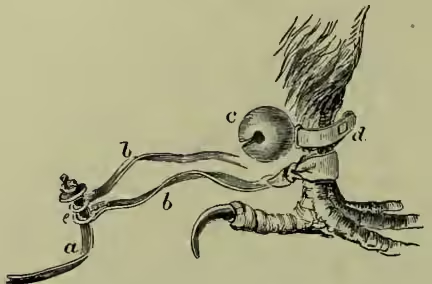
Such, briefly, is the mode of training a passage-hawk. An eyess is somewhat differently treated. A straw-covered platform is put up in some shed or outhouse, and on this the nestlings (which should not be taken too young, or they will turn out screamers) are placed, the platform being about as high up as one can reach to feed the birds. They are fed three times a day on fresh lean beef, while growing, to keep up their strength, or hunger-traces will appear, like cuts across the webs of the feathers, and the latter breaking will render the birds useless. When they are strong enough and able to fly, jesses are put on the legs, and a spherical brass bell (of Dutch or Indian make) on one leg, fastened just above the jess with a little narrow strip of leather termed a bewit (see fig. 1). At feeding time, now once a day, they are called to the lure, and, being allowed their liberty for some weeks (in which state they are said to be flying at hack), they daily gain strength and wing-power, until the time comes for taking them up and commencing their training, which after this stage does not differ much from the method above described for passage-hawks. When flying at hack, a hawk sometimes becomes wild, wanders away to a distance, and kills game for herself. When this is perceived, a bow-net, or other device for snaring, is set for her, to which she is decoyed and recaptured. The first operation in training is hooding, which, if successfully performed, overcomes much difficulty. It requires some patience and dexterity, and should be practised at first in a darkened room, in which the hawk will be much quieter than in broad daylight. The hood is simply a cap of leather (see fig. 2) made to fit the head in such a
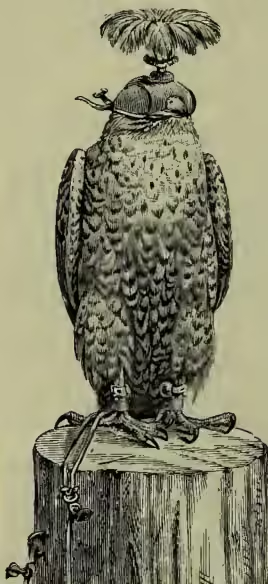
One end of the leash is attached to the jesses, the other to a ring driven into the side or top of the block; and thus the hawk is prevented from escaping. manner as to obscure the light, a single aperture only being left, through which the beak protrudes, and a slit behind, which is opened and closed, when the hood is put on and off, by means of braces, one pair of which opens, the other pair closes the slit; the eye-pieces, which to prevent injury to the eyes are carefully blocked out, are covered for ornament with red or green cloth. By temporarily blindfolding the hawk, the hood causes her to sit perfectly quiet, and prevents her from bating, or fluttering, at the risk of breaking feathers, as she would do if frightened by passers-by until gradually accustomed to them.
Allusion has already been made to the jesses, or soft straps of leather (dog-skin is best), which are fastened to the legs of the hawk, by which to hold her on the glove and tie her to the perch or block. These jesses are about 6 inches long, and are never removed when the hawk is flown. In former times varvels, or flat rings of silver with the owner's name engraved thereon, were permanently attached to the ends of the jesses, and through these one end of the leash was passed, the other end being prevented from going through by a leather button. At the present day, however, most falconers prefer using a figure-8 swivel, which is always detached before the hawk is flown.
The lure, already referred to, is a device for luring the hawk back to her owner after an unsuccessful flight, and on this account the hawk is early made acquainted with it by being fed upon it daily while being trained. There are various patterns; one of the simplest and most easily made consists of a couple of pigeons' wings tied together on a flat circular leaden weight covered with leather, upon which a piece of raw meat is tied on both sides. The tabur-stick and drawer, which were formerly used as lures, have long been discarded.
The beaks and claws of wild caught hawks are generally so long and sharp as to require paring or coping, as it is termed; but this operation requires to be very carefully performed (the hawk being hooded and held by an assistant), and not more than the tenth of an inch removed, or the efficiency of the beak and claws will be impaired. Indeed some falconers will never cope a hawk, except when the beak is overgrown; and with goshawks especially, which have to hold such powerful prey as hares and rabbits, strong and sharp talons are indispensable.
Eastern falconers carry their hawks upon the right hand; but European falconers always carry them on the left, leaving the right hand free for detaching leash and swivel, and removing and replacing the hood.
The following are some of the technical terms used in falconry. The wings of a hawk are termed the sails; the tail, the train; the legs, arms; the toes, petty singles; the claws, pounces; the crop, gorge; the stomach, panel; the pellets of feathers and undigested food which are thrown up after feeding are termed castings. A young hawk from the nest is an eyess; one that can perch but not fly, a brancher; an eyess reared at liberty, a hack-hawk; one taken later on migration, a passage-hawk; a young hawk in the first year's plumage is called a red-hawk, or a soar- or sorc-hawk, from the Fr. sorel, 'a reddish-brown colour.' A wild caught adult hawk is a haggard. After the first moult a hawk is said to be intermewed; when completely moulted, full summed; when purged of all superfluous fat and in good condition, enseamed. A broken feather is repaired by a process termed imping; cutting or paring the beak and claws is termed coping. The prey when living is called the quarry (from the Fr. curée); when dead, the pelt. A hawk is flown either out of the hood—i.e. off the fist—as in rook-hawking, or is put up, or cast off, as in game-hawking before the game is sprung.
In the latter case, when a hawk soars in circles at a height above the falconer's head, she is said to wait on. She stoops when descending with closed wings from a height at the quarry, binds when she seizes it in the air and comes down with it, carries when she flies off with it, rakes off when she flies straight away without soaring, and checks when she changes the bird in pursuit. At home she sits either indoors upon the perch or out of doors upon the block, and is carried to the field hooded upon the cadge, a padded wooden frame of square or oval shape, which is borne by an assistant with the aid of shoulder-strap. In this way six or eight hawks may be carried without difficulty, since, being hooded, they sit perfectly quiet.
The principal works on falconry in English are the treatise on hawking in The Boke of St Albans (1486) of Dame Juliana Berners (q.v.), from which very little practical instruction is to be gained; Gervase Markham's Gentleman's Academie (1595), a later version of the last named; Turberville's Booke of Falconrie (1575-1611); Latham's Falcon's Lure and Cure (1615-18 and 1633); Bert's Approved Treatise of Hawks (1619); Nicholas Cox, The Gentleman's Recreation (1674, and numerous later editions); John Ray's Summary of Falconry (1678); Campbell's Treatise of Modern Falconry (1773); Sir John Sebright's Observations on Hawking (1826); Belanay's Treatise upon Falconry (1841); Salvin and Brodrick, Falconry in the British Isles (1855 and 1873); Freeman and Salvin, Falconry (1859); Freeman's Practical Falconry (1869); Harting's Essays on Sport (1883), Hints on the Management of Hawks (1884), A Perfect Booke for kepinge of Spar Hawkes (1886), and Bibliotheca Accipitraria (1892); Cox and Lascelles, Coursing and Falconry (1892); and Mitchell's Art and Practice of Hawking (1900).