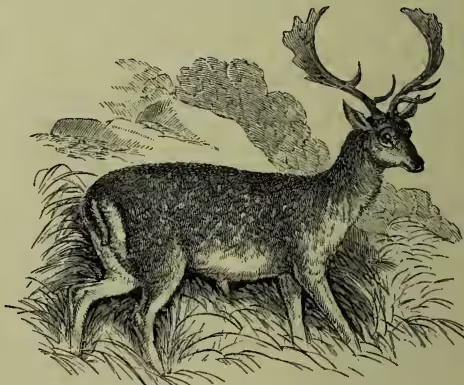
Fallow-deer (Dama vulgaris), a native of the Mediterranean districts of Europe, Asia, and Africa, whence it has been introduced into other countries, such as Britain, where it leads a vigorous semi-domesticated life in many parks. It is a very graceful animal, standing about 3 feet high at the shoulders, coming in stature between the Roe-deer (q.v.) and the Stag (q.v.). The usual summer colour is reddish-brown with white spots, while in winter the spots are fewer and the general shade grayer. The tail is black above, white below. There are, however, numerous colour varieties—e.g. white forms. The antlers, which are confined to the bucks, or males, are cylindrical at the base, give off two tines at some distance apart, and then form a shovel-like or palmate expansion. The young male of the first year has no antlers, and the increasing annual development is marked for six years. Fawn, pricket, sorrel, soare, buck of the first lead, and buck complete are the names used to distinguish the various grades. The eyes and ears are large, and under the former there lie conspicuous sub orbital cavities, which are wholly glandular, and not 'breathing places,' as Gilbert White and others have supposed. The breeding season is in October, and the doe bears in June. There is generally a single fawn, though occasionally two. The fallow-deer seem naturally timid and gentle, and become readily accustomed to man. The flesh is much esteemed.
As to the introduction of this southern species into north Europe, certain information is wanting. It seems to have been unknown in Germany till the 16th century. James VI. of Scotland introduced a hardy variety from Norway, when he brought home his queen, Anne of Denmark. Sir V. Brooke describes a second species (D. mesopotamica) from Persia. The extinct Irish Elk is believed to have been allied to the imported species. See DEER.