Fan-tracery Vaulting, a kind of Late Gothic vaulting (15th and 16th centuries), so called from its resemblance to a fan. The ribs or veins spring from one point, the cap of the vaulting shaft, and radiate with the same curvature, and at equal intervals, round the surface of an inverted curved cone or polygon, till they reach the semicircular or polygonal ribs which bound the upper part of the cone and divide the roof horizontally at the ridge level into diamond and other patterns. The spaces between the ribs are filled with foils and cusps, resembling the tracery of a Gothic window; hence the name fan-tracery. The spaces between the outlines of the fans at the ridge level are called by Professor Whewell (German Churches) ridge lozenges. In Henry VII.'s Chapel, Westminster, one of the best examples of this kind of vaulting, these lozenges are occupied by pendants, which produce a very astonishing effect, looking like arches resting on nothing. They are, however, supported with great ingenuity by internal arches, rising high above the visible vaulting.
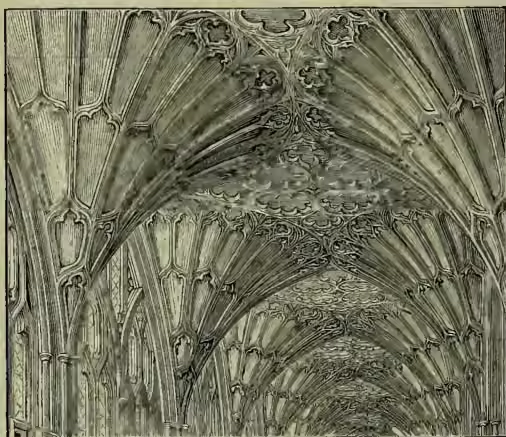
From the Cloisters, Gloucester Cathedral.
This arrangement is one of those tours-de-force which astonish the vulgar, but are only adopted when art has reached a low level and has in a great measure given place to artifice. Fan-tracery is a very beautiful kind of vaulting, and is peculiar to England, where it originated, and where alone it was practised. Among the finest examples are St George's Chapel, Windsor, and King's College Chapel, Cambridge. Fan-tracery is also frequently used in the vaulting of cloisters, as at Gloucester, Canterbury, and Chester.