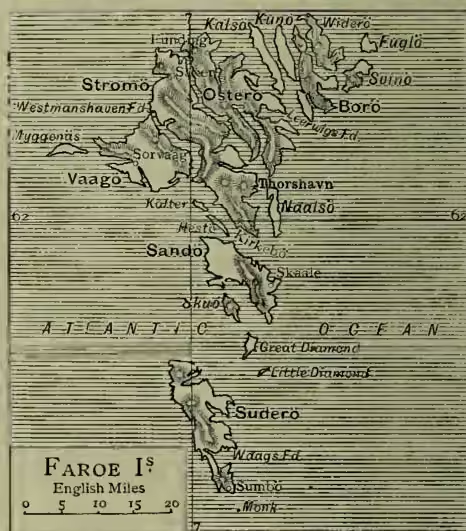
Faroe Islands (Dan. Faar-Öer, 'sheep islands'), a Danish group of islands, twenty-two in number, of which seventeen are inhabited, lying between the Shetlands and Iceland, 200 miles NW. of the former, in 61° 25'—62° 25' N. lat., and 6° 19'—7° 40' W. long. Their area is 513 sq. m., and their population (1850) 9150; (1890) 12,954. The islands are the remains of a single continuous plateau, originally trenched by deep erosion valleys, which, being inundated by the sea during a subsequent era of depression of the land, became converted into fjords and sounds. Geologically they consist of volcanic rocks, horizontally disposed beds of basalt predominating. Seaward they present rugged precipitous cliffs, ranging in height from 1000 to 2300 feet, whilst inland they rise into flat-topped pyramidal mountains, which attain maximum elevations of 2502 feet in Skellingfjeld in Strömö, and of 2895 feet in Slattaretind in Österö. The currents that run through the sounds are swift and dangerous; storms and whirlwinds are frequent; and the harbours and anchorages in the fjords and bays are not very secure, but, on the other hand, nearly always free from ice. For, though the climate is misty and moist, the winters are comparatively mild. Peat and coal are used for fuel. Trees there are none, owing to the storms; timber for building purposes is imported from Norway. Tillage is confined to the cultivation of a few vegetables, and attempts, not always successful, to grow barley. The principal sources of wealth are sheep-farming, wild-fowling, and fishing; and the products of these, including wool, feathers, salt and dried fish, train-oil, and skins, are the principal exports, sent for the most part to Denmark. The largest islands are Strömö (28 miles long by 8 broad), Österö, Vaagö, Sandö, and Süderö. The capital of the group is Thorshavn in Strömö, with 984 inhabitants; the town of Kirkebø, on the same island, was formerly the seat of a bishop. The inhabitants, of Norse descent, are simple and grave in their manners, and industrious in their habits. They speak an Old Norse dialect, though modern Danish is the language of law-courts, churches, and schools. They belong to the Lutheran Church. Since 1854 the islanders have enjoyed a certain amount of self-government under the control of three Danish administrative officers, who officiate as governor, police-inspector, and judge respectively. They send two representatives to the Danish parliament, one to the Upper House, chosen by the popular assembly of the islands, the other to the Lower House, elected directly by the people themselves. From the time of their first colonisation in the 9th century the Faroe Islands belonged to Norway down to 1380, in which year they passed to Denmark. The natives possess a number of ancient epical ballads (kvaði), the most important group being the Sjúrðar Kvaði, or songs of Sigurd (ed. with grammar, glossary, &c. by Max Vogler, i. Paderborn, 1877). The chief names in the native literature are Svabo (1746-1824); N. Mohr (1742-90); J. H. Schröter (1771-1851), the first to devote much attention to the prose literature—some of the folk-stories he collected are to be found in Antiquarisk Tidsskrift (1849-51); the patriotic Poul Nölsö (1766-1809), whose Vogellied is the most popular modern poem in the Faroe dialect; and Venzel Ulrik Hammershaimb (born 1819), editor of Færöiske Kvæder (1851-55).
The only newspaper is printed mostly in Danish. There is a grammar (1854) by Hammershaimb, who has also translated into modern dialect the so-called Fereyningasaga. Till the publication of J. Russell Jeaffreson's The Faroe Islands (1898) the best books were French (Leclercq, 1883; Labonne, 1888).