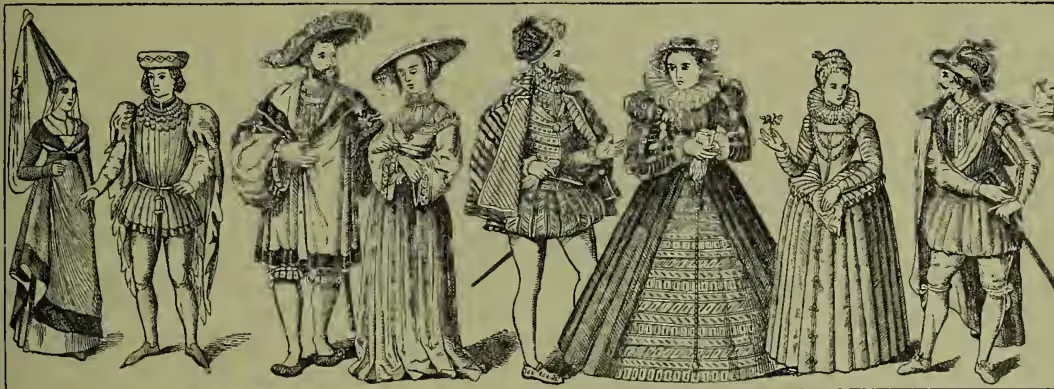
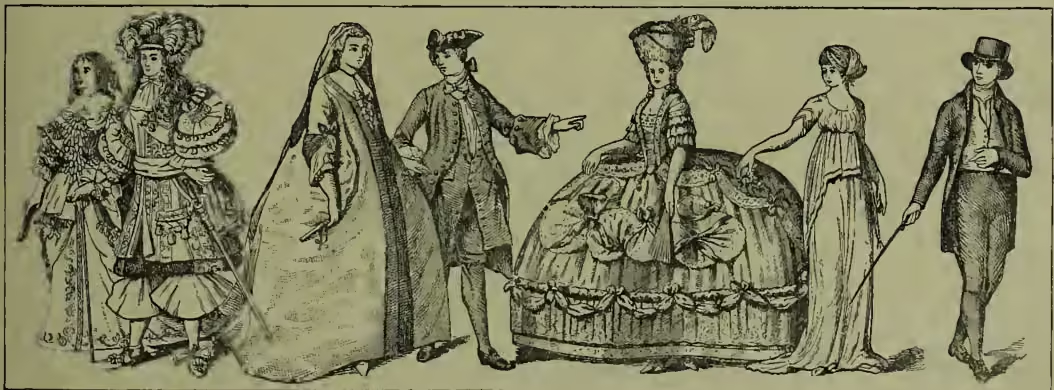
Fashion and Fashionable, terms applied to occupations, pursuits, education, and manners, as well as to most of the luxuries and necessities of modern civilised life, denote an unending series of changes and modifications which are most marked and most apparent in the department of dress. Such variations of costume were unknown to most nations of the ancient world, and among the Romans only influenced the accessories of the toilet. The unchanging East is as unchanging in its dress as in everything else, and the fashions to which savage tribes uncompromisingly adhere remain unaltered for long periods. In some remote districts of European countries peasants still dress in the costume brought two or three hundred years ago by the local nobility from court, and the smock-frock of the English agricultural labourer is a relic of Saxon times. The natural conservatism of man often throws strong light upon long-forgotten social history, and nowhere more than in the survivals in modern costume. Thus, as Mr Tylor points out, there is much to be learnt from so quaintly cut a garment as the modern evening dress-coat. 'The cutting away at the waist had once the reasonable purpose of preventing the coat skirts from getting in the way in riding, while the pair of useless buttons behind the waist are also relics from the times when such buttons really served the purpose of fastening these skirts behind; the curiously cut collar keeps the now misplaced notches made to allow of its being worn turned up or down; the smart facings represent the old ordinary lining; and the sham cuffs now made with a seam round the wrist are survivals from real cuffs, when the sleeve used to be turned back. Thus, it is seen that the present ceremonial dress-coat owes its peculiarities to being descended from the old-fashioned practical coat in which a man rode and worked.' Again, the English clergyman's bands are directly traceable through intermediate stages to the wide collars which everybody wore in Milton's time, the very name of which also survives in our word bandbox. And it is said that the modern cylindrical hat is the indirect descendant of the Puritan steeple-crowned hat, carried across the Atlantic by the Pilgrim Fathers, thence again to France, when Benjamin Franklin and the young Republicans were the height of the fashion, and by the French manipulated into the hat which they have given to all the world.
The Romans spread their dress with their civilisation over Europe, and it was gradually modified by the close-fitting garments of the races of the north till the two styles were united in the 5th century; but fashion in its modern sense cannot be said to begin till the 14th century. Then complaints first arise of clothes being cast aside for others of newer shape and cut. It must be remembered that till the 19th century men's clothes were as delicate in colour and as rich in material as women's; Pepys records in his diary how he had his wife's gowns cut up into waistcoats for himself. The change during the 14th century from close-fitting tunic and hose to long, loose garments trailing on the ground is even more startling than the outcrop of steeple-like headgear which distinguished the ladies of the 15th century.
The sumptuary laws of the 13th, 14th, 15th, 16th, and 17th centuries clearly show that dress was originally a symbol of rank, strictly prescribed for the various classes of society. An early French law complains of each man clothing himself as he pleased, without reference to his rank, so that it was impossible to tell from his dress whether he was a prince, nobleman, citizen, or labourer. In modern days this state of things is fulfilled to the letter, though costume still retains its old significance in the uniforms of the army and navy, of policemen and postmen, in the lawyer's wig and gown, the judge's robe, the bishop's lawn sleeves, and the university student's cap and gown, all of which, as Mr Herbert Spencer remarks, are worn by people whose office it is to uphold established arrangements in church and state. The railway companies and the Post-office impose a uniform on their employees, the maid-servant (in Britain) wears a cap and apron, and the waiter a black suit, but the only class who at all times voluntarily mark themselves off from other men are the clergy. Political and religious opinions have been at times symbolised by dress, as with the Puritans and Quakers; and instances of such distinguishing marks as the tricolor of France, the white cockade of the Bourbons and the Stuarts, the blue and green of the factions in the circus of ancient Constantinople, the orange and green of Irish political parties, and the blue and buff of English elections might be multiplied indefinitely. Dress attained its highest point of significance in France during the last half of the 18th century, when it marks unmistakably the various stages of the Revolution. Rousseau's Émile and Nouvelle Héloïse and Goethe's Werther brought sentimentality into fashion; women's hair was dressed in bandeaux d'amour or poufs de sentiment; and Marie Antoinette and the ladies of her court sought to return to the simplicity of nature by masquerading in the Trianon attired as shepherdesses and milkmaids. The works of Montesquieu and Voltaire had created an admiration for England, and the courtiers of Versailles dressed themselves like English foxhunting squires, while their wives and daughters got themselves up à l'Anglaise in coats with cuffs, collars, and facings, beaver-hats, and cravats. As the political turmoil increased, fashionable attire grew more and more eccentric and multiform, till at last republican institutions triumphed, and the women of France began to clothe themselves as like as possible those of Greece and Rome both in style and scantiness. They discarded costly materials, and shivered through the winter months clad in a few yards of muslin. Men wore a combination of antique and romantic costume invented by the painter David, which was finished off with Hungarian boots. The gorgeous and stately dress of the courts of Louis XIV. and Louis XV. had disappeared with the old régime. At the present time the fashions for women in all civilised countries are set by Paris; for men, though not so exclusively, by London.
One marked feature of the ever-changing kaleidoscope of fashion is its tendency to revolve in cycles. The widely-distended skirts of the 16th century reappear in the 18th and 19th centuries after periods of straight-falling folds; the piles of false hair, artificial flowers, feathers, and jewelry which reached their greatest height on ladies' heads about 1780 have had their modified counterpart in the modern chignon; men's nether garments are by turns skin-tight or loose and full; and the voluminous folds of muslin in which they swathed their necks at the beginning of this century recall in some degree the ruffs of Queen Elizabeth's courtiers. Cycles of alternate luxury and simplicity have also distinguished all ages, though the simplicity of fashion is often more apparent than real. There can be little doubt that fashions change more quickly each decade, a fact due in great measure to increased facilities of communication, while the triumph of democracy is shown by their universal adoption by all classes. The question cannot but arise whether in this continual variation the most advantageous and artistic costumes for men and women may not at last be found and kept, but the probabilities seem to be against such a conclusion. Lotze in his Microcosmus starts the theory that we prolong the consciousness of our personal existence into any foreign body brought into relationship with the surfaces of our own body, so that we feel ourselves grow taller with our high headgear, move with our fluttering laces and ribbons, and derive vigour from the feeling of resistance arising from a tight band or belt. At the same time it is generally allowed that we are more alive to a new sensation than to one which has been long in the field of consciousness, for, from the very fact that it is unusual, our attention is continually directed to it, while a well-known sensation loses its first intensity and the power of directing our thoughts to itself. In order, therefore, that our clothes may yield us the maximum of pleasant feeling which Lotze says we derive from them, they must not be too familiar in shape, colour, and cut—i.e. we must not only have new clothes, but new styles of clothes. But a volume would be required to determine whether this theory satisfactorily accounts for all the changes of fashion.
See Fairholt, Costume in England (new ed. 1885); Planché, Cyclopaedia of Costume (1876-79); Challamel, History of Fashion in France (Eng. trans. 1882); Herbert Spencer's Ceremonial Institutions (1879); Iobida, Nos Aïeules (trans. as Ten Centuries of Toilet, by Mrs Cashel Hoey, 1892); Georgiana Hill, A History of English Dress (1893); and the articles BLOOMER COSTUME, CRINOLINE, HAIR-DRESSING, HAT, BEARD, WIG, FAN, TATTOOING, &c.