Felidæ, a family of carnivores in the digitigrade or æluroid section, corresponding to the genus Felis of Linnæus, and to what we commonly call the cat tribe. They include the most carnivorous of Carnivora, excelling the less specialised forms, just as falcons and eagles are in a similar direction more perfect than many other less predacious birds. Their chief characteristics of habit and structure may be taken together, being obviously complementary.
Conspicuous for their muscular development, they express this most characteristically in the sudden leaps and bounds to which they trust after stalking their prey with all the cunning of true hunters. They crawl stealthily on noiseless, velvety paws, or patiently lurk for passing victims; at the fit moment occurs a sudden, almost explosive, output of reserved energy, a great bound, a yell inspiring terror, a blow or two with the powerful forelimbs, and the sharp canines and sharper retractile claws begin their murderous work on the struggling prey. With the exception of the lion, the Felidæ are more or less arboreal, and make good climbers.
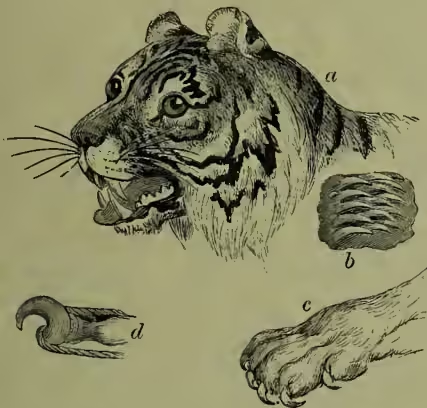
The body is rather long, and very lithe and graceful; the limbs are rather short, except in cheetahs and lynxes; the tail varies from a long appendage to a mere stump. They are the most digitigrade of carnivores—i.e. they walk on the tips of their (five) fingers and (four) toes. Under a glove of velvet they have claws of iron—strong, much curved, very sharp, and retractile; withdrawn by special muscles and ligaments into sheaths when not in use, and their points even turned upwards, so that they are not blunted by unnecessary friction, and do not interfere with the movements of the animal by hooking objects which are in the way. The collar-bones or clavicles, though unattached to shoulder or sternum, are better developed than in other carnivores.
The Felidæ never bury or store their dead prey, but often drag it off to some place of shelter, and in so doing exhibit enormous strength. The leaps a lion can take with a mouthful half as big as itself are herculean marvels. Besides the strength of grip, the powers of rending and mastication are equally well developed. Thus, we find a skull which tends to be short, broad, and rounded, with large posterior ridges for the fixing of muscles, and with a wide cheek (zygomatic) arch in which lie the relatively enormous muscles working the jaws. The latter form powerful short levers, and the articulation is such that only an up and down, and no rotatory, motion is possible.
The teeth are well adapted for their work, the chief features in the dentition being the large size, strength, and sharpness of the canines, and the two specially adapted cutting teeth ('carassials' or 'sectorials')—viz. the last premolar above and the single molar below, which are both compressed into sharp blades. The front teeth are relatively small, and so, but more markedly, is the molar on the upper jaw. The numerical relations of the teeth may be summed up in the formula . The well-known character of the tongue, most conveniently exemplified in the cat, is also to be associated, as far as utility is concerned, with the carnivorous diet. It is thickly covered with sharp, recurved, horny papillæ, strong enough to rasp off the skin and draw blood from the hand, and obviously useful in clearing the flesh off the bones of victims. As is usual in carnivorous animals, the cæcum of the intestine is small and simple. The food varies widely, from the large ruminants attacked by lions and tigers to the mice for which cats hunt. Some of the large forms are said to develop a special partiality for human flesh; some of the smaller do not disdain to eat big insects. In attack the Felidæ often exhibit a wise discretion in seeking to avoid a fair fight with large animals.
Many members of the family have exceedingly beautiful fur, soft and glossy in texture, generally striped and spotted according to the varied pigmentation of the hairs. The markings in some may be regarded as protective; thus, the stripes of the tiger 'assimilate,' according to Wallace, 'with the vertical stems of the bamboo,' and the spots of the leopard are suited to the interrupted light of the jungle. It seems also true, as Eimer has emphasised, that the markings illustrate definite rhythms of development, and exhibit an orderly progression both in the individual and in a series of related forms. They are in fact, here as elsewhere, external indices to constitutional changes. The colour-differences between the sexes are seldom marked, though they are distinct in the Ocelot (Felis pardalis) and a few other forms. The male lion, stronger and larger than the female, is distinguished by his mane, which appears to have protective as well as decorative value. The male Canadian Lynx (F. canadensis) also excels his mate in the development of a ruff round the neck. The Felidæ are very cleanly, taking pains to keep their fur in order, and are free from unpleasant smells. They have, however, a notorious dislike to water.
As one would expect from their habits, the senses of Felidæ are highly developed. Keen scent; quick sight, especially for near objects, and well suited for night-work; acute hearing, and great power of localising sounds; and a delicate tactile sensibility in the strong hairs of the moustache or whiskers, are characteristic. The eyes are large, and possess marked powers of accommodation to different quantities of light; the pupillary opening is rapidly altered, contracting in bright light to a narrow slit, though in some forms into the usual circular shape. The animals generally hunt at night, and then their eyes seem to 'burn brightly.' The ears are of moderate size, usually pointed, and mobile.
The intelligence of the family is certainly highly developed, and many of the members can be readily tamed when young, though a deeply ingrained wildness keeps the domesticated cat or tamed individuals of other species from exhibiting the marvellous educational results familiar in dogs. They are not social animals, never hunting in troops, and even the males and females usually live apart except at the breeding season. In spite of the individualism and ferocity of the Felidæ, maternal care and affection are exhibited in a high degree. Not only will a lioness robbed of her cubs risk her life to rescue them, but the habitual care is tender and lavish.
The wild Felidæ seem to be less prolific than the Canidæ, two or three at a birth being an average number. There are usually eight teats, lying on the breast and the abdomen.
While the above are the chief characteristics of Felidæ, it is necessary also to notice that the family is separated from the adjacent civets (Viverridæ) and hyenas (Hyænidæ) by technical details such as the reduction of molars to one above and one below in each jaw, the presence of only two inferior premolars, the division of the bony auditory prominence or tympanic bulla into two chambers, the number (thirteen) of dorsal vertebrae, and so on.
The Felidæ are almost world-wide in distribution, absent only from the Australian region, Madagascar, and the Antilles. They are especially abundant in warmer climates. In the Old World, Lion (Felis leo), Tiger (F. tigris), Leopard or Panther (F. pardus), Ounce (F. uncia), Wild Cat (F. catus) are well-known species; while in the New World may be noted the Puma (F. concolor), the Jaguar (F. onca), and the Ocelot (F. pardalis). The Lynx (F. lynxus) is probably common to both hemispheres. The Cheetah or Hunting Leopard is sometimes placed in a separate genus, Cynælurus.
Numerous Felidæ occur in Tertiary strata, many quite like species now alive, others with more numerous and less carnivorous teeth, others again (e.g. Smilodon, Machærodus, and especially Eusmilus) with much greater development of upper canines than in modern forms. Through extinct American genera like Nimravus, Professor Cope traces back the modern Felidæ to a race of primitive unspecialised cats. So far as natural selection means the destructive elimination of one animal by another, the Felidæ must rank high as agents in the process, and it is at least certain that their abundant presence must exert an often wholesome restraining influence on many more prolific animals. See CARNIVORA, CAT, CHEETAH, JAGUAR, LEOPARD, LION, LYNX, OCELOT, OUNCE, PUMA, TIGER, &c.