Fencing may be generally described as the scientific handling of a sword or bayonet in attack or defence, though the term is usually limited to the use of the rapier. It is taught in every gymnasium, and in the British army every officer on joining is put through a course of gymnastics of which it forms a part. Non-commissioned officers are taught at the Aldershot Gymnasium, and then appointed instructors in the various garrisons where gymnasiums exist, and to all cavalry regiments, the troopers of which are also trained by them.
FENCING WITH THE RAPIER OR FOIL is admitted to be the best exercise that can be taken. Every muscle of the body is brought into play by it, and hand and eye are trained to act in unison. No description can pretend to teach it. Even an instructor who is not thoroughly capable does more harm than good in attempting to teach fencing, as bad habits are acquired which it is most difficult to unlearn; and, unless every movement is accurately and properly made, there is no science and very little interest in its practice.
The foil in practice used as a substitute for the rapier should have a tapering blade about 32 inches long, and square in section, with a gutta-percha button on the point, and a weighted pommel to the hilt, so as to balance it properly. Masks of wire netting are absolutely essential to protect the face, and leather gloves, jackets, and aprons should also be worn.
Except in Spain, where one straight cut at the head is allowed, the only attack with the rapier or foil is by thrust and lunge (or lunge)—i.e. straightening the elbow so as to bring the sword and arm into line, and then striding forward about 18 inches with the right foot. The defence is by slight movements of the sword hand, which cause the faible (upper half) of the assailant's blade to glide along the forte (lower half) of the defender's foil, and outside it, so as to pass clear of his body, while his point is always kept towards the front, ready to ripost (longe after parrying) without an instant's delay. The proper positions and movements when on guard, engaged, longeing, parrying, advancing, and retreating must be most carefully learned from an instructor, and assiduously practised, as well as the various attacks. A reproduction (fig. 1) of the diagram given by Captain Chapman in his excellent little book, Foil
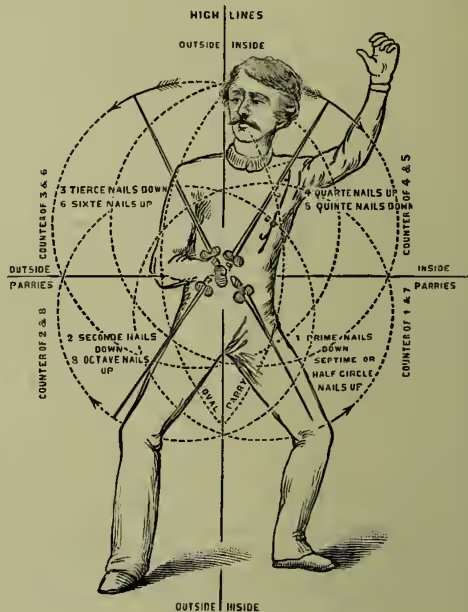
Practice, shows the four lines of attack and the nine parries usually taught. It will be sufficient to mention that a counter parry describes a circle under or over the adversary's foil before throwing it off, and to add the following explanation of terms used in fencing. When the nails are uppermost the sword hand is said to be in supination, when under, in pronation. The thrusts, like the parries are called quarte (or carte), tierce, &c. The flaneonade is an attack made by the assailant binding his blade round the adversary's and longeing at his body under his arm. An attack may be a combination of any of the following movements preceding a longe: disengage, when swords are crossed, changing from one line of attack to another by passing under the adversary's sword; cut over, the same change by whipping over his sword; one, two, a double disengagement; double, both blades horizontal, and circling round parallel to one another; beat, a side-blow of one blade on the other. If a second thrust is made after longeing, and without springing up to guard again, it is called a reprise; and, if made to take advantage of a wide parry not followed by a ripost, a remise. Time thrusts, like cross-counters in boxing, parry a thrust by a thrust.
The system of fencing compiled by Mr Archibald Maclaren, of the Oxford Gymnasium, is that used in the British army, and differs from others in teaching only four parries—viz. quarte, tierce, seconde, and semicircle. All are formed in the usual manner, except the last, which, by raising the hand slightly and elevating the blade as high as the face, guards both the upper and lower openings on the inner or left side, carrying the adversary's blade over the right shoulder, and leaving him completely exposed to the return thrust. In Spain and Italy the left hand is used as an auxiliary in parrying, and in Italy is aided by a dagger, or a cloak.
THE BROAD-SWORD EXERCISE differs from fencing with the foil, in that the weapon employed is intended to cut as well as thrust. For practice a stout, straight stick is used, called a 'single-stick,' having a buffalo-hide or basket handle to protect the knuckles.
The position and movements of the combatant are very similar to those for fencing with the foil.
There are seven cuts, with seven corresponding guards, and three thrusts, as shown on the accompanying diagram, which represents a target placed opposite a pupil, with its centre in a line with the centre of his breast.
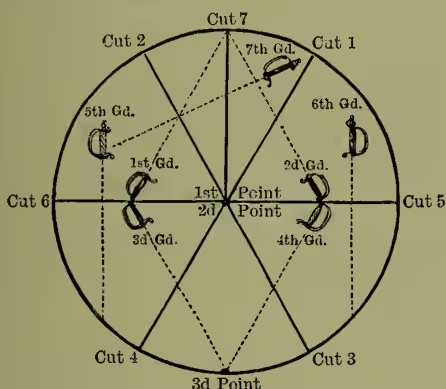
The cuts cross the whole circle through the centre along the thick lines. Nos. 1, 3, and 5 are inside cuts, and may be directed against any part of the left side, and inside of the right leg; 2, 4, and 6 are outside cuts, attacking the right side, and right leg on the outside. No. 7 is a vertical cut, aimed at the head. The dotted lines show the several guards. The points or thrusts are shown by the black dots. The 'parry' consists in bringing the wrist nearly to the right shoulder; whence, as centre, a circular sweep of the sword is made from left to right.
CAVALRY SWORD EXERCISE differs from the foregoing, which is not suitable for horsemen. It has four cuts on each side, two at a mounted, and two at a dismounted adversary. Each cut has a corresponding point and guard.
THE BAYONET EXERCISE taught in the British army has been assimilated to Maclaren's system of fencing. The guards are formed in as nearly as possible the same manner, except that, of course, the rifle is held in both hands, one at the grip, and one in front of the back-sight. The latter remains almost stationary, while the movements of the other form the parries. A new and most effective thrust, called the throw, has been introduced. When making it, the forward hand quits the rifle, which is thrown forward to the full extent of the other arm.
As to the relative values of the sword, rapier, and bayonet, the first, requiring for each cut two motions, one up and the other down, cannot but be much slower in its action than either of the other two; while the last, from its weight, is exhausting and clumsy. The second, on the other hand, has none of these objections, and in skilled hands is by far the most deadly weapon.
See Captain Chapman's Foil Practice; Maclaren's System of Fencing (1864); Captain A. Hutton's Cold Steel (1889); the Manuals of Sword and Bayonet Exercise published by the War Office; and Fencing, Boxing, and Wrestling in the 'Badminton' series, by Grove, Pollock, Armstrong, and Prévost (1889).