Fillan, ST, was the son of Feredach, a prince of Munster, and of St Kentigerna, who in 734 died on Incheailloch in Loch Lomond. He succeeded St Mund as abbot of the monastery on the Holy Loch, but presently withdrew to Upper Glendochart (Strathfillan), 3 miles SSE. of Tyndrum, where he died on 9th January 777. In 1318 Robert Bruce re-established here an Augustinian priory; and here too was the 'holy pool of Fillan,' in which, not a century since, sick people bathed, and lunatics were plunged. The latter were afterwards left all night, bound hand and foot, in a stone coffin; and if in the morning the knots were
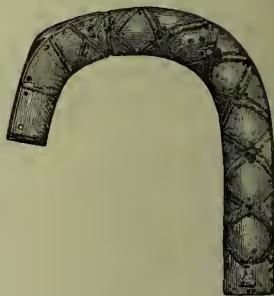
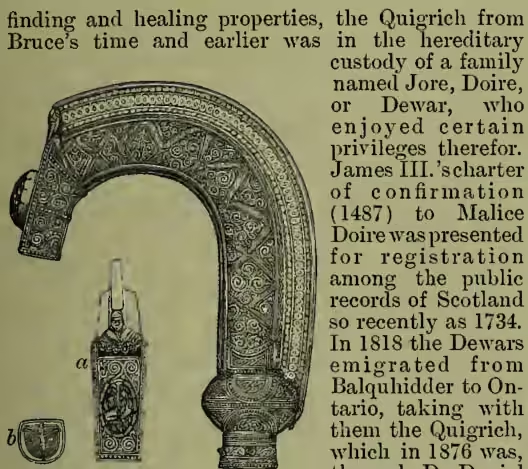
Fig. 1.—Quigrich of St Fillan. untied there was hope of recovery. Two relics of the saint have, after strange wanderings, been reunited at Edinburgh in the Antiquarian Museum. One, his square-shaped bell of cast bronze, 12 inches high, lay in the churchyard, and was employed in that lunatic 'rope-trick,' till in 1798 an English tourist bore it off to Hertfordshire, whence in 1869 it was recovered through Bishop Forbes of Brechin. The other relic is the Quigrich (Gael. cogyrach, 'stranger')—the bronze head of a pastoral staff (fig. 1), adorned with niello, and inclosed in a beautiful outer case of silver (fig. 2), 9 inches high, gilt, and ornamented with chased work and filigree. Both are undoubtedly of Celtic workmanship; but the case is naturally the later of the two, and seems partly assignable to the 14th and 15th centuries. Possessed of both thief-
Wilson, bought for £100 by the Scottish Society of Antiquaries. St Fillans, at the foot of Loch Earn, is associated with an earlier saint, called an lobar, 'the leper,' whose feast fell on 20th June. See Dr John Stuart's 'Historical Notices of St Fillan's Crozier,' in Proc. Soc. Ant. Scot. (xii. 1877), and Dr Joseph Anderson's Scotland in Early Christian Times (i. 1881).