Filter. When solid matter is suspended in a liquid in which it is insoluble, it may be separated by various means (see CLARIFICATION), one of which is filtration. The process of filtration consists in passing the liquid through some porous substance, the interstices of which are too small to admit of the passage of the solid particles, the principle of the action being the same as that of a sieve. One of the simplest forms of filter is that commonly used in chemical laboratories for separating precipitates, &c. A square or circular piece of blotting-paper is folded in four, the corner where the four folds meet is placed downwards in a funnel, and one side is partly opened, so that the paper forms a lining to the funnel. The liquid passes through the pores of the paper, and the solid matter rests upon it. The chief advantages of this filter are its simplicity and the ease with which the solid matter may be removed and examined.
A simple water-filter for domestic purposes is sometimes made by stuffing a piece of sponge in the bottom of a funnel or the hole of a flower-pot, and then placing above this a layer of pebbles, then a layer of coarse sand, and above this a layer of pounded charcoal three or four inches in depth. Another layer of pebbles should be placed above the charcoal, to prevent it from being stirred up when the water is poured in. It is obvious that such a filter will require occasional cleaning, and renewal of the charcoal. By a small addition to this a cottage-filter may be made which, for practical use, is quite equal to the most expensive filters of corresponding size. It consists of two flower-pots, one above the other; the lower one is fitted with the sponge and filtering layers above described, and the upper one with a sponge only. The upper pot should be the larger, and if the lower one is strong, the upper one may stand in it. The two pots thus arranged are placed upon a three-legged stool with a hole in it, through which the projecting part of the lower sponge passes, and the water drops into a jug placed below. The upper pot serves as a reservoir, its sponge stops the coarser impurities, and thus the filtering layers of the lower one may be used for a long period without being renewed, if the upper sponge be occasionally cleaned. Care must be taken to wedge the upper sponge tightly enough, to prevent the water passing from the upper pot more rapidly than it can filter through the lower one.
A great variety of filters are made on a similar principle to the above, but constructed of ornamental earthenware or porcelain vessels of suitable shape. In purchasing a filter, the buyer must not be satisfied with merely seeing that the water which has passed through it is rendered perfectly transparent—this is so easily done by a new and clean filter—but he should see that the filter is so constructed as to admit of being readily cleansed, for the residual matter must lodge somewhere, and must be somehow removed. When large quantities of water have to be filtered this becomes a serious difficulty, and many ingenious modes of overcoming it have been devised. In most of these water is made to ascend through the filtering medium, in order that the impurities collected on it may fall back into the impure water. Leloge's ascending filter consists of four compartments, one above the other; the upper part, containing the impure water, is equal in capacity to the other three.
This communicates by a tube with the lowest one, which is of small height. The top of this is formed by a piece of porous filtering-stone, through which alone the water can pass into the third compartment, which is filled with charcoal, and covered with another plate of porous stone. The fourth compartment, immediately above the third, receives the filtered water, which has been forced through the lower stone, the charcoal, and the upper stone. A tap is affixed to this, to draw off the filtered water, and a plug to the second or lowest compartment, to remove the sediment.
A large number of other ascending filters have been patented. Siphon filters are cylindrical pewter vessels, containing the filtering media, to which is attached a long coil of flexible pipe. When used, the cylinder is immersed in the water-butt or cistern, the pipe uncoiled, bent over the edge of the cistern, and brought down considerably below the level of the water. It is then started by applying the mouth to the lower end, and sucking it till the water begins to flow, after which it continues to do so, and keeps up a large supply of clear water. This, of course, is an ascending filter, and the upward pressure is proportionate to the difference between the height of the water in the cistern and that of the lower end of the exit tube (see SIPHON). Filtering on a large scale is effected by using several tanks or reservoirs, in the first of which is coarse material such as gravel, the water passing from this to a second, and from there through a finer filter to the main receptacle, where the filtered water is stored and drawn off for use.
A common water-butt or cistern may be made to filter the water it receives by the following means: Divide the cistern or butt into two compartments, an upper and a lower, by means of a watertight partition or false bottom; then take a wooden box or small barrel, and perforate it closely with holes; fit a tube into it, reaching to about the middle of the inside, and projecting outside a little distance; fill the box or barrel with powdered charcoal, tightly rammed, and cover it with a bag of felt; then fit the projecting part of the tube into the middle of the false bottom.
Various means of compressing carbon into solid porous masses have been patented, and filters are made in which the water passes through blocks of this compressed carbon. Most of these are well adapted for the purpose, but their asserted superiority over filters composed of layers of sand and charcoal is doubtful. A very elegant and convenient portable filter for soldiers, travellers, and others who may require to drink from turbid ponds and rivers is constructed of Ransome's filtering-stone, and is also made of the compressed carbon. A small cylinder of the stone or carbon is connected with a flexible india-rubber tube in such a manner that the cylinder may be immersed in a river, the mouth applied to a mouthpiece at the other end of the tube, and the water drawn through the filtering-cylinder.
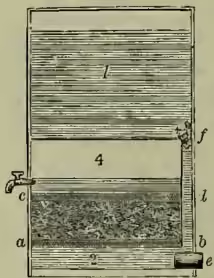
It has been questioned whether soluble matter, such as common salt, is in any degree removed from water by filtration. Theoretically it was assumed that this is impossible, since the filter only acts mechanically in stopping suspended particles; but the results of experiments show that from 5 to 15 per cent. of the soluble salts were separated by sand-filters such as above described. Another most important matter is to ascertain to what extent soluble organic matter may be decomposed by filtration, especially by charcoal filters, and to ascertain how long charcoal and other porous matter retains its property of acting on organic matter in watery solution (see CHARCOAL). This is of the highest importance, as it sometimes happens that water of brilliant transparency, and most pleasant to drink, on account of the carbonic acid it contains, is charged with such an amount of poisonous organic matter as to render its use as a daily beverage very dangerous. A filter of animal charcoal will render London porter colourless. Loam and clay have similar properties. The separation from drinking-water of pathogenic microbes (microscopic sources of pestilence) and their germs is very 1, 2, 3, 4, the four compartments; ab, the first porous stone of third or filtering compartment; cd, the exit filtering stone of d; e, the plug to remove for cleaning out second compartment; f, a loose sponge at entrance of communicating tube. difficult, on account of their extreme smallness; but it has been effected by using porous unglazed earthenware as the filtering medium. It is, however, rather troublesome in practice, as pressure is demanded, and the very fine pores are soon clogged. They may be cleansed by raising the filter material to a red heat. A duplicate is therefore required.
When a liquid contains mucilaginous or other matter having viscous properties, there is considerable difficulty in filtering it, as the pores of the medium become filled up and made watertight. Special filters are therefore required for syrups, oils, &c. Such liquids as ale, beer, &c. would be exceedingly difficult to filter, and therefore they are clarified by the admixture of albumen, gelatin, or some substance with clarifying properties. Oil is usually passed through bags made of horse-hair or twilled cotton cloth (Canton flannel). Syrups are filtered on a small scale by confectioners, &c. by passing them through conical flannel bags, and on a large scale in creased bag-filters, made by enclosing a large bag within a smaller one. Thick syrups are clarified with white of egg, and then they may be filtered through a coarse cloth strainer. A recent theory is that the efficiency of filters, so far from depending on the cleanness of the medium, is largely owing to the multitudes of microbes at work in the substance through which the liquor passes. For the treatment of vegetable juices, see BEER, WINE, SUGAR, &c.; and for filtering on the large scale, see SEWAGE, WATER. The simple laboratory filter has to be modified when strong acid or alkaline solutions, &c. require filtration. Pure siliceous sand, a plug of asbestos, pounded glass, or clean charcoal are used for this purpose.
Air Filters.—The extraordinary powers of charcoal in disinfecting the gaseous products evolved from decomposing animal and vegetable matter have been made available in constructing an apparatus for purifying air that is made to pass through it. A suitable cage, containing charcoal in small fragments, is fitted to the opening from which the deleterious gases issue, and is found to render them perfectly inodorous, and probably innocuous. Mechanical impurities suspended in air may be filtered out by forcing the air through a plug of cotton-wool, as in firemen's respirators.