Finial, an ornament, generally carved to resemble foliage, which forms the termination of pinnacles, gables, spires, and other portions of Gothic architecture. There are traces of foliated terminations, both in stone and metal, on the pediments of classic buildings (see ACROTHERION), but it was not till the 12th century that the finial proper was introduced. During the latter part of that century and the whole of the 13th century, finials of the most perfect form and of infinite variety were used as the crowning ornaments of every salient point in the buildings of the period (see fig. 1). The architects of the 14th century in finials, as in other ornaments, imitated more closely the forms of natural foliage; but their finials had neither the variety of design nor the vigour of outline of those of the preceding century (see fig. 2).
In the 15th and 16th centuries the finials became more and more meagre in form, and are frequently only four crockets set upon a bare pyramidal terminal. Some variety of effect is often obtained during this period by surmounting the finial with a gilded vane. This is common in Tudor and in continental domestic architecture (fig. 3). Finials were carved both in stone and wood, and in the latter material with great delicacy and minuteness. In connection with metal-work finials of metal were used, and, whatever the material adopted, its natural capabilities were made a source of special beauty.
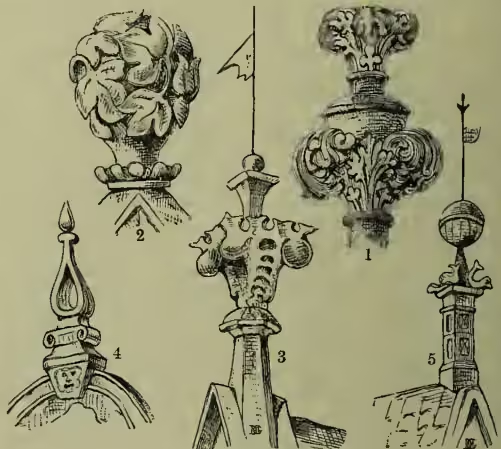
The finial is one of the most effective ornaments of Gothic architecture, and when that style was succeeded by the Renaissance, in the reign of Queen Elizabeth, our forefathers could not persuade themselves to part with the finials to their buildings. 1, from Bishop Bridport's Monument, Salisbury Cathedral; 2, York Minster; 3, Maulbronn, Germany; 4, Crew Hall, Cheshire; 5, Augsburg.
We thus find in Elizabethan architecture a great variety of finials; they are, however, almost entirely of a geometric form, and without foliage (fig. 4), and are frequently, especially when terminating wooden gables, combinations of finial and vane, partly wood and partly iron (fig. 5). In the stricter classic style which succeeded the Elizabethan, some traces of the favourite finial still remain in the balls, obelisks, &c. used as terminations, and also in the shields and supporters (themselves a remnant of feudal times) which form the crowning ornament of gate-piers, pedestals, &c.