Fir, a name applied in a comprehensive sense to the true Pines, the Larch, and certain other conifers, but more properly used to designate the Norway Spruce, the Silver Fir, and their congeners. These two species—now the types respectively of the genera Picea and Abies—were included in the Linnæan genus Pinus; thus, the Norway Spruce was P. Abies, and the Silver Fir was P. Picea. By these specific names the trees were known to Pliny and other ancient writers, but by inadvertence on the part of Linnæus they were misapplied so that each bore the other's name. This confusion was perpetuated when the species were removed from the genus Pinus, and set up as representatives of distinct genera. As kindred species were discovered and introduced, nomenclature became more confounded. Continental botanists endeavoured for long with only partial success to restore the names Picea and Abies to their ancient use. The point, however, has at length been conceded in the Genera Plantarum (1862-76) by Bentham and Hooker; but amateurs and students of coniferæ will still be confronted with the confused nomenclature of the species in works on the subject published prior to the adoption of the recent change of the generic names. Their difficulty will, however, be lessened by their bearing in mind that species hitherto ranged under Abies must now be named Picea; thus, for instance, the Norway Spruce is no longer Abies but Picea excelsa, and the Silver Fir is Abies pectinata, not Picea of that designation.—It should also be noted that some trees commonly called fir are really pines; thus, the Scotch Fir (Pinus sylvestris) is a pine. See PINE.
The genus Abies comprises some twenty-five or thirty species, which are easily distinguished from the Spruce Firs by their erect, cylindrical or but slightly tapering cones, the scales of which are deciduous and fall away in maturity from the axis, which adheres to the branch; and by their flattened leaves being always more or less distinctly arranged in two ranks on each side of the branches, and generally in a horizontal direction. The genus Picea consists of about twelve species, the cones of which are pendulous, and the scales persistent, opening only when mature to shed the seeds. The leaves are arranged spirally, scattered around the branches, needle-like and quadrangular or almost round. These are the broad essential distinctions of these two genera of firs, but they have some features in common. They are all evergreen-trees, mostly of spiral or pyramidal habit, their branches spring from the stem in whorls—a characteristic of certain other conifers—and the scales of the cones are thin or almost scarious at the apex, a point which distinguishes them from the true pines. The species of both are widely distributed over the extra-tropical regions of the northern hemisphere, and the Norway Spruce even penetrates within the Arctic circle.
The last-named species, Picea excelsa, is one of the noblest and most useful of European firs, attaining the height of from 80 to 150 feet, but with no proportionate diameter of trunk, which is usually rather slender compared with its height. It is a native of the north of Germany, Russia, and Norway, where it forms immense tracts of natural forest. Since its introduction into Britain about 1540, it has been extensively planted, chiefly as a nurse for more tender and slower-growing trees, for which purpose its evergreen character and hardy constitution adapt it well. It does not succeed in windy, exposed situations, nor in thin, dry soil, but in moist, alluvial soil it attains its highest development. It is the Fichte of the Germans, called also Rothtanne or Schwarztanne. It yields the same products as the Scotch Fir (Pine) — resin, turpentine, tar, and lamp-black (see these heads); but more resin than turpentine. The true Spruce Resin flows spontaneously from the bark. The purest pieces are whitish or pale yellow, are sold under the name of Common Frankincense, and used for ointments and plasters, and when melted yield the common Burgundy Pitch (q.v.). The bark of the spruce is a good and cheap non-conductor of heat; the cones are an excellent substitute for tanners' bark. In Sweden and Norway the inner bark is made into baskets; and the long and slender roots, split and boiled with alkali and sea-salt, are dried, and twisted into cordage, which is used both for shipping and by farmers. The wood is used for fuel and for house-building; it also supplies masts and spars for ships. It is the White Christiania deal and Danzig deal of the market, and is very largely imported into Britain from Norway and the Baltic. It is whiter, lighter, less resinous, and more elastic than the timber of Scotch Fir. The sap-wood, whilst still in a gelatinous state, is sweet, and is eaten fresh in Sweden and Lapland; and the inner bark, in times of scarcity, is mixed with a little flour or meal of some kind and baked into bread. The young shoots, still covered with their bud-scales, are in many parts of Europe used for fumigation. The leaf-buds are also employed medicinally in cases of scurvy, rheumatism, and gout. The pollen is often sold by apothecaries instead of the dust of the Clubmoss or Lycopodium.
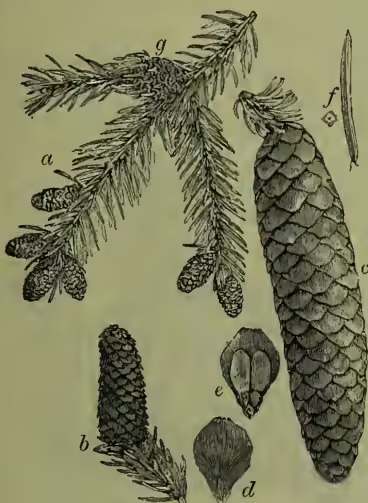
Norway Spruce Fir (Picea excelsa): a, branchlet with male flower; b, branchlet with female flower; c, mature cone; d, one of the scales of cone, outside; e, one of the scales of cone, inside, showing seeds; f, a leaf with cross section; g, gall, caused by punctures of Coccus abietis and other insects.
A very superior variety of this fir is known as the Red Norway Spruce. Dwarf varieties are cultivated amongst ornamental shrubs. The Black Spruce (Picea nigra), of which the Red Spruce (sometimes called P. rubra) is regarded as a mere variety caused by difference of soil, and the White Spruce (P. alba) form great woods in North America. The Black Spruce is found as far north as 65° lat. Both these species are now common in plantations in Britain. Both have quadrangular leaves; those of the Black Spruce are of a dark glaucous green, those of the White Spruce are of a lighter colour. The cones of the Black Spruce are short, ovate-oblong, obtuse, and pendulous, with rounded scales ragged at the edge; those of the White Spruce are oval, and tapering to a point, with entire scales. The Black Spruce is a valuable timber-tree, supplying yards of ships, &c.; but its planks are apt to split. The White Spruce is smaller, and the timber inferior. From the Black Spruce the Essence of Spruce is obtained, which is so useful as an antiscorbutic in long voyages, and is used for making spruce-beer. Spruce-beer is also made by adding molasses or maple-sugar to a decoction of the young branchlets, and allowing the whole to ferment. From the fibres of the root of the White Spruce, macerated in water, the Canadian Indians prepare the thread with which they sew their birch-bark canoes; and the seams are made watertight with its resin. From the twigs of the Oriental Fir (P. Orientalis), a native of the Levant, a very fine clear resin exudes, which is known by the name of Sapindus' Tears. This fir has very short quadrangular leaves, densely crowded and uniformly imbricated. Menzies' Spruce (P. Menziesi) and Patton's Spruce (P. Pattoniana) are now prized as ornamental trees in pleasure-grounds in Britain: both are natives of California, the former covering wide areas at from 7000 to 9000 feet elevation. It makes rapid growth in Britain, and apart from its ornamental value it has been suggested that it should be planted more extensively for its timber, which is described as very durable, though rather coarse grained. In southern California Patton's Spruce attains the height of from 200 to 300 feet, with a circumference of trunk of from 12 to 14 feet; but in northern California, where it is also found in great abundance at elevations of from 4000 to 6000 feet, it reaches the height of 150 feet as its maximum dimensions, towering above the rest of the forest at the lower levels, but dwindling as it ascends the mountains to the proportions of a shrub a few feet high. It is a slow-growing, but very handsome tree in Britain, with light-green, rigid, thickly set leaves having a glaucous tint below, which enhances its beauty. The Himalayan Spruce (P. Morinda) is a remarkably graceful tree found at elevations of from 6000 to 12,000 feet on the Himalayas. Where it succeeds well in Britain, it is one of the most beautiful of pleasure-ground trees, but should not be planted in cold districts. The leaves are longer than those of most other Spruce Firs, and densely clothe the branches, which assume a graceful pendulous outline. The Korean Spruce (P. polita) is a comparatively recent introduction to Britain. It forms vast forests on the mountains of Corea, and is indigenous also to Japan. In England it is a slow-growing tree, and should be planted only in sheltered situations.
The Hemlock Spruce of North America (Abies canadensis) forms great part of the forests of Canada and of the northern states, extending northwards as far as Hudson's Bay. Its timber is not much esteemed, as it splits very obliquely, and decays rapidly in the atmosphere; but the bark is valued for tanning. The leaves are two-rowed, flat, and obtuse. The cones are scarcely longer than the leaves. The young trees have a very graceful appearance, but the older ones are generally much disfigured by remaining stumps of their lower branches.—The Douglas Fir (A. Douglasii) is a noble tree, attaining a height of 250 feet, which forms immense forests in the north-west of America, from 43° lat. to 52° lat. The bark, when the tree is old, is rugged, and 6–9 inches thick. It abounds in a clear, yellow resin. The timber is heavy, firm, and valuable, the growth very rapid. Experimental plantations of this extremely rapid-growing tree laid down in 1860 by the Earl of Mansfield on his Scone estates, Perthshire, encourage the expectation that it will rival and perhaps surpass the larch in value as a timber tree.—The
Mount Enos Fir (A. cephalonica), a native of Cephalonia, attaining a height of 60 feet and a diameter of 3 feet, yields durable and very valuable timber.—All these species have been introduced into Britain, and many of them are now common in our plantations, as well as others from the north-west of America and from the mountains of Asia, and are apparently quite suitable to the climate.
The Common Silver Fir (Abies pectinata, or Pinus picca) has erect cylindrical cones, 5–6 inches long, and two-rowed leaves, with two white lines upon the under side. It forms considerable woods upon the mountains of Central Europe and of the north of Asia, and attains a height of 150–180 feet and an age of 300 years. It is not a native of Britain, but large trees are now to be seen in very many places. The wood is white, contains little resin, is very soft and light, and is employed for the ordinary purposes of coopers, turners, and joiners, and in ship and house carpentry, also for making bandboxes and for many fine purposes, especially for the sounding-boards of musical instruments. The same resinous and oily products are obtained from the Silver Fir as from the Spruce and Scotch Fir, but of superior quality. It yields the beautiful clear turpentine known as Strasburg Turpentine. Very similar to the Silver Fir, but generally of much smaller size, and indeed seldom much above 30 feet in height, is the Balm of Gilead Fir (Abies balsamea), a native of North
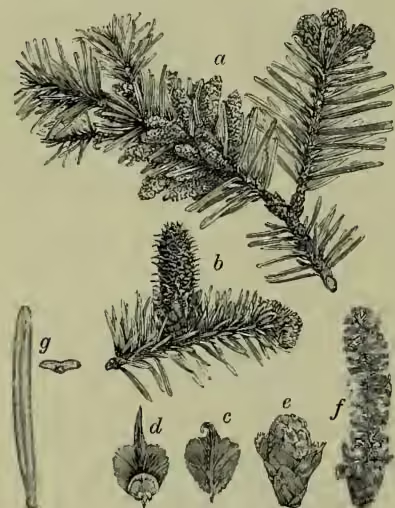
Common Silver Fir (Abies pectinata): a, branchlet with male flowers; b, branchlet with female flowers; c, a scale of cone, outside; d, a scale of cone, inside, showing seed; e, male flower undeveloped; f, male flower fully developed; g, leaf with cross section.
America from Virginia to Canada. The wood is of little value, but the tree yields Canada Balsam (q.v.).
Besides these, a number of other species of Abies are found in the western parts of North America and in the Himalayas, some of which are trees of great magnitude, and yield excellent timber, as A. grandis, a Californian tree of 170–200 feet in height; A. amabilis, a species much resembling it; A. nobilis, a majestic tree, which forms vast forests on the mountains of northern California; A. bracteata, a Californian species remarkable for its slender stem, which rises to a height of 120 feet, and yet is only about 1 foot in diameter at the base, and likewise for the manner in which the middle lobe of each bractea of its cones is produced so as to resemble a leaf; A. Webbiana, the Himalayan Silver Fir, which in its native regions fills the upper parts of mountain-valleys, and crowns summits and ridges at an elevation of upwards of 10,000 feet, of great size, 35 feet in girth, and with a trunk rising 40 feet before it sends out a branch. Most of these have been introduced into Britain with good prospect of their succeeding well in our climate, and other species, as A. Pichta, a native of the Altai Mountains, very nearly resembling the Silver Fir, A. Nordmanniana, A. Frascina, &c. P. religiosa is a tall and elegant tree, a native of the mountains of Mexico, with slender branches, which are very much used by the Mexicans for adorning churches; and its cones are shorter than those of any other Silver Fir.
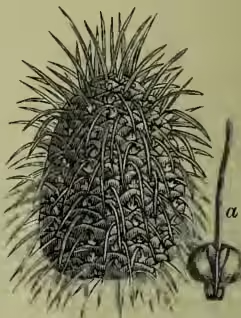
Cone of Abies bracteata: a, scale of cone, showing bract.
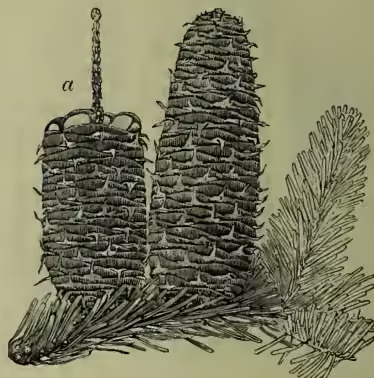
At a the scales are supposed to have fallen away, showing the axis.