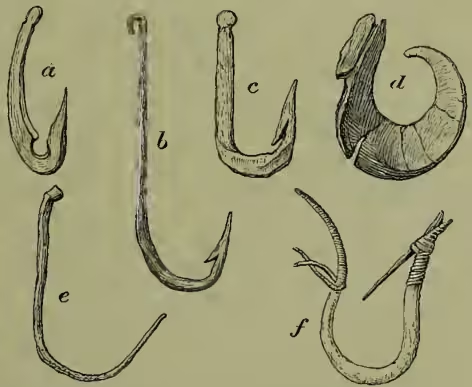
Fish-hooks. Both in Europe and in America fish-hooks have been found, belonging to prehistoric times, which are made of flint, bone, shell, copper, bronze, and, on the latter continent, even of gold. The oldest apparatus for catching fish was not a hook, but a crossbar of flint sharpened at both ends and attached to a thong. Some of the oldest prehistoric fish-hooks, including a few of bone, bear a considerable resemblance to modern English hooks in shape and in the form of the barb. Many of the rude-looking fish-hooks made by savage races are strong, well made, and ingeniously contrived. The shell and bone hooks of the Maoris of New Zealand and the natives of the Solomon Islands, as well as the bone and iron hooks of the Eskimos, are examples of these. Curious fish-hooks of cactus spines, made by Indians, have been found in Arizona. Ancient Roman fish-hooks discovered at Pompeii exactly resemble those in use at the present day, only they are of bronze instead of steel. But almost as much may be said of the prehistoric bronze fish-hooks discovered in Scotland, Ireland, and at several places on the continent of Europe. Illustrations of a large number of ancient fish-hooks are given in a volume on Prehistoric Fishing in Europe and North America, by C. Rau, published by the Smithsonian Institution.
In England fish-hooks are chiefly manufactured at Redditch in Worcestershire. The best of these are still made by hand, and the following is an outline of the stages in the process. (1) Soft cast-steel wire is cut by shears into lengths required for a given size of hook. (2) A number of these cut wires are placed on a plain surface against an upright, and then by means of a strong knife the beards or bars are formed. (3) The points are next put on by carefully filing the wires, each being pointed almost in an instant. (4) By means of a mould mounted in a wooden handle the wires are bent or turned to the proper shape. (5) The ends of the shanks are now ringed, flattened, or marked by an ingenious machine or hammer. (6) At this stage the hooks are hardened—i.e. they are placed in a furnace and brought to a certain heat, which varies with the kind of hook, and then plunged into a vat of oil. (7) They are next tempered by placing them, mixed with emery sand, in a pot over a charcoal fire. There they are kept in constant motion till they are sufficiently tempered. (8) Scouring is effected by placing the hooks with water in barrels and keeping these in motion for one or two days, to remove all scale. (9) Polishing is done by placing the hooks in an oblong bag with emery and rapidly shaking them. Sometimes the polishing is done in barrels moving round at an angle of 45°. Fish-hooks are now, however, chiefly made by machinery which performs most of the above operations automatically.
A large firm who manufacture fish-hooks at Redditch, and who have published an account of the process, from which the above outline has been prepared, state that there are fifty-three different sorts of hooks. Among these there are the kinds known as Kirkby, Limerick, Dublin, Carlisle, Kendal, sneck, round bent, crystal, roach hooks, live-bait snap-hooks, lip-hooks, &c. See ANGLING.