Flag, a strip of some light fabric attached at one end to a staff, used as a national, local, or corporate emblem, for military and naval purposes, to express rejoicing, mourning, and the like, or to make known some fact to spectators. As a military ensign it was probably developed out of the fixed standard of the Romans and other ancient nations, through the transitional forms of the vexillum and labarum, in both of which a square piece of cloth was fastened to a cross bar at the end of a spear. It has, however, been asserted that the Saracens used flying flags prior to their adoption by any country of Christendom. One of the earliest known forms of flag was the Gonfanon or Gonfalon, which was borne near the person of the commander-in-chief, and fixed in a frame in which it could turn. The Bayeux tapestry, in the representation of the Norman Conquest of England, exhibits numerous flags as borne by the knights of William's army. The gonfanon of the Conqueror had three ends, and was charged with a golden cross on a white ground within a blue bordure. The other flags are chiefly small, often three-pointed, and bearing figures which may be considered anticipations of the pales, roundles, and crosses of heraldry. At the battle of Northallerton in 1138 the English standard is said to have consisted of the mast of a ship fitted into a high four-wheeled carriage. On the top of the mast was a silver pyx with a consecrated host. There were displayed from it three banners dedicated respectively to St Peter, St John of Beverley, and St Wilfrid of Ripon. In 1244 Henry III. of England ordered a dragon to be made in fashion of a standard of red silk sparkling all over with fine gold, whose tongue should resemble burning fire, and appear to be continually moving, the eyes being of sapphires or other appropriate stones. Besides the gonfanon, three kinds of flag were much in use in the middle ages—the Pennon, the Banner, and the Standard.
The Pennon was an ensign of knightly rank, only, however, to be used by a knight who had followers to defend it; it was carried below the lance-head, and was of a tapering, sometimes swallow-tailed shape, exhibiting in earlier ages some decorative design, and, after the introduction of heraldry, sometimes the badge, sometimes the arms of its owner. The arms were so represented as to be in their right position when the lance was held horizontally. A diminutive flag of the same kind, called the Pennoncel, was carried by the esquires.
The Banner (q.v.), rectangular in form, was borne by a king, prince, duke, or any other noble down to a knight-banneret (see BANNERET). The owner's coat of arms covered its entire surface, no shield or external ornaments being displayed; such at least was the uniform practice until the 17th century. The Siege of Caerlaverock, a Norman-French rhymed chronicle of the 14th century, describes the arms on the banners of all the nobles and knights-banneret who were with Edward I. in his campaign against Scotland in 1300.
The Standard, strictly so called, a large, long flag, tapering towards the fly (or edge farthest from the staff), and slit at the end, was much in use among persons of distinction in the last half of the 14th, and in the 15th and 16th centuries. Its

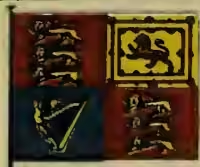
Royal Standard.
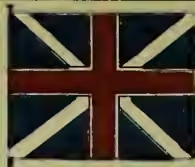
First Union Flag.
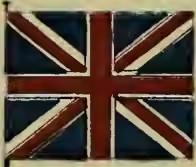
2d Union Flag.
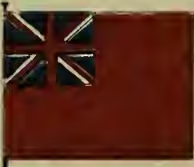
Red Ensign.
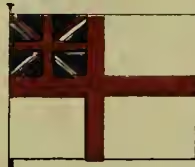
White Ensign.
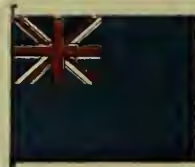
Blue Ensign.
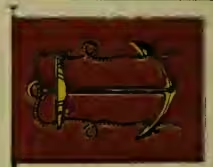
Admiralty.
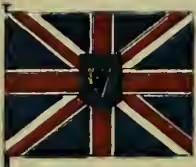
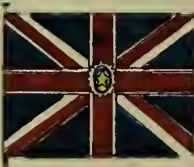
Diplomatic.
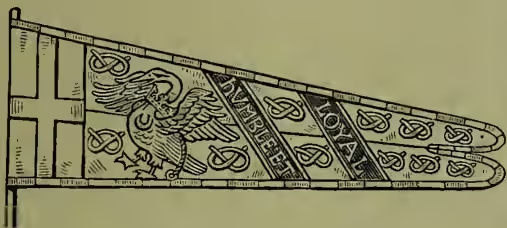
NATIONAL FLAGS. length varied with the owner's rank, and it displayed, not his arms, but his badge or badges. In England the red cross of St George usually occupied the broad end of the standard, different family badges being sometimes separated from each other by the motto placed in one or two diagonal stripes across the field, as in the standard of Sir Henry de Stafford, K.G. (circa 1475), of which a drawing has been preserved at the Heralds' College in London.
Not only nations and persons, but trades and companies, had their flags, often carried into battle. A flag presented by James III. of Scotland to the trades of Edinburgh, and popularly known as the 'Blue Blanket,' was borne at Flodden, and is still in preservation. It is 10 feet long, swallow-tailed in form, and its ground is blue, now much faded. In the upper corner next the staff is the St Andrew's cross, between the crown and thistle, and two escrols bear separate inscriptions.
An account of military flags is given under COLOURS (REGIMENTAL). The remarks that follow apply chiefly to royal and national flags, as borne in modern times. Though national flags are displayed on certain occasions on shore, their use has become far more extensive and important at sea; and a knowledge of them is necessary for all sailors, whether in the navy or merchant service. In old times every chieftain or knight sailed under his own flag, and ships of war sailed under the flag of the admiral, or flag of the port; but the rule has long been that the ships of all countries shall sail under their national colours.
In most countries the sovereign has a flag personal to himself, which, notwithstanding the name of standard attached to it, is most generally, as in Great Britain, a banner in shape. The Royal Standard of the United Kingdom (see plate, fig. 1) is further a banner in this respect also, that it bears over its entire surface the quartered arms of England, Scotland, and Ireland. It is hoisted wherever the sovereign is residing, and on certain fortresses and stations, home and foreign, on royal anniversaries or state occasions, as directed in the Royal Regulations.
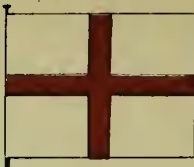
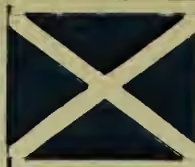
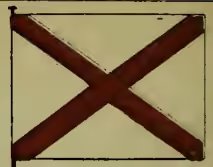
The union flag is a combination (somewhat questionable in point of heraldry) of the separate national flags of the three kingdoms, or at least of what have been accounted such. The red cross on a white field was, before the proper beginnings of heraldry, the distinguishing flag of England, and the white saltire on a blue field (the St Andrew's cross) similarly the flag of Scotland. One of the explanations given regarding the origin of the latter is that it represented the initial letter in Greek of our Saviour's name (X), as borne by the Emperor Constantine. The existing union flag had a predecessor, in which Ireland had no place, introduced in 1606, three years after the union of the crowns of England and Scotland. It was ordered by proclamation that all ships belonging to King James's subjects in both South and North Britain should bear in the maintop the crosses of St George and St Andrew conjoined after a form 'made by our heralds, and sent by us to our admiral to be published to our said subjects.' The first union flag blended the two national flags by placing the cross of St George (fig. 2) over the saltire of St Andrew (fig. 3), as in fig. 4, retaining the blue field of the latter, and giving the former a narrow white border or 'fimbriation,' to represent its white or silver field, and avoid the heraldic solecism of colour on colour. The proclamation of 1606 did not, of course, deal with ships-of-war. The king's ships had then, as now, for their principal flag the ensign, to be presently described; but they also bore, as they still do, a miniature union flag as a jack—i.e. a flag displayed from a staff at the end of the bowsprit, whence the name of union jack, which has in common parlance come to be wrongly applied to the larger as well as the smaller union flag. From this confusion it has arisen that landsmen unversed in sea phraseology, and in search of an etymology for this misapplied name, have suggested its derivation from King James (Jacques) who introduced it, or alternatively from the jacque, or surcoat with a red cross anciently worn by English soldiers. At the Union of 1707 the use of the first union flag was confirmed, and for the first time sanctioned on land as well as sea; and it was also incorporated into the ensign. In consequence of the Union of 1801 the flag just described had to give place to one in which Ireland would be represented, and in which the red saltire on a white ground (as in fig. 5) which had since 1783 contracted an association with St Patrick should be introduced. In the new flag (fig. 6) the St George's cross with its fimbriation remained as it was, and the saltires of Scotland and Ireland were placed side by side, with the white and red alternately uppermost, and a fimbria of white separating the red from the blue field.
The union flag per se has ceased to be the distinguishing flag of British merchant-ships; but there are still occasions on which it is displayed both at sea and on shore. The jack, properly so called, is never flown on shore. When flown from the mast with a white border it is the signal for a pilot; and it must also have a white border when flown from the bowsprit of a merchant-ship.
The Ensign, a large banner hoisted on a long pole called the ensign-staff erected over the poop, or at the gaff when the ship is under sail, is now, in one or other of its three varieties, the flag under which not British ships-of-war only, but British merchant vessels sail. For more than 200 years the British fleet consisted of three divisions, red, white, and blue, each with an ensign of corresponding colour; the white ensign differing from the others in being charged with a St George's cross; and in 1707 the union device was incorporated into the ensign, occupying the upper corner next the staff, which had before been taken up by the cross of St George. In 1864 these divisions of the fleet were abolished; yet the red, white, and blue ensigns are still in use, each with the union device of 1801 introduced in the way that has been described, and the white ensign still charged with the St George's cross. The red ensign (fig. 7) now belongs to merchant-ships and generally to vessels not belonging to the navy. The white (fig. 8) belongs exclusively to the Royal Navy and the Royal Yacht Squadron. The blue (fig. 9) is borne by the Naval Reserve, and also by certain yacht clubs.
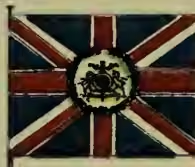
The flag of the lord high admiral (fig. 10), red with an anchor and cable, is hoisted in any ship on board which that high officer is; and the admiral's flag, white with a red cross (as fig. 2), is flown by an admiral when employed afloat, and at the main, fore, or mizzen-toppallant mast-head, according as he is full, vice, or rear-admiral. The union flag and blue ensign are, with certain additions, used occasionally as personal flags, or in particular departments of the service. The lord-lieutenant of Ireland, for example, has the union flag with a blue shield in its centre charged with a golden harp (fig. 11). The governor-general of India has, in the centre of the union flag, the Star of India with a crown over it (fig. 12). British ministers at foreign courts have also the union flag, and in its centre the royal arms within a white circle surrounded by a wreath (fig. 13). British consuls have the blue ensign with the royal arms in the fly. Vessels in the service of British colonies have the blue ensign with the badge of the colony in the fly.
The long pendant, a familiar flag in the navy, is some 20 yards long, and very narrow and tapering. As flown from the mast-head of all ships of the Royal Navy in commission, it is white with a red cross. Such vessels in the service of British colonies are as commissioned as vessels-of-war under Act 28 Vict. chap. 14 wear the long pendant, but blue with a red cross on a white ground next the mast. There is also the broad pendant or burgee, a slightly tapering and swallow-tailed flag, white with a red cross, flown by a commodore or the senior officer of a squadron to distinguish his ship. If used by a commodore of the first class, it is flown at the main-topgallant mast-head, otherwise at the fore-topgallant mast-head.
The Scottish lion and the Irish harp, taken separately, but figured as they appear on the royal standard, are used in Scotland and Ireland as national flags, but have no official recognition.
In the following notice of the flags of other maritime nations the technical language of heraldry is as much as possible avoided. The word standard is used for the flag of the sovereign, and the form of flag is assumed to be rectangular unless otherwise described.
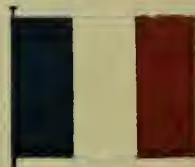
France.—As royal standard, the blue hood of St Martin was succeeded by the plain red oriflammé (the standard of the abbey of St Denis), and the oriflammé in the 15th century by a blue standard powdered with fleurs-de-lis, the fleurs-de-lis being, as in the arms of France, eventually reduced to three in number. The white flag afterwards became the standard in the reign of Henry IV. The history of the national flag is somewhat confused prior to 1794, when the tricolor of three vertical divisions, blue, white, and red (fig. 14), was adopted. The white flag was reintroduced as royal standard and national flag at the restoration of monarchy, giving place again in 1830 to the tricolor, which has ever since been used both in the navy and as mercantile flag. Under the two empires the imperial standard was the tricolor, powdered with golden bees, the central stripe being charged with the eagle of the empire.
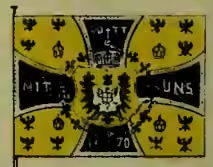
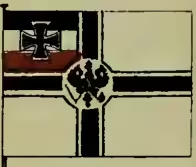
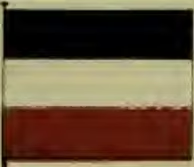
Germany.—The standard of the German empire (fig. 15) has the iron cross (technically a cross patée sable fimbriated argent) on a gold or yellow field, each quarter being charged with three black eagles and an imperial crown, and over the whole a yellow or gold shield, with the imperial arms ensignéd with a crown and surrounded by the collar of the black eagle. The naval ensign (fig. 16) is white, divided by a black cross of which the arm next the flagstaff is shorter than the other, and in the inner section of the cross is the Prussian eagle on a white field. The upper quarter next the flagstaff is composed of three horizontal stripes of black, white, and red, and has in its centre the iron cross. The flag of the merchant service consists of three horizontal stripes of black, white, and red (fig. 17).
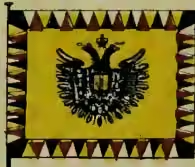
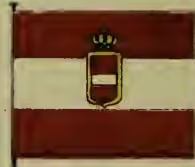
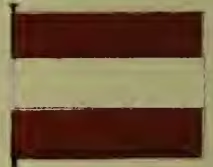
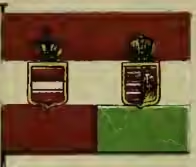
Austria.—The imperial standard (fig. 18) is yellow, displaying the eagle of the empire, and has an indented border of gold, silver, blue, and black. The man-of-war's flag (fig. 19) has three horizontal divisions, the central one white, the other two red : on the central division is a shield striped as the flag, with a narrow gold border, and ensignéd with the imperial crown. The flag of the merchant service (fig. 20) is the same, but without the shield or crown. The Austro-Hungarian mercantile flag (fig. 21) has the lower stripe half red and half green, with two shields containing respectively the arms of Austria and of Hungary.
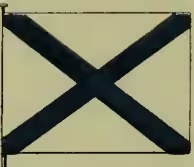
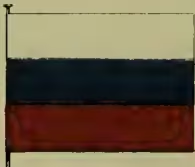
Russia.—The standard is yellow, charged with the arms of the Russian empire. The naval ensign (fig. 22) has a blue saltire on a white ground. The merchant flag (fig. 23) consists of three horizontal stripes of white, blue, and red.
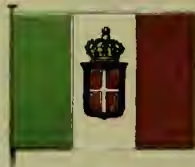
Italy.—The royal standard, white with a blue border, displays the full armorial achievement of the king of Italy. The flag of the navy (fig. 24) has three vertical stripes of green, white, and red; in the centre is a red shield charged with a white cross and bordered with blue (the arms of the dukes of Savoy) ensignéd with the crown. The mercantile flag is the same, without the crown.
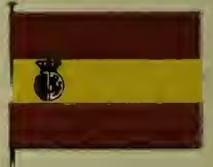
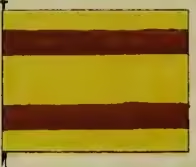
Spain.—The standard is entirely occupied with the quarterings of the Spanish escutcheon armorially marshalled. The flag of the navy (fig. 25) has three horizontal stripes, red, yellow, and red, the middle stripe being broader, and charged in the end next the staff with a circular shield ensignéd with a crown and containing the impaled arms of Castile and Leon. The merchant flag (fig. 26) is yellow, with two horizontal bars of red across it.
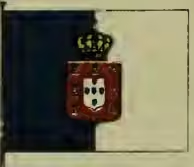
Portugal.—The standard is red, charged with the Portuguese arms and crown. The flag of the navy (fig. 27) is of blue and white, divided vertically and similarly charged. The mercantile flag is the same.
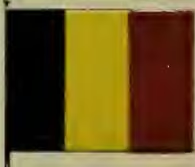
Belgium.—The standard is striped vertically black, yellow, and red, the yellow stripe charged with the royal achievement. The mercantile flag (fig. 28) is like the standard, but without the achievement.
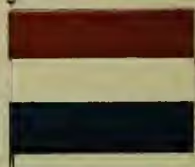
Netherlands.—The standard is striped horizontally red, white, and blue, with the royal achievement on the white stripe. The naval and merchant flag (fig. 29) have the same three stripes, without the achievement.
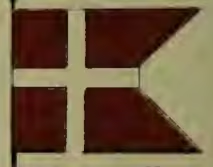
Denmark.—The flag (probably the oldest in existence, dating from the 13th century) is red, with a white cross. In the standard the cross widens into a square in the centre, in which are the royal arms surrounded by the collars of the Elephant and the Dannebrog. Both the standard and the man-of-war's flag (fig. 30) are swallow-tailed. The merchant flag is like the ensign, but rectangular.
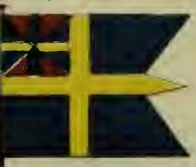
Sweden and Norway.—The flag of Sweden being blue with a yellow cross, that of Norway red with a blue cross and white fimbriation, the two were combined in 1817 into one device, somewhat after the manner of the union flag of Britain. The ensign (fig. 31) is the above-described flag of Sweden (blue with a yellow cross), with the union device in the upper quarter next the flagstaff. The standard has the royal achievement in the centre of the Norwegian cross. Both standard and naval ensign are three-pointed; the mercantile flag differs from the latter in being rectangular.
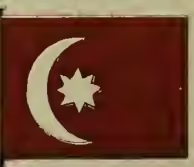
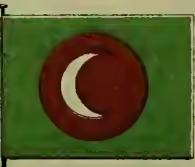
Turkey.—The flag of the navy (fig. 32) is red, charged with a decrescent moon and an eight-pointed star, both white. The merchant flag (fig. 33) is green, with a red circle in the centre, on which is a white decrescent moon.
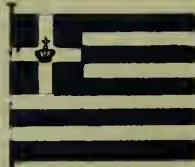
Greece.—The standard is blue, charged with a white cross, whose inner limb is shorter than its outer, the royal arms, supporters, &c. being in the centre. The flag of the navy (fig. 34) has nine horizontal stripes alternately blue and white, the upper quarter next the staff being blue, with a white cross, in whose centre is a crown. The merchant flag is the same without the crown.
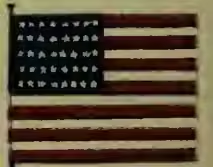
United States.—The stars and stripes of the United States of America (fig. 35) are said to have been suggested by the coat armorial of the Washington family (argent, three bars gules, in chief three mullets of the second), but it is hardly possible to reconcile this supposition with the actual history of the American flag. The earliest flag consisted of horizontal stripes, with the earlier British union device in the place which it occupies in the British ensign. Soon after the Declaration of Independence congress resolved that the flag of the United States should have thirteen stripes, alternately red and white, and that the British union device should be superseded by a blue field with thirteen white stars, the number both of stripes and of stars being correspondent to the number of states. In 1808 it was enacted that the stripes should continue to be thirteen, that the stars should be twenty in number, there being then twenty states, and that a star should be added for every new state that came into the union. The admission of four states in 1889, of two in 1890, and of Utah in 1896, brought up the number of stars to forty-five. The flag of the American admiral has the stripes alone, and the stars are used separately as a jack.
By a general international understanding, a flag of truce is white, and it is usual to hoist with it the national flag of the enemy, the white flag at the main, and the enemy's ensign at the fore. Striking the flag denotes surrender, and the placing the flag of one country over that of another indicates the victory of the former. The ensign and pendant at half-mast indicate mourning, the red flag mutiny, the black flag a pirate, and the yellow flag quarantine.
For the use of flags as signals, which has of late years been brought to great perfection, see SIGNALING.
Naval flags are now made of a light woollen fabric called bunting. Their size is expressed by the number of breadths of which they are composed, the regulation bunting being 9 inches wide.